
Choosing a computer-related degree after Class 12 can feel confusing. You may enjoy working with computers, want to become a software developer, or be curious about how technology works behind the scenes. But when you compare BCA and B.Sc Computer Science, one question naturally comes up: which course will help you reach your career goals?
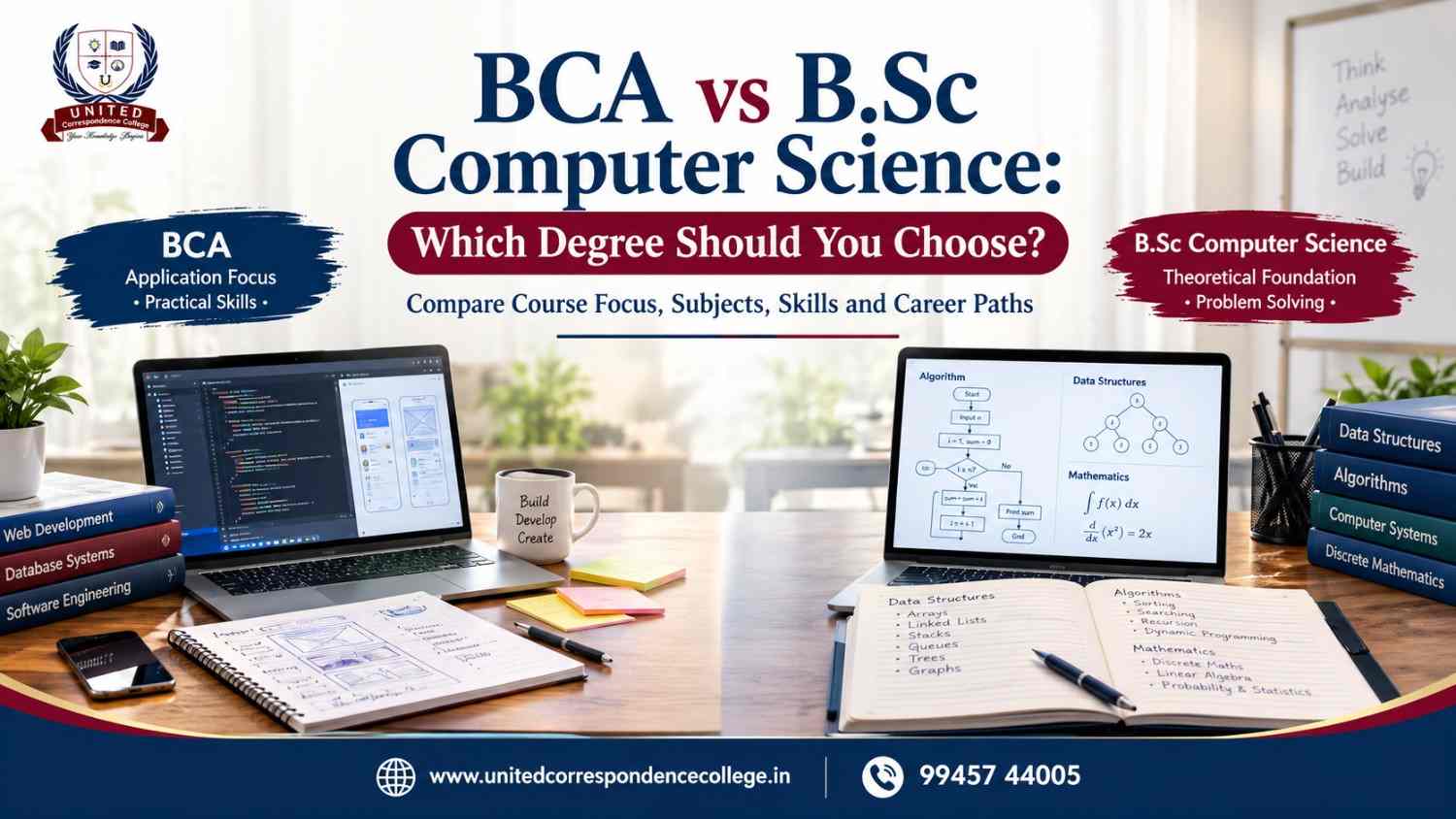
Both degrees can provide a foundation for entering the technology field, but they may approach computing from different academic perspectives. BCA generally emphasises computer applications, programming and software development, while B.Sc Computer Science often places greater emphasis on computing principles, algorithms, mathematics and theoretical foundations. The exact difference depends on the university and its curriculum.
Your decision also depends on your learning preferences, previous subjects, future study plans and personal circumstances. If you need flexibility because of work or other responsibilities, exploring BCA distance education may be relevant, provided you verify the availability and recognition of the specific programme.
Instead of choosing a degree simply because someone recommends it, take time to understand what each option offers. This guide will help students, working professionals and learners returning to education compare the two pathways, identify their priorities and make a more informed decision.
Before Comparing Degrees, Understand What Kind of Learner You Are
Imagine two students sitting in a computer laboratory.
One enjoys building a small application, designing a website and finding ways to make software easier to use. The other wants to understand how algorithms work, why certain problems are difficult to solve and how computers process information.
Both students are interested in computing, but their interests may lead them towards different academic experiences.
This is why your preferred way of learning matters as much as the degree title.
You may prefer BCA if you enjoy application-focused learning
BCA can be worth exploring if you are interested in software applications, programming, databases and the practical side of information technology.
You may enjoy tasks such as:
- Developing small software projects.
- Learning programming languages and application development.
- Understanding databases and information systems.
- Exploring web technologies and software tools.
- Connecting technical knowledge with practical problems.
These interests do not mean that BCA contains no theory. Every computing programme requires conceptual understanding. However, an application-oriented curriculum may appeal to learners who want to connect computing concepts with the development and use of software.
You may prefer B.Sc Computer Science if you enjoy understanding the fundamentals
B.Sc Computer Science may appeal to students who want to explore the principles behind computing in greater depth.
You might enjoy:
- Studying algorithms and computational problem-solving.
- Understanding data structures and computer systems.
- Exploring mathematical concepts related to computing.
- Learning how programming languages and computational processes work.
- Investigating the theoretical foundations of technology.
This does not mean that B.Sc Computer Science is purely theoretical. Many programmes include programming laboratories, projects and practical assignments.
The important question is not which student is better. It is which learning experience matches your interests, strengths and willingness to develop new skills.
BCA and B.Sc Computer Science: What Is the Real Difference?
Before looking at careers, it helps to understand the general academic orientation of each qualification.
BCA stands for Bachelor of Computer Applications. It is an undergraduate degree associated with computer applications and information technology.

B.Sc Computer Science is a Bachelor of Science degree focused on computer science as an academic discipline. Its curriculum may combine programming with mathematical, theoretical and systems-related subjects.
However, degree names alone cannot tell you everything. Two universities offering the same qualification may have different elective subjects, project requirements, practical components and teaching approaches.
BCA vs B.Sc Computer Science — Side-by-Side Comparison
| Comparison factor | BCA | B.Sc Computer Science |
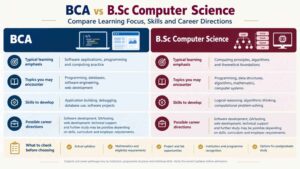
| General focus | Computer applications and software-related skills | Computer science principles and computational foundations |
| Programming | Often an important component | Often an important component |
| Theory and mathematics | Depends on the curriculum | Mathematics and theoretical concepts may receive greater emphasis |
| Practical learning | May include application development, labs and projects | May include programming labs, algorithms and computing projects |
| Typical subject areas | Programming, databases, web development and software applications | Algorithms, data structures, programming, mathematics and computer systems |
| Potential next steps | IT roles, software-related work and eligible postgraduate programmes | IT roles, computing-related study and eligible postgraduate programmes |
| Best comparison method | Review the actual syllabus and practical components | Review the actual syllabus and practical components |
Note: This is a general comparison, not a universal rule. Always check the curriculum of the specific university before deciding.
The table gives you a starting point, but do not make your final decision based on a single subject or the name printed on the degree certificate.
Read the course structure, look at the practical requirements and identify which programme will help you develop the knowledge you want to use.
What Will You Actually Learn During the Degree?
A degree becomes easier to evaluate when you move beyond its title and look at the subjects you may study.
Although curricula vary, both qualifications can introduce learners to important computing concepts. The difference lies in how those subjects are organised, the depth of coverage and the balance between application-oriented work and theoretical foundations.
Programming and software development
Programming teaches you how to give computers instructions to perform tasks. You may learn a language such as C, C++, Java or Python, depending on the programme.
Over time, you may progress from simple exercises to projects involving data processing, application logic or software development.
Do not assume that learning a programming language alone makes you job-ready. You also need to understand problem-solving, debugging, code organisation and how to build reliable applications.
Data structures and algorithms
Data structures help organise information, while algorithms describe the steps used to solve problems.
For example, an application that searches through thousands of records needs an effective way to store and retrieve information. Understanding these concepts can help you design more efficient solutions.
These topics are valuable for students interested in software engineering, programming interviews and advanced computing study.
Databases and information management
Many applications rely on databases to store information about customers, products, transactions or learning records.
Database subjects may introduce concepts such as tables, queries, relationships and data management. Practical assignments can help you understand how applications interact with stored information.
Computer systems and operating systems
Understanding computer systems helps explain how hardware, software, memory and operating systems work together.
These concepts can be useful when learning about system performance, application behaviour, troubleshooting and other technical problems.
Mathematics and computational thinking
Mathematics can support logical reasoning, algorithm analysis and certain areas of computer science. The amount and type of mathematics required depend on the programme.
If mathematics is not your strongest subject, do not immediately rule out either degree. First, review the admission criteria and syllabus, then assess whether you are willing to strengthen the relevant concepts.
For students comparing courses, the most useful question is this: which curriculum gives you the right combination of foundational knowledge, practical learning and progression opportunities?
“If you’re considering a career in computer applications, explore our detailed guide to the Distance BCA Course in India: Eligibility, Fees, Admission Process and Career Opportunities to understand the admission requirements, course costs, and career pathways available after completing a BCA.”
Choose by the Work You Want to Do, Not Just the Degree Name
It is natural to think about jobs while selecting an undergraduate programme. However, a degree does not automatically determine your future occupation.
Employers may consider your qualification alongside programming ability, projects, communication skills, problem-solving and relevant experience. Your learning choices during the degree can make a meaningful difference.
Here are some career directions you may explore.
Software development
Software developers create, test and maintain applications. Their work can involve writing code, solving technical problems, reviewing existing systems and collaborating with other developers.
Both BCA and B.Sc Computer Science graduates may pursue software-related opportunities, depending on the employer’s requirements and the candidate’s skills.
Web development
Web developers build and maintain websites and web applications. They may work with front-end technologies, server-side programming, databases and related tools.
A practical portfolio containing functional projects can help demonstrate what you know beyond your academic results.
Software testing and quality assurance
Testing professionals evaluate software to identify defects and confirm that applications behave as expected.
Entry-level opportunities may involve manual testing, writing test cases and documenting problems. Some positions require knowledge of automated testing tools or programming.
Data-related roles
Data-related work may involve collecting, organising, analysing or presenting information. Depending on the role, relevant skills can include SQL, spreadsheets, Python, statistics and data visualisation.
A degree alone may not provide every skill needed for a specialised data position, so check job descriptions and build your knowledge accordingly.
IT support and systems-related work
Some graduates begin with technical support, application support or other entry-level IT responsibilities. These roles can develop troubleshooting skills and provide exposure to business technology environments.
Your interests may change as you gain experience. That is perfectly normal. The purpose of an undergraduate degree is to build a foundation that you can develop further.
Match Your Interests With a Possible Study Route
Not every learner begins with the same academic background or career plan. Some students know they want to work in software development, while others are still exploring the technology sector.
Working professionals may also be looking for a qualification that complements their current responsibilities. Learners returning to education after a break may need to rebuild their study habits before tackling demanding technical subjects.
Which Study Route Might Suit Your Priorities?
| Your situation or interest | What to explore | What to check before deciding |
| You enjoy building applications and learning practical IT skills | Compare BCA programmes | Programming subjects, project work, databases and practical assessments |
| You enjoy algorithms, mathematics and computing concepts | Compare B.Sc Computer Science programmes | Mathematical requirements, theoretical subjects and laboratory work |
| You want to move into software development | Compare both degrees against relevant job requirements | Programming curriculum, projects, internships and portfolio opportunities |
| You are working while studying | Investigate suitable flexible learning options | Class schedules, examinations, practical requirements and study workload |
| You want to pursue postgraduate study | Check the eligibility rules for your intended next qualification | Accepted undergraduate degrees, subject requirements and minimum marks |
| You are returning to education after a break | Compare the curriculum and available learner support | Admission eligibility, learning materials, assessment methods and support services |
The table is a decision aid, not a guarantee that a particular qualification will meet every employer’s or university’s requirements.
If you are interested in postgraduate study, check the admission requirements of the institutions you may apply to later. For example, learners considering MCA distance education in Bangalore should verify the specific postgraduate programme’s eligibility conditions, including any mathematics or subject requirements.
Planning ahead can help you avoid selecting a degree that does not fit your intended next step.
Eligibility, Mathematics and Admission: What Should You Check?
Students sometimes assume that BCA always accepts students from every stream or that B.Sc Computer Science always requires the same combination of science subjects. Neither assumption is safe.
Eligibility can vary by university, admission year, entrance examination and programme structure.
Some institutions may accept students from different academic streams for BCA, subject to their specific rules. Others may require particular subjects or minimum marks. B.Sc Computer Science programmes may have their own subject and mathematics requirements.
Before applying, check:
- Whether your Class 12 subjects meet the programme’s requirements.
- The minimum marks or grade requirements.
- Whether mathematics or computer science is compulsory.
- Whether admission is based on merit, an entrance test or another process.
- Whether additional subject or document requirements apply.
- Whether the qualification supports your intended postgraduate plans.
The National Testing Agency’s CUET (UG) information is a useful official starting point if the university you are considering uses CUET. However, CUET participation and subject requirements differ by institution and programme, so check the current admission bulletin and the university’s own criteria.
What if mathematics is a concern?
Do not choose a degree only because you believe it will avoid mathematics. Instead, examine the actual syllabus.
Some programmes may include discrete mathematics, statistics, calculus or other mathematical concepts, while the amount and emphasis can differ.
If you need additional preparation, revise basic algebra, logical reasoning and problem-solving before starting. Building these foundations gradually can make technical subjects less intimidating.
A careful eligibility check is much better than discovering after admission that you do not meet a programme’s requirements.
What If You Need to Study While Working or Managing Other Responsibilities?
Not every learner can follow a conventional full-time study schedule.
A working professional may want to improve their qualifications without leaving a job. A student may need to manage family responsibilities, while someone returning to education may prefer a more flexible routine.
For these learners, the study mode deserves as much attention as the degree itself.
Understanding flexible learning options
Depending on availability, learners may consider regular classroom education, recognised open and distance learning, or online programmes.
Each option has different requirements. Some programmes may involve scheduled online sessions, while others may rely more heavily on self-study and planned assessments. Practical work and examinations may also require specific arrangements.
If you are considering BCA distance education, investigate the actual programme rather than assuming that every university offers the same mode or flexibility.
Ask these questions before enrolling:
- Can you realistically manage the weekly study workload?
- Are the learning materials accessible and sufficiently detailed?
- How are practical assignments and programming exercises completed?
- What support is available when you struggle with a subject?
- Where and how are examinations conducted?
- Are there compulsory sessions or other attendance requirements?
- Does the programme fit your work and family schedule?
Flexibility can make education more manageable, but it does not remove the need for regular study. Computing subjects require practice, and leaving all assignments until examination time can make learning much harder.
Is Distance Learning Right for Your Situation?
Distance learning may suit learners who need to manage education alongside other commitments. However, the decision requires more than checking whether classes are conducted remotely.
Students must also evaluate programme quality, academic support, practical learning and official recognition.
Check recognition before applying
The University Grants Commission’s Distance Education Bureau explains how learners can verify whether an institution and its specific programme are recognised for open and distance learning or online education.
Visit the official UGC Distance Education Bureau to understand the verification process and the importance of checking recognition for the relevant admission session.
Do not assume that an institution’s recognition for one course automatically covers every course it offers. Equally, do not assume that recognition in an earlier academic year necessarily applies to a later admission session.
Understand the practical requirements
Computer-related degrees involve more than reading textbooks. You may need to write code, practise debugging, complete assignments and develop projects.
Before choosing a flexible programme, find out how these activities are supported. Check whether you have access to the necessary software, computing resources, learning materials and academic guidance.
If you are already working in IT, you may be able to connect some academic concepts with your professional experience. If you are new to computing, you may need to set aside additional time for practical exercises.
Consider your study habits
Distance learning often requires independent planning. You need to establish a routine, track deadlines and ask for help when you do not understand a topic.
A simple weekly schedule can help:
- Set aside fixed hours for reading and lectures.
- Practise programming regularly rather than only before examinations.
- Complete assignments in smaller stages.
- Review difficult topics at the end of each week.
- Maintain a record of projects and concepts you have learned.
The best learning mode is the one that fits your circumstances while allowing you to meet the academic and practical requirements of the programme.
How to Compare Colleges Without Getting Distracted by Marketing
Once you narrow your choice to a degree, the next challenge is comparing institutions.
Course advertisements may highlight fees, convenience or career opportunities. Those details can be useful, but they should not replace a careful review of the actual programme.
If you are searching for a B.Sc correspondence college in Karnataka, compare the institution’s programme details, learning support and recognition status. The same approach applies when exploring an IT correspondence college in bangalore or another location.
Your Final Checklist Before Applying
| What to compare | Questions to ask | Why it matters |
| Recognition | Is the institution authorised to offer this specific programme in the chosen mode for the relevant session? | Helps you verify the programme’s formal status |
| Syllabus | Are the subjects aligned with your interests and future plans? | Helps you choose a suitable academic direction |
| Eligibility | Do your subjects and marks meet the admission requirements? | Prevents avoidable admission problems |
| Practical learning | Are programming exercises, projects and assessments clearly explained? | Helps you understand how you will develop technical skills |
| Fees | What is the full cost, including applicable examination or other charges? | Helps you plan your budget realistically |
| Learning support | Are study materials, academic guidance and assessment information available? | Helps you understand what support you can expect |
| Future progression | Will the qualification meet the requirements of your intended postgraduate course or job applications? | Helps you plan beyond graduation |
Do not rely solely on advertisements, rankings or promises of employment. Read official programme documents and ask the institution for clarification when any information is unclear.
If you are comparing multiple colleges, write down the answers and evaluate each option using the same criteria. This makes it easier to identify differences that genuinely matter to you.
After Graduation: Employment, Further Study and Skill Development
Your undergraduate degree is an important milestone, but it is not the end of your learning journey.
The technology sector changes continuously. New tools emerge, existing technologies evolve and employers may expect candidates to demonstrate practical problem-solving skills alongside academic knowledge.
Build projects that demonstrate your abilities
A small, well-executed project can help you practise what you learn.
Depending on your interests, you might build:
- A basic inventory management application.
- A student record system using a database.
- A personal portfolio website.
- A simple expense tracker.
- A data analysis project using a public dataset.
- A small application that solves a practical everyday problem.
Document what the project does, which technologies you used and what you learned while developing it. If you encounter a problem, explain how you investigated and resolved it.
Learn beyond the syllabus
Your programme may introduce several technologies, but you can deepen your knowledge in areas that match your goals.
For example, an aspiring developer may practise version control and software testing. A student interested in data may explore SQL and statistics. Someone interested in cybersecurity may begin by learning networking fundamentals and secure computing practices.
Choose additional learning based on a clear objective rather than collecting certificates without applying the knowledge.
Consider postgraduate study
Some graduates continue their education through postgraduate programmes in computer applications, computer science, data-related fields or other computing disciplines.
If you are considering MCA distance education in Bangalore, check the current eligibility criteria of the universities you may apply to. Requirements can differ, particularly regarding mathematics, qualifying subjects and minimum marks.
You can also review official programme information from Indira Gandhi National Open University (IGNOU) to understand how an established open university presents its programme structure, admission details and further-study pathways. Confirm the details of the specific programme before making an application.
Further study can deepen your knowledge, but it is not the only route to career development. Projects, work experience, internships and continuous skill development can also contribute to your professional growth.
Common Mistakes Students Make When Choosing Between BCA and B.Sc Computer Science
Even students who research their options can make decisions based on incomplete information. Recognising these mistakes early can help you avoid unnecessary confusion.
Choosing only by degree name
A degree title does not reveal every subject, practical requirement or teaching method. Compare the syllabus of the actual programmes you are considering.
Assuming one degree guarantees a job
Neither qualification automatically guarantees employment, a particular salary or a specific job title. Career outcomes depend on several factors, including skills, projects, experience, employer requirements and the opportunities available.
Ignoring mathematics and eligibility
Do not assume that subject requirements are identical across institutions. Confirm the official criteria before applying.
Underestimating practical work
Reading about programming is not the same as writing and debugging code. Make time for practical exercises and projects throughout your studies.
Selecting a programme based only on fees
Cost matters, especially for students managing a limited budget. However, compare the total cost alongside recognition, syllabus, support, assessments and learning arrangements.
Postponing career preparation until graduation
You do not need to wait until your final semester to explore careers. Read job descriptions, practise relevant skills and build projects as your knowledge develops.
The better approach is to treat your degree as the foundation of a longer learning process. A thoughtful choice at the beginning can help you use your time and effort more effectively.
How to Make Your Final Decision With Confidence
By now, you may have a clearer idea of what separates the two degrees. The final step is to bring your academic interests, career plans and personal circumstances together.
Start by identifying the kind of computing work you find interesting. If you enjoy developing applications and exploring practical IT tasks, compare BCA programmes closely. If you are particularly interested in algorithms, mathematics and the theoretical side of computing, examine the B.Sc Computer Science curriculum.
Next, shortlist institutions and verify their admission criteria, programme recognition, syllabus, practical requirements and fees. If you need flexible learning, check the exact availability and conditions of the programme rather than assuming that a particular degree is offered through distance or online learning everywhere.
Finally, consider what you want to do after graduation. Review entry-level job descriptions, identify the skills they commonly request and check whether your chosen programme gives you opportunities to build those skills.
For students, working professionals and learners returning to education, the right decision is not necessarily the most popular course. It is the programme that fits your goals, eligibility, learning preferences and long-term plans.
Conclusion: Choose the Degree That Fits Your Goals
BCA and B.Sc Computer Science can both provide pathways into computing, but they may differ in academic emphasis, subject structure and learning experience. BCA generally focuses on computer applications and software-related learning, while B.Sc Computer Science often provides a broader study of computational principles and theory. The actual balance depends on the university and programme.
If you are still deciding, compare the syllabus, eligibility criteria, practical components and future study requirements instead of relying on the degree name alone. Think about the work you want to explore, the skills you are ready to develop and the learning environment that suits your circumstances.
For learners who need flexibility, BCA distance education may be worth investigating where an appropriately recognised programme is available. Confirm the programme’s official status, practical arrangements and eligibility before enrolling.
You can also explore UCC to review the educational information available on its official website and identify the details relevant to your academic plans. Choose a programme only after verifying its current availability and suitability for your goals.
Frequently Asked Questions (FAQs)
1. Which is better, BCA or B.Sc Computer Science?
Neither degree is universally better. BCA generally focuses on computer applications and software-related learning, while B.Sc Computer Science often emphasises computing principles, algorithms and mathematical foundations. Compare the actual syllabus, practical work and eligibility requirements before choosing.
2. Can I become a software developer after BCA?
Yes, BCA can be a route towards software development, provided you develop the relevant programming, problem-solving and project skills. Employers may also consider experience, practical knowledge and other role-specific requirements.
3. Is B.Sc Computer Science more difficult than BCA?
Difficulty depends on your interests, academic preparation and the programme’s curriculum. A course with more mathematical and theoretical content may feel challenging to some students, while application development and programming projects may be demanding for others.
4. Is mathematics compulsory for BCA or B.Sc Computer Science?
Requirements vary by institution and programme. Some courses may require mathematics or particular Class 12 subjects, while others may have different criteria. Check the official eligibility rules before applying.
5. Can I study BCA through distance education?
Some recognised institutions offer BCA through distance or online learning, but availability and recognition must be checked for the specific institution, programme and admission session. Review the practical requirements and learning support before enrolling.
6. What jobs can I apply for after BCA or B.Sc Computer Science?
Depending on your skills and employer requirements, possible entry-level directions include software development, web development, software testing, IT support and selected data-related roles. The exact opportunities available to you will depend on your preparation and the position’s eligibility criteria.
7. Can I pursue MCA after BCA or B.Sc Computer Science?
Potentially, yes. Eligibility depends on the university and programme. Some institutions specify mathematics, qualifying subjects or minimum marks. Check the current admission requirements of the postgraduate programme you intend to pursue.
8. Is a distance degree valid for further education?
Degrees awarded through recognised open and distance learning or online programmes can be treated as equivalent to corresponding conventional degrees under applicable UGC regulations. Students must verify the institution and specific programme’s recognition status for the relevant admission session and check any additional requirements imposed by their intended next institution.
9. What should I check before choosing a correspondence college?
Check programme recognition, eligibility, syllabus, fees, examinations, practical requirements, learning support and future progression options. Confirm details through official sources rather than relying solely on promotional material.
10. Can working professionals pursue a computer-related degree?
Depending on programme eligibility and scheduling, working professionals may be able to pursue a suitable degree while employed. Review the expected study workload, examination arrangements, practical requirements and recognition status before enrolling.
11. Is BCA enough to start an IT career, or do I need additional certifications?
A BCA can provide an academic foundation, but additional certifications are not universally required for every IT job. Practical projects, programming ability, internships and role-specific skills can help strengthen your profile. Choose certifications based on the requirements of your intended career rather than collecting them without a clear purpose.
Ready to explore your next step? Visit UCC to learn more about the available educational information, compare your options carefully and use the website’s available contact options to contact us if you need clarification. A well-informed decision today can give you a stronger foundation for the learning and career opportunities you pursue tomorrow.