
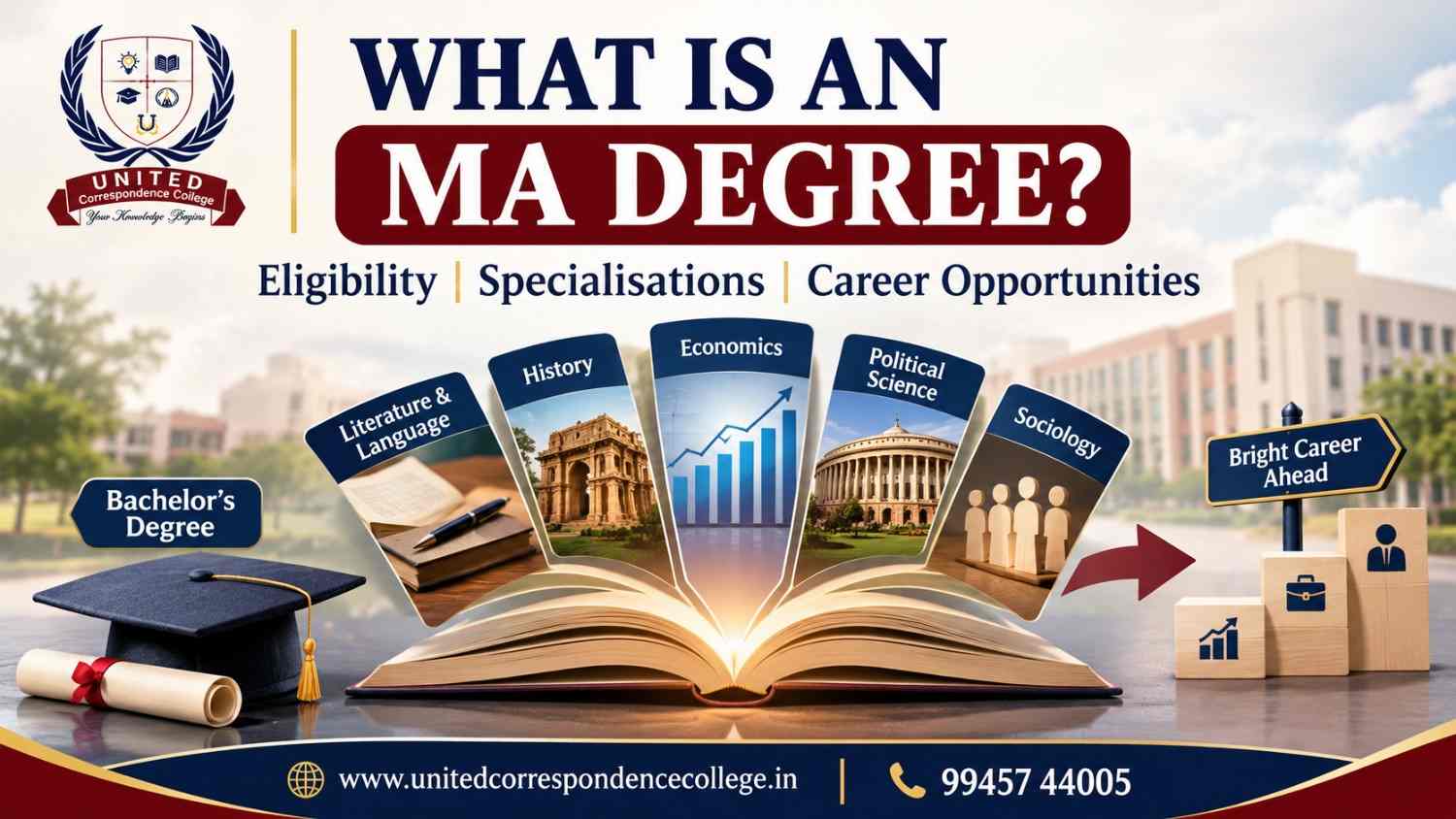
Introduction: What Comes After Graduation?
Completing a bachelor’s degree is an important achievement, but it also brings a new question: what should you study next? For graduates who want to explore a subject in greater depth, an MA Degree can be a valuable postgraduate option. Whether you are interested in literature, history, economics, sociology or political science, a Master of Arts programme allows you to build advanced subject knowledge and develop skills that can support different career paths. If you are exploring an MA correspondence college in India, understanding the specialisations, eligibility requirements and available learning modes can help you make a more informed decision.
An MA is not only for students who plan to become teachers or pursue academic research. It can also be relevant to graduates interested in writing, communication, administration, research, publishing and other professional areas.
For students finishing their BA, working professionals considering further education, or learners returning to studies after a break, the next step is to identify a subject that matches their interests and future plans. This guide explains what an MA degree involves, which specialisations you can explore, how admission works, what careers may be available and what to check before choosing a programme.
What Is an MA Degree and What Makes It Different?
MA stands for Master of Arts. It is a postgraduate degree generally offered in subjects related to arts, humanities, languages and social sciences. The programme allows students to move beyond the introductory knowledge gained during graduation and study a chosen subject in greater detail.
For example, a student who completed a BA in English may choose an MA in English to explore literature, language, criticism and writing more deeply. A graduate interested in society may consider Sociology, while someone curious about public affairs may explore Political Science.
The main difference between undergraduate and postgraduate study is the depth of learning. A bachelor’s degree usually introduces students to several foundational areas. An MA focuses more closely on a particular subject and may involve advanced reading, interpretation, research, academic writing and independent study.
Depending on the specialisation and university, an MA programme may include:
- Core papers covering the main concepts of the subject.
- Elective papers that allow students to explore specific areas.
- Academic assignments and written examinations.
- Research methods and project work, where required.
- Presentations, discussions or practical components, depending on the programme.
The exact structure differs between universities. However, the broader purpose is to help learners understand their chosen subject more deeply and develop the ability to examine ideas, information and arguments carefully.
Is an MA the Right Next Step for You?
Not every graduate has the same reason for pursuing postgraduate education. Some want to continue in their favourite subject, while others want to improve their qualifications or explore a different professional direction. An MA can serve different academic goals, depending on the programme selected.
If You Enjoyed Your Graduation Subject
If you found a particular subject interesting during your bachelor’s degree, an MA gives you the opportunity to explore it further. You may study advanced topics, examine different viewpoints and understand how the subject connects with society and professional work.
For example, a BA graduate who enjoyed History may want to study historical research, social developments and cultural movements in greater depth.
If You Want to Develop a Specialisation
Graduation often provides a broad understanding of a subject. Postgraduate study allows you to concentrate on a particular academic area.
A student interested in language may choose English, while someone interested in economic systems may consider Economics. The specialisation you select can influence the subjects you study and the career areas you explore later.
If You Are Already Working
Working professionals may consider an MA to strengthen their academic background, develop communication or analytical skills, or prepare for a future role. Depending on the university and programme, flexible learning arrangements may help them continue studying alongside employment.
If You Want to Change Your Career Direction
Some graduates discover that their interests change after entering the workplace. An MA in a suitable subject may help them explore a new academic area. However, admission into a different specialisation is not automatic. Universities may require a related undergraduate background or specific subjects.
If You Are Returning to Education
A break in education does not necessarily prevent you from pursuing postgraduate study. If you have completed a recognised bachelor’s degree and meet the programme’s admission conditions, you may be able to apply for an MA.
The important step is to identify a course that matches your previous qualification, current interests and future plans.
Explore the Popular MA Specialisations Before Choosing One
The value of an MA depends partly on the subject you choose. Each specialisation offers a different way to understand people, ideas, institutions and the world around us.
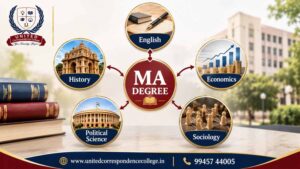
Here are some popular areas students can explore.
MA English
MA English focuses on literature, language, literary criticism and different forms of written expression. Students may study poetry, drama, novels, literary movements and the relationship between literature and society.
This specialisation may interest graduates who enjoy reading, writing, language and communication. Related career areas include content development, editing, publishing, education and communication.
MA History
MA History explores events, societies, cultures, political developments and historical interpretations. Students may examine different periods, regions and historical sources.
The subject can be relevant to learners interested in research, education, heritage, museums, archives and public history.
MA Economics
MA Economics examines how economies function, how resources are allocated and how policies affect individuals, businesses and societies.
Students may study economic theory, development, public finance, markets and research methods. It may suit graduates interested in economic analysis, policy research, banking-related support roles and further academic study.
MA Political Science
Political Science focuses on government, political institutions, public policy, political ideas and international relations.
Students explore how political systems operate, how decisions are made and how institutions influence society. Possible areas of interest include public affairs, policy research, administration and academic work.
MA Sociology
Sociology studies society, social relationships, communities, institutions and social change. It helps students understand how factors such as education, culture, family, employment and social structures influence people’s lives.
This subject may interest learners who want to explore research, social development, community programmes, education and related fields.
MA Psychology
MA Psychology introduces advanced study of human behaviour, mental processes, psychological theories and research.
Students should understand that an academic postgraduate qualification in Psychology does not automatically provide eligibility for every professional or clinical role. Specific professional practice may require additional recognised qualifications, supervised training and compliance with applicable rules.
MA Public Administration
Public Administration examines governance, public institutions, administrative systems and the implementation of policies.
It may interest students who want to understand how government departments, public organisations and development programmes function.
MA Education
MA Education explores educational systems, learning processes, educational thought and related issues. It may be suitable for graduates interested in education, academic support, curriculum-related work or further study in the education field.
The availability of these specialisations, their names and their admission requirements vary by university. Always review the current programme details before applying.
How Do You Know Which MA Specialisation Suits You?
Choosing a specialisation is easier when you consider your interests rather than selecting a subject simply because it is popular. The right choice should connect your academic background with the kind of knowledge you want to develop.
Start by asking yourself these questions:
- Which subject did you enjoy during graduation?
Think about the papers you found interesting and the topics you wanted to understand better. Your undergraduate experience can provide useful clues.
- What kind of learning do you enjoy?
Some students enjoy reading and interpreting literature. Others prefer analysing economic information, studying social behaviour or understanding political institutions.
- What type of career would you like to explore?
If you are interested in writing and publishing, English may be worth exploring. If you are curious about public policy, Political Science or Public Administration may be relevant. Your career interest should guide your shortlist, but it should not be the only deciding factor.
- Do you want to continue in the same subject or explore a related one?
Continuing in the same subject may provide a natural academic progression. Moving to another specialisation can also be possible, depending on the university’s admission rules.
Use this simple comparison to begin shortlisting options:
| Your Interest | Specialisation to Explore | What You May Study |
| Literature and language | MA English | Literature, language and writing |
| Society and culture | MA Sociology | Social systems and relationships |
| Government and public affairs | MA Political Science | Political systems and public policy |
| Markets and economic issues | MA Economics | Economic principles and policies |
| Historical events and civilisation | MA History | Historical developments and societies |
A useful approach is to shortlist two or three subjects, compare their syllabuses and check the eligibility requirements before making a final decision.
What Does Studying an MA Actually Involve?
An MA programme is not simply a continuation of undergraduate textbooks. The learning process usually requires students to examine topics more closely, understand different viewpoints and express their ideas clearly.
Although the exact teaching and assessment methods depend on the university, postgraduate study commonly involves the following activities.
Advanced Subject Reading
Students read textbooks, academic articles, research papers and other subject-related material. The aim is to understand concepts in depth rather than memorise information for examinations.
Analysing Ideas and Arguments
Many MA subjects involve different theories and interpretations. Students learn to compare viewpoints, examine evidence and develop reasoned conclusions.
Academic Writing
Assignments and written assessments help students organise information, explain concepts and communicate their understanding in a structured way.
Research and Independent Study
Some programmes introduce research methods or require project work. Students may learn how to identify a topic, collect relevant information, examine sources and present findings.
Presentations and Discussions
Depending on the programme, students may take part in presentations, discussions or other academic activities. These can help develop confidence and communication skills.
These learning activities help students become more independent learners. They also provide opportunities to practise skills that may be useful in professional environments.
Eligibility: Can You Apply for an MA After Any Bachelor’s Degree?
In many cases, students can apply for an MA after completing a recognised bachelor’s degree. However, eligibility is not identical across all universities and specialisations.
Some programmes accept graduates from different academic backgrounds, while others require applicants to have studied a particular subject during graduation.
Students Who Have Completed a BA
BA graduates are among the common applicants for MA programmes. They may choose to continue in the same subject or explore another specialisation if the university allows it.
For example, a graduate who studied English may apply for MA English, while a graduate with a suitable background in Economics may consider MA Economics.
Graduates from Other Streams
Some universities accept applicants with a bachelor’s degree in Science, Commerce or another discipline for selected MA programmes. Others may require a related subject background.
If you completed B.Com, B.Sc or another undergraduate qualification, check the specific eligibility conditions before selecting a course.
Working Professionals
Working professionals who have completed a recognised bachelor’s degree may apply if they meet the programme’s academic requirements. They should also review the class schedule, assignment deadlines and examination arrangements.
Students Returning After a Break
A gap between graduation and postgraduate admission does not automatically make a student ineligible. The main considerations are the validity of the previous qualification and the admission rules of the university.
Before applying, check:
- Whether your bachelor’s degree is recognised.
- Whether the specialisation accepts your graduation subject.
- Whether a minimum percentage or grade is required.
- Whether an entrance examination is conducted.
- Whether additional subject prerequisites apply.
- Whether the university has specific admission conditions for your category.
Do not assume that every MA specialisation accepts graduates from every stream. Confirm the current eligibility criteria with the awarding university.
How Long Does an MA Take and What Is the Course Structure?
A conventional MA programme in India commonly has a minimum duration of two years. Depending on the university and applicable regulations, the programme may be organised into semesters or year-wise study arrangements.
Some universities also provide a longer maximum completion period to accommodate learners who need additional time.
| Course Detail | General Information |
| Qualification | Master of Arts |
| Typical minimum duration | 2 years |
| Study structure | Semester-wise or year-wise |
| Learning components | Core papers, electives and research-related work where applicable |
| Assessment | Examinations, assignments, projects or other university-defined methods |
The exact course structure depends on the specialisation and institution. For example, an MA in English may include literature and language papers, while an MA in Economics may focus on economic theory, policy and analysis.
As one example of how universities publish programme information, the IGNOU Common Prospectus provides programme-specific details such as eligibility, duration, fees and study arrangements. Always consult the latest prospectus of the university you are considering rather than relying on an older course description.
What Skills Can You Develop During an MA?
An MA can help students develop more than subject knowledge. The process of reading, analysing, researching and communicating ideas can strengthen skills that are useful across several professional areas.
Research and Information Analysis
Students learn to locate relevant information, assess sources and organise findings. These abilities can be useful in research assistance, academic support and information-based roles.
Critical Thinking
Postgraduate study often involves examining different arguments and interpretations. Students practise evaluating information instead of accepting every statement at face value.
Written Communication
Assignments and academic writing help students express ideas clearly, structure arguments and present information in an organised manner.
Verbal Communication
Presentations and discussions, where included, can help learners explain concepts, respond to questions and communicate with different audiences.
Subject-Specific Knowledge
An MA develops a deeper understanding of the chosen specialisation. This knowledge may support further academic study or help students explore relevant career areas.
Problem-Solving
Analysing social, economic, historical or literary questions encourages students to examine issues from different perspectives and develop thoughtful responses.
Time Management and Independent Learning
Postgraduate students often need to manage reading, assignments and examinations alongside other responsibilities. Planning their study time can help them become more organised and independent.
These skills are not limited to one profession. Their usefulness depends on how students apply them and whether they combine academic knowledge with relevant experience.
What Career Opportunities Can You Explore After an MA?
An MA can support different career directions, but the opportunities available depend on your specialisation, experience, additional qualifications and employer requirements.
It is helpful to think about careers according to the type of work you would like to do.
Education and Academic Support
Students interested in teaching, learning and academic activities may explore roles such as:
- Academic Coordinator.
- Educational Content Developer.
- Research Assistant.
- Subject Tutor, where permitted by the employer and applicable requirements.
- Academic Support Executive.
For school teaching, college teaching and other formal academic positions, an MA alone may not be sufficient. Additional qualifications, eligibility tests or professional requirements may apply.
Writing, Publishing and Communication
Graduates with strong language and writing abilities may explore:
- Content Writer.
- Copywriter.
- Editor.
- Publishing Assistant.
- Communication Executive.
- Editorial Assistant.
An MA in English or another relevant subject may provide useful subject knowledge. Practical writing samples, editing ability and experience can also influence recruitment.
Research and Analysis
Students interested in studying information and examining evidence may consider:
- Research Assistant.
- Survey Research Associate.
- Policy Research Assistant.
- Project Research Executive.
- Research Documentation Assistant.
Some roles may require knowledge of research methods, data handling or specialised software in addition to a postgraduate degree.
Administration and Public Services
Graduates interested in organisational and public-sector work may explore:
- Administrative Executive.
- Programme Coordinator.
- Project Assistant.
- Public Policy Support Associate.
- Documentation Executive.
Government recruitment is usually based on the eligibility criteria of the specific examination or vacancy. An MA does not automatically provide entry into a government position.
Social Development and Community Programmes
Students with an interest in society and development may look at opportunities in non-profit organisations, research projects and community programmes.
Possible roles include:
- Community Programme Assistant.
- Project Coordinator.
- Social Research Assistant.
- Development Programme Support Executive.
The requirements vary depending on the organisation and the responsibilities involved.
What Salary Can You Expect After an MA?
Salary after an MA is not fixed. Two graduates with the same qualification may receive different offers depending on their subject, job role, location, experience and employer.
A fresher entering a content, research or administrative role may start at a different salary level from someone with relevant work experience or specialised skills.
The following figures are broad indicative estimates for career planning, not guaranteed salary offers or official pay scales.
| Career Area | Indicative Annual Salary |
| Content Writing and Editing | ₹2–₹4.5 lakh |
| Education and Academic Support | ₹2–₹5 lakh |
| Research Assistance | ₹2.5–₹5 lakh |
| Administration and Programme Coordination | ₹2.5–₹5 lakh |
| Communication and Publishing | ₹2.5–₹5 lakh |
Actual compensation may be lower or higher depending on the organisation, city, responsibilities and candidate’s experience.
Students can improve their career readiness by developing practical skills alongside their postgraduate studies. For example, an MA English student may build a writing portfolio, while an Economics student may benefit from learning spreadsheet tools and basic data analysis.
For information about employment services and career resources, learners can explore India’s National Career Service portal.
Can You Pursue an MA While Working?
Many graduates want to continue their education but cannot leave their jobs or other responsibilities. A flexible learning arrangement may help them manage both, provided the programme is offered through a permitted and recognised mode.
This is one reason learners explore Distance education in Bangalore and other flexible postgraduate options.
Regular Learning
Regular programmes generally involve attending classes according to the university timetable. This may suit students who can devote time to campus-based learning and academic activities.
Open and Distance Learning
Open and Distance Learning (ODL) programmes are designed to provide an alternative to conventional classroom-based education. Depending on the university, students may receive self-learning materials, academic support, counselling sessions and examination arrangements.
Online Learning
Online programmes use digital platforms for learning activities. The format, interaction methods, assessments and examination arrangements depend on the university and programme.
What Should Working Professionals Consider?
Before enrolling, working professionals should check:
- Whether the study schedule fits their working hours.
- How assignments and examinations are organised.
- Whether online sessions or counselling activities are compulsory.
- How study materials are provided.
- Whether academic support is available.
- Whether the programme is recognised for the relevant academic session.
A flexible mode can make postgraduate education easier to manage, but students should not choose a programme based on convenience alone. The awarding university, programme recognition and academic requirements matter just as much.
What Should You Check Before Choosing an MA Through Distance Education?
Finding a course is only the beginning. Before enrolling, students should compare universities and understand exactly what qualification they will receive.
If you are searching for an MA correspondence college in India, use the following checklist to evaluate your options.
1. Verify University and Programme Recognition
Check whether the university is recognised and whether the specific MA programme is approved or entitled for the intended learning mode and academic session.
The University Grants Commission’s Distance Education Bureau (UGC-DEB) provides information about recognised institutions and programmes. Its guidance asks students to verify recognition for the particular session rather than assuming that previous recognition automatically continues.
2. Review the Specialisation and Syllabus
Read the complete syllabus before selecting a programme. Check the subjects, electives, assessment methods and any project or research requirements.
Make sure the specialisation matches your interests and academic background.
3. Understand the Complete Fee Structure
Compare the total cost rather than looking only at the advertised tuition fee. Check for:
- Admission and registration charges.
- Tuition fees.
- Examination fees.
- Study material charges, if applicable.
- Project or practical-related fees, where required.
- Other university charges.
Ask for a clear fee breakdown before making a payment.
4. Check the Examination Process
Understand how examinations are conducted, where examination centres are located and whether assignments must be submitted within specific deadlines.
This is particularly important for working professionals who need to plan their time.
5. Review Academic Support
Find out how students can access study materials, academic guidance, counselling sessions and administrative support.
Good communication and clear student information can make the learning experience easier to manage.
6. Confirm Future Academic and Career Requirements
If you plan to pursue further education, apply for a specific job or prepare for a professional examination, check whether the MA qualification meets the relevant eligibility requirements.
A course that suits one career goal may not automatically meet the requirements of another.
How Is an MA Different from Other Postgraduate Options?
Students sometimes compare an MA with other master’s programmes before deciding which qualification to pursue. The right option depends on the subject they studied during graduation and the direction they want to take next.
MA vs M.Sc
An MA generally focuses on arts, humanities and social science subjects, while an M.Sc focuses on science and related disciplines.
For example, students interested in literature may consider an MA in English, whereas graduates interested in scientific subjects may explore an M.Sc programme.
Learners comparing a BA correspondence college in Bangalore with an M.Sc correspondence college in Bangalore should remember that these are different academic pathways. A BA is an undergraduate qualification, while an M.Sc is a postgraduate qualification with its own subject and eligibility requirements.
MA vs MBA
An MA focuses on a selected academic subject, while an MBA is designed around business and management areas such as finance, marketing, human resources and operations.
Students interested in advanced subject knowledge may prefer an MA, while those looking for business and management education may consider an MBA.
| Qualification | Main Academic Focus | Common Subject Areas |
| MA | Arts, humanities and social sciences | English, History, Sociology, Economics |
| M.Sc | Sciences and related disciplines | Mathematics, Physics, Chemistry, Life Sciences |
| MBA | Business and management | Finance, Marketing, Human Resources, Operations |
Your graduation background, interests, eligibility and career plans should guide this decision. Do not choose a qualification only because it is popular or because someone else recommends it.
How United Correspondence College Can Help You Explore Higher Education Options
Choosing a postgraduate programme involves more than selecting a subject. Students also need to understand admission conditions, learning arrangements, fees and the qualifications they will receive.

United Correspondence College provides information about educational options for students and working professionals exploring their next academic step.
If you are comparing courses or considering an MA, begin by identifying your graduation background and the subject you want to study. Then review the programme details and confirm the awarding university, eligibility conditions and permitted mode of learning.
Learners exploring correspondence colleges in Bangalore or other flexible education options should take time to compare the actual university programmes rather than relying only on advertisements or course titles.
You can explore UCC’s available course information and contact the college to understand the options relevant to your academic goals. Before applying, make sure you have verified the recognition and admission requirements of the specific programme.
Conclusion: Your Graduation Is Not the End of Learning
Completing a bachelor’s degree gives you a foundation, but it does not mean your learning journey has to stop there. An MA can help you explore a subject in greater depth, strengthen your academic abilities and consider new professional directions.
Whether you are interested in English, History, Economics, Political Science, Sociology or another specialisation, the right choice should reflect your interests and future plans.
If you are exploring an MA correspondence college in India, remember to check the university’s recognition, programme eligibility, syllabus, fees and permitted learning mode before enrolling. Working professionals and students returning to education should also consider whether the study arrangements fit their personal and professional responsibilities.
A postgraduate qualification is most valuable when it supports a clear academic or career goal. Take time to compare your options, understand the requirements and choose a programme that helps you move forward with confidence.
“If you’re exploring postgraduate options after completing your BA, check out our guide on Which Course Is Best After BA? to discover popular courses, career opportunities and higher education pathways.”
Frequently Asked Questions (FAQs)
1. What is an MA degree?
MA stands for Master of Arts. It is a postgraduate qualification that allows students to study a subject in greater depth after completing a bachelor’s degree. Popular subjects include English, History, Economics, Sociology and Political Science.
2. What is the duration of an MA course in India?
An MA programme commonly has a minimum duration of two years. The exact duration and maximum completion period depend on the university, programme structure and applicable regulations.
3. Can I pursue an MA after completing a BA?
Yes. Students who have completed a recognised BA can apply for MA programmes if they meet the university’s eligibility requirements. They may continue in the same subject or choose another specialisation where permitted.
4. Can I pursue an MA in a different subject from my bachelor’s degree?
Some universities allow graduates to apply for an MA in a different subject, while others require a related undergraduate background or specific subjects. Always check the admission conditions of the programme.
5. Which MA specialisation is best for career opportunities?
There is no single best specialisation for everyone. MA English may suit students interested in writing and publishing, MA Economics may interest those drawn to economic analysis, and MA Sociology or Political Science may suit learners interested in social research and public affairs. Choose according to your interests, eligibility and career plans.
6. Can working professionals pursue an MA through distance education?
Yes, working professionals may pursue an MA through ODL or online learning if the university and specific programme are recognised or entitled for that mode and academic session. They should check examination schedules, assignment requirements and study arrangements before enrolling.
7. What is the difference between MA and M.Sc?
An MA generally covers arts, humanities and social science subjects, while an M.Sc focuses on science and related disciplines. Eligibility depends on the subject and university requirements.
8. What jobs can I get after completing an MA?
Depending on the specialisation and additional requirements, graduates may explore opportunities in writing, editing, publishing, research assistance, academic support, administration, communication and programme coordination.
9. What is the average salary after an MA in India?
There is no fixed salary for MA graduates. Entry-level earnings vary by specialisation, job role, employer, location and experience. Building relevant practical skills and gaining work experience can improve career opportunities.
10. Is an MA degree useful for further studies?
Yes. An MA can provide a foundation for further academic study, including doctoral research where the candidate meets the relevant admission and eligibility requirements. Some students also prepare for teaching eligibility tests or other competitive examinations, depending on their career goals.
Take the Next Step Towards Your Postgraduate Journey!
An MA degree can help you deepen your knowledge, develop valuable skills and explore new career opportunities in your chosen field. Whether you are a recent graduate or a working professional looking to advance your education, choosing the right programme is an important step towards your future.
If you are exploring an MA correspondence college in India, take time to understand the available specialisations, eligibility requirements, course structure and learning options before making your decision.
Connect with United Correspondence College to learn more about higher education pathways and find an option that aligns with your academic interests and career goals.
Visit www.unitedcorrespondencecollege.in or call 99457 44005 to take the next step towards your postgraduate education.
Explore suitable higher education options with United Correspondence College and take an informed step towards your next academic goal.