

One Cyberattack Can Change Everything – Why Cyber Security Skills Matter
Imagine logging into your bank account and discovering an unauthorised transaction, or opening a business email that exposes confidential customer information. These situations show why digital security has become essential in everyday life. As businesses and individuals depend more on technology, the demand for professionals who can protect digital systems continues to grow. A BCA in Cyber Security introduces students to computer applications and digital protection, while BCA distance education offers a learning route worth exploring for those who need flexibility.
Cyber security is no longer limited to large technology companies. Banks, hospitals, educational institutions, government departments, online shopping platforms and small businesses all depend on secure digital systems. They need professionals who understand how cyber threats work and how information, networks and applications can be protected.
For students interested in computers, technology and problem-solving, this field offers an opportunity to develop relevant technical knowledge. It can also be an interesting direction for working professionals and learners who want to return to higher education and build a foundation in information technology.
But what exactly does a BCA in Cyber Security involve? Which subjects will you study? Can you pursue this qualification through distance learning? And what career opportunities can you explore after graduation?
Let’s understand the complete journey, from learning computer fundamentals to exploring opportunities in the cyber security industry.
What Is Cyber Security and Why Do Businesses Need It?
Every time someone makes an online payment, accesses a company database, sends an email or stores information on a cloud platform, digital systems handle valuable data.
Cyber security refers to the practices, technologies and processes used to protect computers, networks, applications and information from unauthorised access, misuse, damage and cyberattacks.
Its main purpose is to maintain three important aspects of information security:
- Confidentiality: Ensuring that sensitive information is accessible only to authorised people.
- Integrity: Protecting information from unauthorised changes or manipulation.
- Availability: Ensuring that systems and information remain accessible when required.
These principles are important for organisations of every size.
Consider a hospital that stores patient records digitally. If someone gains unauthorised access to its database, confidential medical information could be exposed. Similarly, a business experiencing a ransomware attack may lose access to important files and face interruptions in its operations.
Cyber security helps organisations reduce these risks through preventive measures, monitoring and incident response.
Why Is Cyber Security Important Today?
Several developments have increased the importance of digital protection.
Growth of online transactions: Digital payments, internet banking and e-commerce platforms handle large volumes of sensitive financial information.
Increasing cloud usage: Businesses store applications and information on cloud platforms, making access management and cloud protection important.
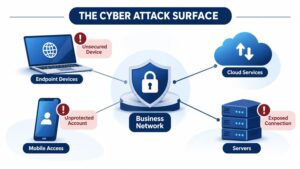
Remote working: Employees accessing company systems from different locations create additional security considerations.
Connected devices: Smart devices, sensors and connected equipment introduce new points that organisations must protect.
Data privacy requirements: Businesses must handle customer and employee information responsibly and follow applicable data protection requirements.
The Indian Computer Emergency Response Team (CERT-In) publishes advisories about emerging cyber threats and recommended security measures. Its guidance demonstrates why organisations need to pay attention to authentication, software updates, access control and incident response.
What Is BCA in Cyber Security? Understanding the Course
Bachelor of Computer Applications (BCA) is an undergraduate degree that introduces students to computing, programming, software applications and information technology.
A cyber security specialisation builds on this foundation by introducing concepts related to protecting computer systems, networks, applications and digital information.
The exact programme structure varies between universities. Some institutions offer a dedicated BCA in Cyber Security, while others provide a general BCA with cyber security electives, specialised modules or additional certifications.
The programme generally aims to help students understand how computer systems function and how security principles can be applied to protect them.
What Makes This Specialisation Different?
A general computer applications programme provides foundational knowledge of software, programming and computing.
A cyber security-focused programme adds subjects and learning activities related to:
- Network security.
- Information security.
- Computer system protection.
- Cyber threat identification.
- Cryptography fundamentals.
- Ethical hacking concepts.
- Digital forensics.
- Security monitoring.
For example, a student learning computer networks may also explore how network communication can be protected against unauthorised access.
Similarly, programming knowledge can help learners understand common software vulnerabilities and secure coding principles.
The combination of computer application knowledge and security awareness can provide a foundation for exploring different areas of the IT industry.
What Will You Study? Exploring the Course Subjects
The syllabus is one of the most important aspects to review before selecting an undergraduate programme.
BCA Cyber Security subjects generally combine computing fundamentals with specialised security concepts. However, the exact subjects and semester arrangements depend on the university.
Building the Computing Foundation
Before learning how to protect digital systems, students need to understand how those systems work.
Common foundational subjects may include:
- Computer Fundamentals.
- Programming in C.
- Object-Oriented Programming.
- Data Structures.
- Database Management Systems.
- Mathematics for Computing.
- Software Engineering.
- Web Technologies.
These subjects help students understand how software is developed, how information is stored and how computer applications operate.
For example, database management introduces students to data storage and retrieval, while programming develops logical thinking and problem-solving abilities.
Understanding Networks and Systems
Cyber security professionals need to understand the infrastructure they are protecting.
Relevant subjects may include:
- Computer Networks.
- Operating Systems.
- Network Administration.
- Linux Fundamentals.
- Computer Architecture.
- Network Security.
- System Administration.
These topics introduce students to how computers communicate, how operating systems manage resources and how networks connect different devices.
A basic understanding of networking is particularly useful when exploring areas such as network monitoring and security administration.
Learning to Protect Digital Information
The specialised part of the curriculum introduces students to security-related concepts.
Depending on the university, subjects may include:
- Introduction to Cyber Security.
- Information Security Management.
- Cryptography.
- Ethical Hacking Fundamentals.
- Cyber Laws.
- Digital Forensics.
- Malware Analysis Fundamentals.
- Application Security.
- Cloud Security.
For instance, cryptography introduces techniques used to protect information, while digital forensics focuses on examining digital evidence in an organised manner.
Practical Learning and Project Work
Some programmes include laboratory sessions, assignments, practical exercises and project work.
These activities can help students understand how theoretical concepts are applied.
Examples may include:
- Creating a basic password-strength evaluation tool.
- Understanding firewall configurations in a controlled environment.
- Analysing sample system logs.
- Learning basic network monitoring.
- Studying secure authentication methods.
- Building a simple application with appropriate security practices.
Students should check whether their chosen programme includes practical components and what facilities are available.
Important: The subjects listed are examples of topics commonly associated with computer applications and cyber security education. They should not be treated as a guaranteed syllabus for every BCA programme.
Skills That Turn a Computer Learner into a Cyber Security Professional
Studying cyber security involves more than understanding computer terminology. Professionals must be able to examine technical problems, identify unusual patterns and make responsible decisions.
Students can begin developing these abilities during their undergraduate education.
1. Programming Knowledge
Programming helps students understand how software works and how applications are developed.
Languages such as Python, C, C++ and Java may be useful depending on the area of cyber security they want to explore.
For example, Python can be used for basic automation, data processing and security-related scripting.
2. Networking Knowledge
Understanding IP addresses, network protocols, routers, firewalls and communication systems is important for identifying network-related security problems.
A good networking foundation can help students understand how information travels between devices.
3. Analytical Thinking
Cyber security professionals regularly examine system activity, logs and security alerts.
Analytical thinking helps them identify unusual patterns and understand whether an activity requires investigation.
4. Problem-Solving Abilities
Security incidents rarely follow an identical pattern.
Professionals must examine available information, identify possible causes and decide which actions are appropriate.
5. Attention to Detail
A small configuration error or unusual login attempt may indicate a larger security issue.
Careful observation helps professionals recognise details that might otherwise be overlooked.
6. Ethical Responsibility
Cyber security involves handling confidential information and accessing sensitive systems.
Professionals must respect privacy, follow organisational policies and perform security testing only with proper authorisation.
7. Continuous Learning
Technology and cyber threats change regularly. Professionals need to stay informed about software updates, new vulnerabilities, security tools and industry practices.
Students can also improve their learning through independent projects, technical documentation and supervised laboratory exercises.
Different Areas of Cyber Security You Can Explore
Cyber security is a broad field. Students do not have to follow only one career direction after completing their education.
Understanding its different areas can help them identify which technical activities interest them most.
Network Security
Network security focuses on protecting communication systems and connected devices.
It involves understanding firewalls, network monitoring, access controls and security configurations.
Professionals in this area help organisations reduce unauthorised network access and protect information moving between systems.
Application Security
Application security focuses on identifying and reducing vulnerabilities in software applications.
It involves understanding secure programming practices, authentication, input validation and application testing.
Students interested in software development may find this area worth exploring.
Cloud Security
Businesses increasingly use cloud platforms to store information and operate applications.
Cloud security involves protecting cloud infrastructure, user permissions, stored information and connected services.
Knowledge of cloud computing and identity management can be useful in this area.
Ethical Hacking and Penetration Testing
Ethical hackers examine systems for security weaknesses with explicit permission from the system owner.
Their work involves controlled testing, documentation and recommendations for improving security.
It is important to understand that ethical hacking is not unauthorised access. Testing must always follow a defined scope and legal authorisation.
Digital Forensics
Digital forensics involves examining electronic devices, files and other digital evidence to understand what happened during an incident.
It may be used in investigations involving unauthorised access, data theft and other digital offences.
Security Operations
Security operations teams monitor systems and investigate security alerts.
They may use security information and event management tools, endpoint monitoring systems and incident response procedures.
Students interested in monitoring and investigation can explore this area as they build their technical foundation.
Who Can Apply? Eligibility and Admission Requirements
Eligibility requirements are important when choosing an undergraduate programme.
Although the general admission pathway for BCA begins after Class 12, individual universities may have different conditions.
Educational Qualification
Candidates generally need to complete Class 12 or an equivalent qualification from a recognised board.
Students from commerce, science and arts backgrounds may be eligible, depending on the university’s admission rules.
Mathematics Requirements
Some universities require Mathematics or Computer Science at the qualifying level, while others accept students from different academic streams.
Therefore, applicants should not assume that every BCA programme has identical subject requirements.
Minimum Marks
Certain institutions specify minimum qualifying marks in Class 12.
The required percentage may depend on the university, admission category and programme guidelines.
Admission Process
Admission may be based on Class 12 marks, merit lists or an entrance examination, depending on the institution.
Applicants may be asked to submit:
- Class 10 mark sheet.
- Class 12 mark sheet.
- Transfer or migration certificate, wherever applicable.
- Identity proof.
- Passport-size photographs.
- Other documents specified by the university.
Can Students Who Have Taken a Break Apply?
A break in education does not automatically prevent someone from pursuing an undergraduate degree.
Students who discontinued their education can explore admission options if they meet the institution’s eligibility requirements.
Similarly, working professionals interested in building a computer applications foundation can consider learning arrangements that suit their schedules.
The most important step is to verify the eligibility conditions of the actual degree-awarding university before applying.
Regular or Distance Learning: Which Study Route Works Better?
Students have different learning requirements.
Some prefer attending classrooms, while others need an arrangement that allows them to manage education alongside employment, family responsibilities or other commitments.
Both regular and distance learning can support undergraduate education, but their structure and learning experience may differ.
Regular BCA vs Distance BCA
| Comparison factor | Regular BCA | Distance BCA |
| Learning environment | Classroom-based | Remote learning |
| Study schedule | Usually follows a fixed timetable | Generally offers greater flexibility |
| Learning resources | Classroom teaching and academic materials | Printed or digital learning resources |
| Interaction | Regular classroom interaction | Available academic support channels |
| Practical exposure | May include scheduled laboratory sessions | Depends on programme facilities and arrangements |
| Suitable for | Students preferring campus learning | Learners balancing other responsibilities |
The choice should depend on your personal circumstances and the actual structure of the programme.
For cyber security, students should pay particular attention to practical learning. Understanding security concepts requires more than reading textbooks. Students should also develop technical familiarity through safe laboratory exercises and guided projects.
Distance learning may provide scheduling flexibility, but learners must take responsibility for building their practical skills.
Can You Build a Cyber Security Foundation Through Distance Education?
Yes, students can explore computer applications education through distance learning, provided the university and specific programme are recognised or entitled to offer that programme in the chosen mode for the relevant academic session.
However, there is an important distinction between earning an academic qualification and developing practical cyber security skills.
A degree can introduce foundational concepts, but technical confidence develops through consistent practice.
How Can Distance Learners Develop Practical Skills?
- Practise programming regularly
Students can begin with basic programming exercises and gradually learn how to write scripts for simple technical tasks.
- Understand operating systems
Familiarity with Windows and Linux environments can help learners understand system administration and security configurations.
- Learn networking fundamentals
Study IP addressing, network protocols, firewalls and basic network troubleshooting.
- Use controlled learning laboratories
Students can practise in authorised virtual environments designed for learning security concepts.
They should never test systems belonging to other people or organisations without permission.
- Complete small projects
Simple projects can demonstrate how students apply their knowledge.
For example, a learner might develop a basic password-strength checker or examine sample security logs.
- Explore additional technical training
Structured training programmes can supplement academic learning. The National Institute of Electronics and Information Technology (NIELIT), under the Ministry of Electronics and Information Technology, publishes information about cyber security training and related technical courses.
What Should You Check Before Choosing a Distance Programme?
If you are considering BCA distance education in bangalore, examine the actual university and course details rather than relying only on the institution’s location or promotional claims.
Check:
- Whether the university is recognised.
- Whether the specific BCA programme is approved for the selected learning mode and admission session.
- Whether the course includes cyber security subjects.
- Whether practical learning resources are available.
- How assignments and examinations are conducted.
- Whether academic support is provided.
- What the complete fee structure includes.
The UGC Distance Education Bureau provides official information about institutions and their approved programmes. Its FAQ specifically advises students to verify recognition for the session in which they intend to take admission, because recognition in a previous year does not automatically establish recognition for the next session.You can verify the relevant details through the UGC Distance Education Bureau.
This is particularly important for learners comparing an IT correspondence college in bangalore with other educational options.
Your First Cyber Security Projects: Learning Beyond the Syllabus
One of the best ways to understand cyber security is to work on small, structured projects.
Students do not need to begin with advanced security tools. They can start with simple activities that develop technical thinking.
Here are some beginner-friendly examples.
Project 1: Password Strength Evaluation
Create a basic programme that evaluates password characteristics such as length, character variety and common patterns.
The purpose is to understand why weak passwords are easier to guess and how stronger authentication practices improve account security.
Project 2: Basic Network Observation
Use an authorised learning environment to observe network traffic and understand how devices communicate.
Students can learn about IP addresses, protocols and the difference between normal and unusual network activity.
Project 3: Simple Security Log Analysis
Examine sample system logs to identify repeated failed login attempts, unexpected access times or other unusual entries.
This introduces students to the kind of information security teams examine during monitoring.
Project 4: Secure Web Application Fundamentals
Develop a simple demonstration application and learn about basic security practices such as input validation, authentication and safe handling of user information.
Project 5: File Integrity Checking
Create a small programme that uses cryptographic hash functions to identify whether a file has changed.
This helps students understand the importance of data integrity.
These projects can become useful learning exercises and portfolio examples. They also help learners understand whether they enjoy programming, investigation, networking or system administration.
Remember that all security experiments should be conducted on systems and data you own or have explicit permission to use.
Where Can a BCA in Cyber Security Take Your Career?
After completing an undergraduate programme, students can explore different entry-level opportunities in the IT and information security industry.
However, it is important to understand that a degree alone does not guarantee a specialised cyber security position. Employers may also look for practical knowledge, technical projects, certifications and relevant experience.
The following career paths can help students understand where their education may lead.
1. Cyber Security Analyst
Cyber security analysts help organisations monitor their systems, identify potential security risks and support preventive measures.
Their work may involve reviewing security alerts, examining system logs, checking vulnerabilities and assisting with incident investigations.
Students interested in analysing technical problems can explore this role as they develop their knowledge.
2. Security Operations Centre (SOC) Analyst
SOC analysts monitor an organisation’s digital infrastructure for suspicious activity.
They work with security monitoring tools, examine alerts and help investigate potential security incidents.
Entry-level SOC roles can provide exposure to practical security operations and incident handling.
3. Information Security Executive
Information security executives support the implementation of organisational security practices.
Their responsibilities may include maintaining security documentation, assisting with access management, reviewing policies and supporting compliance activities.
4. Network Security Associate
Network security associates help maintain and monitor network protection systems.
They may assist with firewall configurations, network monitoring, access controls and basic troubleshooting.
A strong understanding of networking is particularly useful for this role.
5. Junior Penetration Tester
Penetration testers conduct authorised security assessments to identify weaknesses in applications, networks and systems.
Junior professionals may assist with testing activities, documentation and vulnerability reporting under supervision.
This career path generally requires additional practical training and knowledge of security testing methods.
6. Digital Forensics Assistant
Digital forensics assistants support the examination and preservation of digital evidence.
They may help organise forensic information, document findings and assist experienced investigators.
Knowledge of operating systems, file systems and digital evidence handling can be beneficial.
7. IT Security Support Executive
IT security support professionals assist with everyday security-related requirements.
Their responsibilities may include user access management, basic security troubleshooting, endpoint protection and reporting suspicious activity.
This can be a useful starting point for graduates who want to gain experience in IT operations before specialising further.
Cyber Security Job Roles and What Professionals Actually Do
Understanding job titles is useful, but students should also know what the work involves.
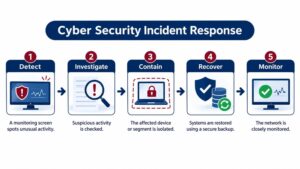
A security analyst may spend considerable time reviewing system alerts, while a penetration tester may focus on examining applications for weaknesses.
The right career direction depends on your interests and the technical skills you develop.
Career Roles, Responsibilities and Indicative Salaries
| Job role | Main responsibilities | Indicative annual salary |
| IT Security Support Executive | Basic security support and access management | ₹2.5–4 lakh |
| Junior SOC Analyst | Monitoring alerts and supporting investigations | ₹3–5.5 lakh |
| Cyber Security Analyst | Identifying risks and reviewing security incidents | ₹3–6 lakh |
| Network Security Associate | Supporting network protection and monitoring | ₹3–5.5 lakh |
| Junior Penetration Tester | Assisting with authorised security assessments | ₹3–6 lakh |
| Digital Forensics Assistant | Supporting digital evidence examination | ₹2.5–5 lakh |
These are broad indicative planning estimates, not guaranteed salaries or verified national averages. Actual compensation depends on employer, location, technical ability, certifications, experience and job responsibilities.
Which Career Path Should You Consider?
Your interests can help you identify a suitable starting direction.
- If you enjoy monitoring and investigation, explore SOC operations.
- If you like networking and infrastructure, consider network security.
- If you enjoy programming, explore application security.
- If you are interested in technical testing, learn about authorised penetration testing.
- If you enjoy examining digital information, explore digital forensics.
- If you prefer system administration, consider IT security support.
Students should remember that specialised positions may require experience beyond an undergraduate degree.
Salary Expectations: What Can Fresh Graduates Earn?
Salary is an important consideration when planning a career, but cyber security compensation varies considerably across organisations.
A graduate entering an IT support role may have a different starting salary from someone joining a security operations team with relevant practical skills.
Similarly, specialised positions often require additional technical knowledge and experience.
What Influences Salary?
Technical skills: Knowledge of programming, networking, operating systems and security tools can influence employment opportunities.
Practical experience: Internships, laboratory work and technical projects can help demonstrate the ability to apply academic knowledge.
Certifications: Relevant professional certifications may help candidates demonstrate specialised knowledge, depending on employer requirements.
Location: Compensation may differ between technology hubs and smaller cities.
Employer requirements: IT service companies, financial institutions, consulting firms and technology organisations may have different salary structures.
How Can Students Improve Their Earning Potential?
Instead of concentrating only on the expected starting salary, students should work towards building a strong technical foundation.
Some useful steps include:
- Strengthen programming and networking fundamentals.
- Learn Linux and basic system administration.
- Practise using authorised security laboratories.
- Complete projects that demonstrate technical understanding.
- Develop professional communication and documentation skills.
- Explore relevant certifications after understanding their prerequisites.
- Look for internships and suitable entry-level opportunities.
A combination of academic education, practical learning and continuous improvement can help graduates progress towards more specialised roles.
What Happens Next? Higher Studies After BCA
An undergraduate computer applications degree can provide a foundation for further education.
Some graduates prefer to enter the workforce, while others want to continue studying to develop specialised knowledge.
Here are some higher education options to consider.
MCA (Master of Computer Applications)
MCA is a postgraduate programme that develops advanced knowledge of computer applications, software development and computing technologies.
Graduates can explore this option if they want to strengthen their broader IT background.
Admission requirements vary by university and may include specific subject or mathematics conditions.
MSc in Cyber Security
An MSc in Cyber Security focuses more deeply on information protection, security technologies, threat analysis and related technical areas.
Students should check the eligibility conditions of the institution before applying.
Postgraduate Diploma in Cyber Security
Some institutions offer specialised postgraduate diploma programmes that introduce advanced security concepts and practical applications.
These may be worth exploring for graduates seeking focused technical learning.
Professional Certifications
Professional certifications can supplement academic qualifications.
Depending on their career interests and eligibility, learners may explore:
- CompTIA Security+.
- Cisco Certified CyberOps Associate.
- Certified Ethical Hacker (CEH).
- Certified Information Systems Security Professional (CISSP).
- Relevant cloud security certifications.
Some certifications have experience requirements or specific eligibility conditions. For example, students should understand that CISSP is an advanced professional certification and not simply an entry-level qualification.
Other Technical Learning Options
Students may also develop knowledge in:
- Cloud computing.
- Network administration.
- Database management.
- Secure software development.
- Digital forensics.
- Information security management.
The best option depends on whether you want to move towards security operations, software security, network protection or another technical specialisation.
The Future of Cyber Security: New Threats, New Opportunities
Technology continues to change how people work, communicate, shop and manage information.
As digital services expand, organisations must also pay attention to the security risks associated with their systems.
Here are some developments shaping the future of cyber security.
1. Artificial Intelligence and Cyber Security
Artificial intelligence is influencing both security operations and cyber threats.
Security teams can use AI-supported tools to identify unusual patterns and process large volumes of security information.
At the same time, malicious actors may use AI to create convincing phishing messages and automate certain activities.
This makes technical awareness and responsible use of security technologies increasingly important.
2. Cloud Security
Businesses increasingly depend on cloud-based applications and storage systems.
Protecting user accounts, access permissions, business information and cloud infrastructure will remain an important area of technical work.
Students interested in cloud security can gradually develop knowledge of cloud platforms and identity management.
3. Digital Payment Security
Online banking, UPI transactions and digital payment platforms have become part of everyday financial activity.
Protecting these systems requires attention to authentication, fraud prevention, transaction monitoring and data security.
4. Internet of Things Security
Smart devices, connected appliances, industrial sensors and other IoT technologies create additional security considerations.
Professionals must understand how connected devices communicate and how their systems can be protected.
5. Data Privacy and Information Protection
Businesses handle personal and organisational information that must be managed responsibly.
Understanding data protection principles, access controls and secure information handling can become useful for professionals working in this area.
6. Growing Importance of Cyber Awareness
Technology alone cannot prevent every security incident.
Employees and users must understand phishing, suspicious links, unsafe downloads and account protection.
India’s National Cyber Crime Reporting Portal also provides a facility for reporting cybercrime complaints. Its official helpline for cyber financial fraud is 1930. Students can explore the National Cyber Crime Reporting Portal to understand how cybercrime reporting works in India.
These developments show that cyber security is not limited to one technology or job role. It is a continually developing field that connects computing, business operations, data protection and responsible technology use.
How to Choose the Right BCA Programme for Your Career Goals
Choosing an undergraduate programme requires careful consideration.
A programme may have an attractive title, but students should examine its actual curriculum, academic structure and learning arrangements before applying.
This is especially important when selecting a specialised programme such as BCA in Cyber Security.
Important Factors to Compare
| Selection factor | What students should check |
| University recognition | Verify the university’s legal recognition and applicable approval status |
| Programme availability | Confirm that the specific BCA programme is offered in the selected mode |
| Course curriculum | Check programming, networking and cyber security subjects |
| Practical learning | Understand laboratory access, projects and technical learning resources |
| Eligibility | Verify Class 12 requirements and any mathematics conditions |
| Learning support | Review study materials and available academic guidance |
| Examination system | Understand assignments, assessments and examination arrangements |
| Fees | Check the complete fee structure and additional charges |
| Higher education | Consider whether the qualification supports your intended postgraduate options |
Choose According to Your Educational Situation
If you have recently completed Class 12:
Start by comparing the syllabus, eligibility requirements and academic support available through different institutions. A strong computing foundation is important before moving into specialised security topics.
If you are a working professional:
Consider whether the learning schedule, examination arrangements and independent study requirements can fit your employment responsibilities.
If you have discontinued your education:
Check whether you meet the university’s admission conditions and whether the programme provides a suitable way to resume undergraduate studies.
If you want to enter the cyber security industry:
Look beyond the degree title. Check whether you will have opportunities to develop programming, networking, operating system and practical security knowledge.
Common Mistakes to Avoid
- Choosing a course without reviewing its actual syllabus.
- Assuming every BCA programme includes the same cyber security subjects.
- Selecting an institution without checking university recognition.
- Assuming distance learning automatically provides hands-on laboratory exposure.
- Depending only on certificates without developing practical skills.
- Believing that completing a degree guarantees a cyber security job.
- Ignoring the importance of ethical and authorised security practices.
A careful comparison can help students select an academic pathway that supports their long-term interests.
Starting Your IT Education Journey with United Correspondence College
Choosing an undergraduate programme is an important step, especially for students who want to build a future in technology.
For learners exploring IT distance education, it is useful to compare different academic options and understand how they fit their career interests.
United Correspondence College provides an educational platform for students exploring higher education and correspondence-based learning opportunities.
Before selecting a BCA programme, students should understand the degree-awarding university, programme availability, eligibility conditions, syllabus, learning mode and applicable recognition requirements.
If you are comparing distance education colleges in bangalore or correspondence colleges in bangalore, do not make your decision based only on location or flexibility. Consider the academic structure and whether the programme supports your long-term educational goals.
BCA distance education may be worth exploring for learners who need a flexible study arrangement. However, students interested in cyber security should also plan for independent technical practice and practical skill development.
United Correspondence College encourages learners to make informed decisions about their educational journey by understanding the available learning options.
Explore UCC to learn more about educational opportunities and clarify your admission-related queries.
Conclusion: Build the Knowledge to Protect the Digital World
Cyber security has become an important part of modern technology because individuals, businesses and institutions depend on digital systems every day.
From protecting online transactions and confidential information to monitoring networks and identifying security threats, the field offers several areas for technical exploration.
A BCA in Cyber Security can introduce students to computer applications, programming, networking and information protection. It can also provide a foundation for exploring higher education and different IT career paths.
However, selecting the right programme requires careful consideration of the syllabus, eligibility, university recognition, practical learning opportunities and future academic options.
Whether you are a recent Class 12 graduate, a working professional or someone planning to restart your education, take time to compare suitable programmes before making a decision.
Your journey into cyber security starts with understanding technology, developing the right skills and learning how to use them responsibly.
Explore the educational opportunities available through United Correspondence College and take an informed step towards your future in information technology.
“Explore the exciting possibilities of emerging technologies by reading our guide on MCA in AR and VR to understand the specialisation, essential skills, and future career opportunities.”
Frequently Asked Questions About BCA in Cyber Security
1. What is BCA in Cyber Security?
BCA in Cyber Security is an undergraduate computer applications programme that introduces students to programming, computer networks, information security and digital protection. Its purpose is to develop a foundation for understanding how computer systems and information can be protected.
2. What are the subjects in BCA Cyber Security?
Common subjects may include Computer Fundamentals, Programming, Data Structures, Database Management, Computer Networks, Operating Systems, Cryptography, Network Security, Ethical Hacking Fundamentals and Digital Forensics. The actual syllabus varies by university.
3. What is the eligibility for BCA in Cyber Security?
Generally, students must complete Class 12 or an equivalent qualification from a recognised board. Some universities require Mathematics or Computer Science, while others accept students from different streams.
4. Can I pursue BCA in Cyber Security after Commerce or Arts?
Yes, some universities accept students from commerce and arts backgrounds. However, eligibility requirements differ, so candidates should check the specific admission criteria before applying.
5. Can I study BCA in Cyber Security through distance education?
Students can explore distance or online BCA programmes where the specific university and programme are recognised or entitled to operate in that learning mode for the relevant academic session. Practical technical learning should also be considered.
6. Is BCA in Cyber Security difficult?
The programme involves technical subjects such as programming, networking and information security. Students who practise regularly, understand computer fundamentals and develop problem-solving skills can gradually build confidence in these areas.
7. What jobs can I get after BCA in Cyber Security?
Graduates can explore entry-level opportunities such as IT Security Support Executive, Junior SOC Analyst, Cyber Security Analyst, Network Security Associate and Digital Forensics Assistant, depending on their practical skills and employer requirements.
8. What is the salary after BCA in Cyber Security?
Entry-level compensation varies according to the job role, employer, location and technical skills. Graduates may begin in IT support or junior security positions and improve their earning potential through practical experience and specialised training.
9. Can I pursue MCA after BCA in Cyber Security?
Yes, graduates can explore MCA programmes, subject to the admission requirements of the university. They can also consider postgraduate programmes in cyber security or related computing fields.
10. Is Mathematics compulsory for BCA in Cyber Security?
Not at every university. Some institutions require Mathematics at the qualifying level, while others have different eligibility conditions. Always check the admission guidelines of the university.
Take the Next Step Towards a Career in Cyber Security
A career in cyber security begins with the right knowledge, technical skills and a willingness to keep learning. If you are interested in protecting digital systems, identifying security threats and building a future in the IT industry, a BCA can help you develop a strong academic foundation.
Choosing the right learning path is equally important. United Correspondence College can help you explore suitable higher education options that align with your academic background and career goals. Before enrolling, check the programme’s curriculum, eligibility, recognition and learning support to make an informed decision.
Ready to take the next step? Contact United Correspondence College at www.unitedcorrespondencecollege.in to discuss your higher education options and move closer to your career goals.