
Augmented Reality (AR) and Virtual Reality (VR) are changing how people learn, shop, work, design products and experience digital content. From virtual product demonstrations and immersive training to interactive games and digital simulations, these technologies are creating new opportunities for professionals with computing and software development skills.
For students who want to explore these areas, a Master of Computer Applications (MCA) can be a useful postgraduate pathway. However, it is important to understand what an MCA in AR and VR involves, which technical skills matter, what career options may be available and how to select a suitable programme.
Students comparing MCA distance education in bangalore options should look beyond the course title. The curriculum, programming subjects, practical projects, awarding university, learning mode and access to relevant tools can all affect how well a programme supports a learner’s career goals.
This guide explains AR and VR in simple terms, outlines the subjects and skills learners may need, explores potential careers, and shares practical steps for choosing an appropriate postgraduate course.
What Is an MCA in AR and VR?
An MCA is a postgraduate programme focused on computer applications, software development, computing systems and related technologies. An AR/VR-focused MCA would combine core computing knowledge with concepts and practical skills used to develop immersive digital experiences.
The precise curriculum depends on the university and the programme. A course may cover programming, computer graphics, 3D environments, interaction design, real-time rendering, simulation, game development or immersive application development. Not every MCA includes these subjects, so students should check the official syllabus rather than assume that AR and VR are included.
Augmented Reality adds digital elements to a view of the real world. Virtual Reality places users inside a computer-generated environment that they can explore through compatible devices.
An AR/VR specialisation can be relevant to learners interested in software development, interactive applications, simulation, gaming, visualisation and immersive user experiences. It is not limited to entertainment: organisations may also use immersive technologies for education, industrial training, architecture, healthcare-related simulations and product demonstrations.
Before enrolling, check whether the programme is a dedicated AR/VR specialisation, an MCA with selected immersive-technology subjects, or a general MCA that you plan to supplement with separate AR/VR projects.
What Is the Difference Between AR, VR and MR?
These terms are related, but they describe different ways of combining digital content with a user’s surroundings.
- Augmented Reality (AR): Adds digital information, images or objects to a view of the real environment.
- Virtual Reality (VR): Creates a computer-generated environment that users can experience through compatible equipment.
- Mixed Reality (MR): Allows digital content and the physical environment to interact in more integrated ways, depending on the device and platform.
For example, an AR application could let a customer preview how a piece of furniture might look in a room. A VR application could allow a trainee to practise a task inside a simulated workplace. An MR experience could place digital objects into a physical environment and support interaction between them.
| Technology | How it works | Example use | Skills that may be relevant |
| Augmented Reality (AR) | Adds digital content to a view of the real world | Interactive product previews or learning overlays | Mobile development, tracking, 3D assets and user interaction |
| Virtual Reality (VR) | Places the user inside a digital environment | Virtual training, simulations and immersive games | 3D development, interaction design and performance optimisation |
| Mixed Reality (MR) | Integrates digital content with physical surroundings | Interactive design or industrial visualisation | Spatial computing, 3D development and device-specific development |
The technologies overlap, and tools or terminology can vary between platforms. Students do not need to master every category immediately. A better starting point is to learn programming fundamentals and then build small projects using one technology and development environment.
What Subjects May Be Covered in an AR/VR Specialisation?
The subjects offered depend on the institution and the exact programme. A dedicated specialisation may include a combination of computing fundamentals, visual computing and immersive application development.
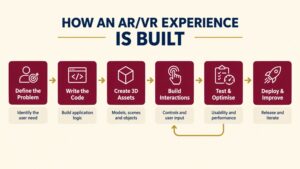
Potential topics include:
Programming and software development: Languages such as C#, C++, Python or JavaScript may be useful depending on the platform, project and role. The most relevant language is the one required by the tools you intend to use.
Computer graphics and 3D modelling: Learners may explore coordinate systems, 3D objects, materials, lighting, animation and the process of rendering digital scenes.
Human-computer interaction: This area considers how people interact with digital systems. In immersive applications, the placement of controls, movement, comfort and feedback can strongly influence the user experience.
Game engines and real-time development: Tools such as Unity or Unreal Engine are used for many interactive 3D applications. Their relevance depends on the project and the platform.
Spatial tracking and interaction: AR/VR applications may rely on tracking movement, identifying surfaces, responding to gestures or positioning digital objects in a scene.
Testing and optimisation: Immersive applications need to respond smoothly and reliably. Developers may need to test usability, frame performance, device compatibility and interaction behaviour.
Project work: A useful curriculum should give students opportunities to apply their knowledge through assignments, demonstrations, practical exercises or a final project.
These are examples of relevant subjects, not a guaranteed curriculum for every MCA. Review the actual syllabus, practical requirements and project structure before choosing a course.
Who Should Consider an MCA in AR and VR?
An AR/VR-focused learning path may suit students who enjoy both technology and creative problem-solving. It can be particularly interesting for people who want to develop interactive applications rather than work only with conventional websites or business software.
You may want to explore this area if you:
- I enjoy programming and want to apply it to interactive 3D experiences.
- Are interested in gaming, simulations, digital visualisation or immersive learning.
- Like solving problems that combine software, graphics and user experience.
- I want to learn how applications respond to movement, spatial information or user interaction.
- Are willing to build projects and keep learning as tools and platforms evolve.
A background in computer applications, computer science, information technology or a related field can help. However, the suitability of your academic background depends on the admission rules of the programme you select.
AR/VR development is not purely about visual design. It may require debugging, mathematics, logical reasoning, software testing and careful performance optimization. Students who prefer the field should be ready to develop both technical fundamentals and practical experience.
What Are the Eligibility Requirements?
There is no single eligibility rule that applies to every MCA programme. Requirements vary by university, admission policy, previous qualification and the programme’s academic structure.
Commonly, applicants need a recognised bachelor’s degree. Some institutions may specify a BCA, computer science, IT or related qualification, while others may accept graduates from a wider range of disciplines subject to their conditions.
Mathematics requirements can also differ. Some universities expect mathematics at the 10+2 or undergraduate level, while others may have different criteria or additional conditions. Do not rely on a general online article as confirmation that you qualify.
Before applying, verify:
- The accepted undergraduate qualifications.
- Any minimum marks or grade requirements.
- Whether mathematics or specific subjects are compulsory.
- Whether entrance tests or other admission steps apply.
- Whether the course is offered online, in distance mode, in a hybrid format or on campus.
- Whether practical sessions, campus visits or scheduled examinations are required.
Applicants who are changing careers should pay particular attention to subject prerequisites. If you have a non-computing degree, you may need to build programming and mathematics foundations before taking on advanced immersive-development projects.
“Students interested in emerging technology careers can also explore our guide to AI Automation Engineer careers to understand the skills, qualifications, and practical experience needed to pursue opportunities in artificial intelligence and automation.”
Which Skills Are Important for AR and VR Careers?
A postgraduate qualification can provide structure, but practical ability matters when applying for development roles. Students should aim to build a combination of programming knowledge, 3D development skills, problem-solving ability and project experience.
Programming: Learn variables, functions, object-oriented programming, data structures, debugging and basic software design. Choose a language based on the tools and roles you want to pursue.
3D fundamentals: Understand coordinates, transformations, lighting, materials, cameras and scene organisation. These concepts help you understand how digital environments are created and displayed.
Interactive development: Learn to connect user input to application behaviour. This may involve controls, object manipulation, navigation, event handling and feedback.
User experience: An application should be usable, not simply visually impressive. Think about clarity, comfort, accessibility, navigation and the amount of information presented to the user.
Testing and optimisation: Test applications on appropriate devices and identify issues such as lag, tracking errors, confusing controls or excessive resource use.
Collaboration: Immersive projects may involve developers, designers, 3D artists, testers and subject-matter experts. Clear communication and version control help teams work effectively.
| Skill area | What to learn | Example practice task |
| Programming | Core syntax, logic, functions and debugging | Build a small interactive application |
| 3D development | Objects, lighting, materials and scene setup | Create a simple 3D room or product model |
| AR/VR interaction | Input, movement, object placement and controls | Develop an interactive scene with basic controls |
| User experience | Navigation, feedback and usability | Ask users to test a prototype and record issues |
| Testing and optimisation | Performance, compatibility and error handling | Identify and fix problems in a small project |
| Portfolio development | Documentation, screenshots and demonstrations | Publish a project with a clear explanation of your contribution |
You do not have to master all these areas before starting. Begin with programming and one small project, then gradually add 3D concepts and interactive features.
Can You Learn AR and VR Through Online or Distance Education?
Online and distance learning can help students balance education with employment or other commitments. However, the learning mode alone does not guarantee that a course will provide the practical experience required for AR/VR development.
When comparing MCA distance education in bangalore options, check whether the curriculum includes relevant programming subjects, project work and access to appropriate learning resources. If the programme is a general MCA, you may need to supplement it with separate courses, tutorials and portfolio projects focused on immersive technology.
Ask the institution the following questions:
- Does the syllabus specifically include AR, VR, game development, computer graphics or related subjects?
- Are practical assignments and project work included?
- Are there requirements to attend laboratories, workshops, examinations or campus sessions?
- Which software and hardware are needed, and who is responsible for providing them?
- Is the programme delivered by a recognised awarding university, and what is the exact mode of study?
- Can students access academic guidance when they encounter technical problems?
The Ministry of Education’s National Education Policy 2020 provides broader policy context for technology, skills and education in India. It should not be treated as confirmation that a particular AR/VR programme is recognised or available in a specific mode.
A flexible programme can be useful, but students should plan for independent practice. If a course does not include immersive-development projects, build that experience separately instead of assuming that the degree title alone will demonstrate AR/VR proficiency.
What Career Opportunities Are Available After Learning AR and VR?
Career opportunities depend on your technical ability, portfolio, work experience and the requirements of individual employers. Completing an MCA does not automatically qualify someone for a specialist role; employers may expect demonstrable programming skills and familiarity with relevant tools.
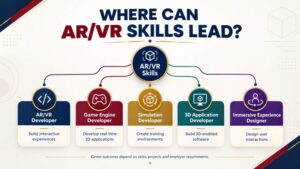
Possible career directions include:
AR/VR developer: Builds applications and interactive experiences for compatible devices and platforms. The role may involve programming, testing and integrating assets.
Unity or Unreal developer: Uses a game engine to create interactive environments, simulations, visualisations or games. The exact tools required depend on the employer and project.
3D application developer: Develops software that uses 3D environments, models or visualisation features. This role may overlap with simulation and product visualisation.
Immersive experience designer: Focuses on the way people interact with an immersive application. Depending on the role, this may involve prototyping, interaction design and usability testing, alongside technical collaboration.
Simulation developer: Creates simulated environments for training, demonstrations or operational practice. The subject matter may come from manufacturing, education, construction or other industries.
Software developer with immersive-technology skills: Works in a broader software role while contributing to projects that include 3D visualisation, spatial interaction or immersive interfaces.
Technical artist or 3D pipeline specialist: Works between visual assets and development tools, helping assets function correctly in interactive applications. This path may require stronger modelling, animation or graphics skills.
| Career direction | Typical work | Useful evidence of ability |
| AR/VR developer | Develops immersive applications and interactions | A working AR/VR prototype with documented features |
| Game-engine developer | Builds interactive 3D scenes and application logic | A project demonstrating scripting and scene development |
| Simulation developer | Creates simulated environments for training or visualisation | A scenario-based simulation with clear user controls |
| Immersive experience designer | Designs and tests user interactions | A prototype, user-flow explanation and usability findings |
| 3D application developer | Integrates 3D assets into software experiences | A demonstrable 3D application with organised code |
| Software developer | Builds and maintains software, potentially including immersive features | A strong programming portfolio and evidence of software fundamentals |
AR/VR skills can be applied across different industries, but demand varies by location, employer and project. Students should examine real job descriptions to understand the technologies, experience and portfolio evidence requested for their target roles.
How Is AR/VR Being Used in India?
Immersive technology is relevant beyond gaming. Organisations can use AR and VR to communicate complex information, practise tasks in controlled environments, visualise products and support interactive learning.
Examples include:
- Education and training: Virtual environments can help learners explore scenarios or practise procedures.
- Architecture and construction: 3D visualisation can support design reviews and spatial understanding.
- Manufacturing: Simulations can be used to demonstrate workflows or support training.
- Retail and product visualisation: AR can help customers preview selected products in their surroundings.
- Entertainment and media: Interactive environments can support games and other immersive experiences.
- Research and development: Immersive tools can support prototypes, demonstrations and experimentation.
India’s technology ecosystem includes public-sector initiatives relating to emerging technologies. The Government of India’s Digital India page on the Centre of Excellence on Virtual and Augmented Reality at IIT Bhubaneswar describes research and innovation in areas such as education, healthcare-related applications, product development and entertainment.
The Ministry of Electronics and Information Technology’s AI and Emerging Technologies Group also identifies AR/VR among emerging technology areas supported through policy and strategy work.
These resources show that AR/VR is an area of technology interest; they do not guarantee a particular number of jobs or employment outcomes for graduates. For career planning, combine industry awareness with current job listings, practical skill development and realistic portfolio goals.
How Can You Practise AR and VR Before Choosing a Course?
You can start exploring immersive development before committing to a specialisation. A small, completed project can help you decide whether you enjoy the combination of programming, visual design and interactive problem-solving.
Try the following progression:
Step 1: Learn programming basics. Practice variables, loops, functions, classes and debugging. Write small programs before moving to more complex environments.
Step 2: Explore 3D concepts. Learn about coordinates, objects, cameras, lighting and materials. You can begin with a simple scene rather than a full virtual world.
Step 3: Choose one development tool. Select a platform or engine that matches your interests and the type of project you want to build. Follow its official learning materials and check its hardware requirements.
Step 4: Create a small prototype. For example, build a 3D room with interactive objects, a simple product viewer or a basic learning environment.
Step 5: Test and improve it. Ask another person to try the prototype. Observe whether they can understand the controls, complete the task and use the application comfortably.
Step 6: Document your work. Explain the problem you wanted to solve, the tools you used, what you built, the challenges you faced and how you improved the result.
Keep the first project small enough to finish. A functional prototype with a clear explanation is often more useful for learning than an ambitious project that remains incomplete.
How Can You Build a Portfolio for AR/VR-Related Roles?
A portfolio helps employers or collaborators understand what you can do. It should show more than screenshots: include enough detail to explain your technical contribution and the decisions behind the project.
Useful portfolio projects might include:
- A simple AR-style product preview or object-placement demonstration.
- A small interactive 3D environment.
- A simulation that walks users through a task.
- A prototype that uses clear controls and provides feedback.
- An improvement to an existing project, with a description of the original problem and your solution.
For each project, include the objective, your role, tools and languages used, core features, important technical decisions and known limitations. Add screenshots or a short video when they help demonstrate the application. If the project is hosted publicly, include a repository or demonstration link where appropriate and ensure you have permission to share all assets.
Do not present tutorial work as an original creation without acknowledging the source. If you followed a tutorial, explain what you changed or added. Employers may ask questions about the code or design, so your portfolio should reflect work you genuinely understand.
You can also develop general software projects alongside AR/VR work. Strong programming fundamentals, version control, testing and clear documentation can support a wider range of IT roles.
How Should You Choose the Right MCA Programme?
The right programme depends on your academic background, career goals, budget, available time and preferred learning mode. Avoid selecting a course solely because its title mentions a technology you find interesting.
Use this checklist before making a decision:
- Check the awarding university. Confirm which institution will award the qualification and review its official programme information.
- Verify recognition and programme status. Check the current recognition or approval requirements applicable to the institution, programme and mode of delivery.
- Read the syllabus. Look for programming, software development, graphics, interactive applications and project work relevant to your goal.
- Understand the learning mode. Confirm whether the programme is online, distance, hybrid or campus-based. Do not assume that every mode is available for every course.
- Review practical requirements. Ask about labs, workshops, software, hardware, project supervision and any compulsory attendance.
- Check admission conditions. Verify eligibility, minimum marks, subject requirements, documents and deadlines directly with the institution.
- Calculate the full cost. Consider tuition, examination charges, study materials, software, equipment and travel if applicable.
- Review student support. Understand how you will receive academic guidance, resolve administrative issues and obtain information about examinations.
- Compare career relevance. Match the curriculum against job descriptions for the roles you are targeting.
Students comparing MCA distance education in bangalore programmes should apply these checks consistently across institutions. The same approach is useful when reviewing an IT correspondence college in bangalore or comparing distance education colleges in Bangalore. Focus on verifiable programme details, not just promotional claims.
If a programme does not offer an AR/VR specialisation, it may still teach relevant computing foundations. You would need to confirm that the curriculum meets your needs and plan additional specialist learning where necessary.
Exploring Relevant IT Education Options with United Correspondence College
Students interested in immersive technology may first want to strengthen their foundations in computer applications, programming and software development. An MCA can be one route to advanced computing knowledge, while independent projects and focused technical training can help develop skills for particular areas such as AR and VR.
United Correspondence College provides information about its MCA offering on its MCA programme. The page describes a general MCA and lists areas including computer applications, software development, data science, artificial intelligence, cybersecurity and cloud computing. It does not currently list a dedicated AR/VR specialisation.
For that reason, students specifically seeking an AR/VR qualification should confirm the current curriculum and availability directly before making an application. Do not assume that a general MCA includes specialist AR/VR modules or practical equipment.
You can also explore the United Correspondence College to review its broader course information. When comparing IT distance education options, check the awarding university, exact programme name, learning mode, eligibility, syllabus and practical requirements.
If you are comparing correspondence colleges in Bangalore or looking for a correspondence college in India, use the same verification process for every institution. Ask for written confirmation of the details that matter to you, particularly if your career goal requires specific technical subjects or hands-on training.
To discuss your academic background and available programme options, contact United Correspondence College. Make your decision after confirming that the course matches your educational needs and career plan.
Is an MCA in AR and VR the Right Choice for You?
An MCA with relevant AR/VR content may be worth considering if you enjoy software development and want to create interactive digital experiences. It can provide a structured route to advanced computing study, but the value of the specialisation depends on the quality of the curriculum and how much practical work you complete.
Before choosing, ask yourself three questions:
- Do I enjoy programming and problem-solving enough to work through technical challenges?
- Does the programme include the subjects and practical projects relevant to the role I want?
- Am I prepared to continue learning tools and techniques beyond my formal coursework?
If you are unsure, start with a small 3D or interactive application before committing to a specialist learning path. This can help you understand the work involved and identify which skills you want to develop.
Remember that a general MCA, an AR/VR specialisation and a separate AR/VR certificate are not interchangeable. Compare their curricula and outcomes carefully, and choose the route that best matches your current qualification and long-term goals.
Frequently Asked Questions
1. What is an MCA in AR and VR?
It is a description for an MCA programme that combines computer applications and software development with subjects related to augmented reality and virtual reality. The actual subjects vary by institution, so check the official syllabus before enrolling.
2. Is AR/VR a good career option after MCA?
It can be a suitable direction for graduates who enjoy programming, interactive applications and 3D development. Career opportunities depend on practical skills, portfolio quality, experience and employer requirements.
3. What programming languages are useful for AR and VR?
The best language depends on the tools and platform. C# is commonly associated with Unity development, while C++ is used in many Unreal Engine and performance-focused contexts. JavaScript and other languages may be useful for web-based or platform-specific experiences.
4. Can I study AR and VR through distance education?
You may be able to study relevant computing foundations through a distance or online programme, but not every MCA includes AR/VR subjects. Confirm the syllabus, practical sessions, equipment needs and learning mode before enrolling.
5. Is an MCA in AR and VR suitable for students without a BCA?
It depends on the university’s eligibility rules. Some programmes accept graduates from related disciplines or other backgrounds subject to specific conditions. Verify the admission criteria and any mathematics or computing prerequisites.
6. What projects can beginners build to learn AR/VR?
Beginners can create a simple 3D room, an interactive product viewer, a basic object-placement prototype or a guided simulation. Start with a manageable project, test it and document what you learned.
7. Does United Correspondence College offer a dedicated MCA in AR and VR?
The United Correspondence College MCA page currently lists general computing-related areas but does not list a dedicated AR/VR specialisation. Contact the college to confirm any updated programme options before applying.
8. How should I compare MCA distance education options in Bangalore?
Compare the awarding university, current recognition and programme status, eligibility, syllabus, learning mode, practical requirements, total cost and student support. If you specifically want AR/VR development, verify that the programme includes relevant subjects or plan additional practical training.
Conclusion
AR and VR offer interesting ways to combine software development, 3D environments and interactive experiences. Students who want to explore this field should build a strong computing foundation, learn relevant tools, complete practical projects and develop a portfolio that demonstrates their abilities.
An MCA may provide a useful postgraduate pathway, but the course title alone is not enough to establish that it covers AR/VR. Review the syllabus, confirm the programme’s status and learning mode, and ask about practical training before enrolling.
If you are comparing MCA distance education in bangalore, choose a programme that fits your academic background and broader computing goals. Then supplement your formal study with focused AR/VR learning and projects so you can demonstrate the skills relevant to your intended career.