
Choosing a degree after Class 12 can feel like a major decision, especially when you enjoy science but are unsure which subject to pursue. A B.Sc can open different academic and professional directions, from computer science and biotechnology to mathematics, chemistry and environmental studies. Students exploring a Science distance degree in Bangalore may also want to understand flexible learning options before making a decision. The right choice depends on your interests, strengths, eligibility and the kind of work you hope to do in the future.
A science degree is not limited to students who dream of becoming researchers. It can help build a foundation for careers in technology, laboratories, education, analytics, research and several other sectors. The important thing is to understand what each specialisation involves before selecting one.
First, Understand What a B.Sc Degree Actually Offers
A Bachelor of Science, commonly known as B.Sc, is an undergraduate degree focused on scientific subjects and their applications. Depending on the programme, students may study areas such as physics, chemistry, mathematics, biology, computer science, statistics or biotechnology.
Unlike a course that focuses only on theoretical knowledge, many science programmes combine classroom learning with practical activities. These may include laboratory sessions, experiments, assignments, projects, fieldwork and research-based learning. The exact structure depends on the subject, university and programme.
For example, a student studying chemistry may learn about chemical reactions, laboratory techniques and the properties of different substances. A computer science student may explore programming, databases and computing concepts. Someone studying mathematics may develop the ability to work with equations, patterns, logical problems and quantitative methods.
A B.Sc degree can therefore offer more than subject knowledge. It can help students develop a scientific approach to everyday problems: observing a situation, asking questions, examining evidence and reaching a reasoned conclusion.
It is also important to understand that completing a B.Sc does not automatically qualify someone for every profession connected with science. Some roles require postgraduate qualifications, professional registration, specialised training or practical experience. Students should consider these requirements while planning their education.
Which Science Subject Matches Your Interests?
Before looking at course names, think about the subjects and activities that naturally hold your attention. A specialisation is easier to pursue when you are genuinely interested in what you will study.
Consider these examples:
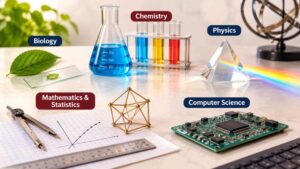
- Enjoy understanding living organisms? Biology-related subjects such as zoology, botany, microbiology and biotechnology may interest you.
- Interested in numbers and logical problems? Mathematics and statistics can suit students who enjoy calculations, patterns and structured reasoning.
- Curious about computers and technology? Computer science may be worth exploring if you like programming, software and digital systems.
- Like experiments and understanding materials? Physics and chemistry offer opportunities to study how the natural and physical world works.
- Concerned about nature and sustainability? Environmental science can help you explore ecosystems, pollution, conservation and environmental challenges.
You do not have to decide your entire career at this stage. Instead, identify the subjects you are willing to study in depth for several years. Also consider whether you prefer working with numbers, living organisms, computers, laboratory equipment or environmental issues.
A useful approach is to look at the syllabus of each programme. The course title may sound interesting, but the actual subjects will give you a clearer idea of what your academic experience will involve.
Popular B.Sc Specialisations After 12th: Explore Your Options
There are several B.Sc specialisations available to students after Class 12. Their availability and admission requirements vary between institutions, so it is important to check the individual programme details.
Here are some popular options to help you understand the differences.
B.Sc Physics
Physics explores matter, energy, motion, forces, electricity, magnetism and the principles that explain the physical world. Students interested in understanding how machines, devices and natural systems work may enjoy this subject.
The programme can build a foundation for further study in physics, applied physics, electronics and related scientific areas. Depending on additional qualifications and skills, graduates may explore laboratory support, technical roles, research assistance and education-related pathways.
B.Sc Chemistry
Chemistry focuses on substances, their composition, properties and the reactions through which they change. Students learn about topics such as organic chemistry, inorganic chemistry, physical chemistry and analytical methods, depending on the curriculum.
It may interest learners who enjoy laboratory work and understanding how materials behave. Further study can lead towards specialised areas such as analytical chemistry, industrial chemistry and other related disciplines.
B.Sc Mathematics
Mathematics develops numerical reasoning, logical thinking and the ability to solve complex problems. Students may study algebra, calculus, geometry, differential equations and other mathematical topics.
The subject can be useful for learners interested in teaching, research, quantitative analysis, finance-related work and further study in statistics or applied mathematics. Some professional roles may require additional technical or industry-specific skills.
B.Sc Biology
Biology is the study of living organisms and the systems that support life. Depending on the programme, students may explore cell biology, genetics, ecology, evolution and human or plant biology.
This specialisation can provide a foundation for further study in life sciences and related fields. Students interested in research, laboratory work, environmental studies and biological applications may find it suitable.
B.Sc Computer Science
Computer science focuses on computing systems, programming, software concepts, algorithms and data management. Students may learn programming languages, database fundamentals, operating systems and software development concepts.
It can be a suitable option for students interested in technology and digital problem-solving. Graduates may explore entry-level opportunities in software support, testing, technical operations and related areas, depending on their practical skills and experience.
B.Sc Biotechnology
Biotechnology combines biological knowledge with technological applications. It explores how living systems, cells and biological processes can be used in areas such as agriculture, healthcare, food production and research.
Students may study genetics, molecular biology, microbiology and laboratory methods. Those interested in life sciences and applied research may consider this specialisation.
B.Sc Microbiology
Microbiology is the study of microorganisms such as bacteria, fungi, viruses and other microscopic life forms. Students may learn about microbial growth, identification, laboratory techniques and the role of microorganisms in health, food and the environment.
Further study may support opportunities in specialised laboratory work, quality control and research-related areas. Some positions require additional qualifications and practical training.
B.Sc Zoology
Zoology focuses on animals, their structure, behaviour, classification, physiology and relationships with the environment. It may appeal to students who are interested in wildlife, animal biology and biodiversity.
Possible academic directions include ecology, wildlife science, animal physiology and related postgraduate programmes.
B.Sc Botany
Botany explores plant life, including plant structure, growth, reproduction, classification and interaction with the environment. It can be useful for students interested in agriculture-related research, plant science, biodiversity and environmental studies.
Further education may lead towards specialised work in plant biotechnology, ecology, horticulture or related areas.
B.Sc Statistics
Statistics deals with collecting, organising, analysing and interpreting data. Students learn mathematical and statistical methods that can help explain patterns and support decisions.
This subject can be relevant to analytics, research, business reporting and quantitative work. Learning statistical software and data tools can strengthen a graduate’s practical profile.
B.Sc Environmental Science
Environmental science examines the relationship between people, natural resources and ecosystems. Students may explore pollution, climate-related issues, conservation, environmental management and sustainability.
It can be a suitable choice for learners interested in environmental protection and sustainable development. Further study may support opportunities in environmental monitoring, research assistance and related fields.
B.Sc Psychology
Psychology studies human behaviour, thought processes, emotions and mental processes through scientific approaches. Programme structures and eligibility can differ between universities, so students should check whether the course is offered as a B.Sc and what subjects are included.
Further study is generally important for specialised psychology careers. Students should also check the professional qualifications required for any regulated role they wish to pursue.
Compare Popular B.Sc Specialisations
| Specialisation | Main area of learning | Suitable for students interested in |
| Physics | Matter, energy and physical systems | Experiments and scientific principles |
| Chemistry | Substances and chemical reactions | Laboratory work and materials |
| Mathematics | Mathematical concepts and problem-solving | Numbers and logical reasoning |
| Computer Science | Computing and programming | Technology and software |
| Biotechnology | Biological systems and technology | Life sciences and innovation |
| Microbiology | Microorganisms and their applications | Laboratory and biological sciences |
| Statistics | Data collection and interpretation | Numbers, patterns and analysis |
| Environmental Science | Ecosystems and sustainability | Nature and environmental issues |
The table is a starting point, not a ranking. The best specialisation is the one that matches your interests, academic preparation and future plans.
What Will You Actually Learn During a B.Sc?
A common question students ask is whether a science degree involves only textbooks and examinations. In reality, the learning experience can include different activities depending on the specialisation.
Core subject knowledge: Students study the principles and concepts that form the foundation of their chosen discipline. A mathematics programme, for example, may involve problem-solving and mathematical reasoning, while a biology programme may focus on living systems.
Practical learning: Laboratory sessions, experiments and demonstrations may form an important part of subjects such as chemistry, physics, microbiology and biotechnology. The nature and frequency of practical work depend on the programme.
Research and observation: Students may learn how to frame questions, collect information, observe results and interpret findings. These activities introduce them to scientific methods.
Projects and assignments: Subject-related projects can help learners apply what they have studied. A computer science student might develop a small application, while an environmental science student might examine a local environmental issue.
Data interpretation: Many science subjects involve understanding measurements, results, patterns and evidence. Students gradually learn how to draw conclusions from information rather than relying only on assumptions.
This combination of knowledge and application helps students understand how their subject connects with real situations. Before applying, review the curriculum and find out what practical, project or laboratory requirements are included.
Skills That Make a B.Sc Graduate Career-Ready
A degree provides subject knowledge, but students also need skills that help them apply that knowledge in academic and professional settings.
Analytical and Critical Thinking
Science often involves examining information, identifying patterns and evaluating possible explanations. These abilities can help graduates approach problems carefully instead of accepting the first answer they find.
Numerical and Logical Reasoning
Mathematics, statistics and several other science subjects develop the ability to work with numbers and structured information. These skills can be useful in research, analytics, finance-related work and technical roles.
Observation and Attention to Detail
Small details can influence scientific results. Students who learn to observe carefully and record information accurately develop habits that are valuable in laboratory, research and quality-related work.
Research and Problem-Solving
Research involves identifying a question, gathering relevant information, selecting an appropriate method and interpreting the outcome. These skills can be strengthened through projects, assignments and practical activities.
Technical and Digital Literacy
Digital tools are increasingly used across science-related fields. Depending on the specialisation, students may benefit from learning spreadsheets, statistical software, programming, laboratory instruments or subject-specific applications.
Communication and Teamwork
Being able to explain a result clearly is important. Students should practise writing reports, presenting findings, discussing ideas and working with others on academic tasks.
Time Management and Independent Learning
A degree requires consistent effort. Managing assignments, practical work, examinations and personal responsibilities can help students become more organised and independent.
Students can start developing these skills during their undergraduate years. Small projects, online learning, internships where available and practical exercises can help them connect classroom knowledge with real applications.
Are You Eligible? What to Check Before Applying
Eligibility is one of the most important things to confirm before selecting a B.Sc programme. Many undergraduate science courses require students to complete Class 12 or an equivalent qualification. However, the subjects required can differ significantly.
For example, a physics or mathematics programme may expect students to have studied the relevant subjects in Class 12. Biology-related programmes may require a biology background. Computer science programmes can have different subject combinations depending on the university.
Some institutions also specify minimum marks, entrance examinations or additional admission conditions. Do not assume that the requirements of one university will be the same as those of another.
B.Sc Eligibility: What Students Should Check
| Class 12 background | Possible study directions | Important point to check |
| Physics, Chemistry and Mathematics | Physics, Mathematics, Chemistry and selected Computer Science programmes | Required subject combinations and programme rules |
| Physics, Chemistry and Biology | Biology, Biotechnology, Microbiology and Zoology | Biology and other science subject requirements |
| Mathematics with other subjects | Mathematics, Statistics and selected computing programmes | Mathematics eligibility |
| Other subject combinations | Selected B.Sc programmes, depending on the institution | Individual university admission rules |
Students who have taken a break after school or are returning to education should also check whether their previous qualification meets the admission conditions. Working professionals considering an undergraduate science programme should review the same requirements rather than assuming that work experience replaces academic eligibility.
For a clear picture of science education and research pathways in India, students can explore the Department of Science and Technology’s INSPIRE programme. It provides information about initiatives designed to encourage young people to study basic and natural sciences and consider research careers.
What Can You Become After a B.Sc? Career Paths Beyond the Classroom
A B.Sc can lead towards different career directions, but the opportunities depend on the specialisation, practical skills, experience and further qualifications. Some graduates begin with entry-level roles, while others continue studying before entering a specialised profession.
Instead of thinking only about job titles, it helps to understand the industries and types of work connected with different science subjects.

Research and Laboratory Careers
Students from chemistry, biotechnology, microbiology, physics and biology backgrounds may explore laboratory-related opportunities. Possible entry-level roles include laboratory assistant, research assistant and quality control assistant.
The exact responsibilities depend on the employer and the nature of the laboratory. Some positions require practical experience, postgraduate education or specific technical training.
Technology and Computing Careers
Computer science graduates can explore entry-level roles in software support, application testing, technical operations and IT services. Students who develop programming, database and problem-solving skills may strengthen their applications for technology-related positions.
A degree alone may not be enough for every software role. Employers may also look for project experience, knowledge of relevant tools and the ability to demonstrate practical skills.
Healthcare and Life Sciences
Biotechnology, microbiology and related science subjects can provide a foundation for further learning in life sciences. Graduates may explore support roles in laboratories, pharmaceutical operations, quality processes and related areas, subject to the employer’s qualification requirements.
Clinical and regulated healthcare professions generally require specific professional qualifications. A general B.Sc should not be treated as a substitute for those requirements.
Environment and Sustainability
Environmental science and related subjects can lead towards opportunities connected with environmental monitoring, sustainability support, field research and conservation-related projects.
Some roles may involve collecting field information, preparing reports, supporting assessments or working with organisations involved in environmental management. Specialised positions may require postgraduate qualifications.
Business and Analytics
Students with mathematics, statistics or computer science backgrounds may consider data-related and analytical work. Entry-level directions can include reporting assistant, statistical assistant, data analyst trainee or business operations analyst, depending on the candidate’s technical abilities.
Learning tools such as spreadsheets, statistical software, SQL or programming languages can be useful for students interested in this area.
Education and Academic Support
Graduates who enjoy explaining scientific concepts may consider education-related pathways. However, teaching positions often have specific qualification and eligibility requirements. Students interested in school or college teaching should check the relevant rules and consider the postgraduate or professional qualifications required.
B.Sc Specialisation and Possible Career Directions
| B.Sc specialisation | Potential career directions | Further learning that may help |
| Computer Science | Software support, testing and IT operations | Programming and software development |
| Mathematics | Quantitative support and analytical roles | Applied mathematics and analytics |
| Statistics | Data analysis and statistical support | Data tools and statistical software |
| Biotechnology | Life sciences and laboratory support | Advanced biotechnology |
| Microbiology | Quality control and laboratory roles | Microbiology and specialised laboratory training |
| Chemistry | Quality testing and chemical industries | Analytical chemistry |
| Environmental Science | Environmental monitoring and sustainability | Environmental management |
These are possible directions rather than guaranteed job outcomes. Before choosing a career, review job descriptions and identify the qualifications, tools and experience employers expect.
Students can also use the Government of India’s National Career Service portal to explore career information, job opportunities, vocational guidance and skill-development resources. It can be a useful starting point when researching different occupations and planning the next step after graduation.
What Salary Can You Expect After a B.Sc?
Salary is one of the factors students consider while choosing a degree. However, there is no single salary that applies to every B.Sc graduate. Earnings can differ according to the specialisation, employer, location, experience, practical knowledge and additional qualifications.
A graduate entering a laboratory support role may have a different starting salary from someone entering an IT-related position. Similarly, a student with strong programming or analytical skills may apply for opportunities that require a different skill set from those expected in a traditional laboratory role.
It is useful to think about salary in stages.
At the entry level: Fresh graduates may begin with trainee, assistant, junior or support positions. These roles help them understand workplace processes and gain practical experience.
After gaining experience: Professionals may take on more responsibility, specialise in a particular area or move into roles that require stronger technical knowledge.
After higher education: A postgraduate degree or professional qualification may make certain specialised roles accessible. However, the value of further study depends on the career direction and the requirements of the field.
To research salary expectations, compare current job advertisements for the specific role you want. Look at the required qualification, experience, location and technical skills. This will give you a more realistic picture than relying on a general salary figure for all science graduates.
Is a B.Sc Enough, or Should You Study Further?
Completing an undergraduate degree is an important milestone, but it does not have to be the end of your academic journey. Many students continue with higher education to specialise in a subject or prepare for a particular career.
M.Sc in a Related Specialisation
An M.Sc can help students develop deeper knowledge in areas such as physics, chemistry, mathematics, biotechnology, microbiology, computer science or environmental science. It may be useful for learners interested in research, specialised technical work or academic careers.
MCA for Eligible Students
Students with a suitable academic background may consider a Master of Computer Applications if they want to build a career in computing and software-related areas. Admission requirements vary, so students should check the mathematics and other eligibility conditions.
MBA for Management-Oriented Careers
Some B.Sc graduates may consider an MBA if they want to move towards management, business operations, analytics management or related professional areas. The value of this route depends on the student’s interests and career objectives.
Research-Oriented Programmes
Students who enjoy scientific investigation may explore postgraduate research pathways. Research careers can require advanced qualifications and may involve specialised training, project work and academic experience.
Certifications and Skill-Based Learning
Short courses can help graduates develop additional skills in areas such as programming, data analysis, laboratory techniques, quality processes or digital tools. These courses can complement a degree, although they do not replace formal qualifications where those are required.
The right next step depends on what you want to do. A student interested in research may need a different academic plan from someone who wants to enter an IT support role or explore business management.
What If You Cannot Follow a Traditional College Schedule?
Not every learner can follow the same education route. Some students have family responsibilities, some need to work while studying, and others return to education after a gap. For these learners, understanding the available learning modes is an important part of course selection.
A student researching a Science distance degree in Bangalore should first identify the exact subject and programme they want to study. They should then check whether that particular programme is available through an approved distance or online mode and whether its practical requirements can be completed appropriately.
Science programmes need special attention because many subjects involve laboratory sessions, experiments, fieldwork or practical assessments. A programme that is suitable for flexible learning in one subject may not be suitable in the same way for another. Students must verify the mode of delivery and practical arrangements directly with the institution.
Learners researching a B.Sc correspondence college in Karnataka should compare the programme details rather than choosing an institution based only on its location or advertising. They should check the awarding university, programme recognition or approval where applicable, course structure, examination arrangements and support facilities.
Those looking into Science distance education in Bangalore can also compare the flexibility of the learning schedule with their personal responsibilities. Working professionals may need to understand how assignments, examinations and practical requirements fit around their jobs.
Online learning resources can supplement formal education as well. The Government of India’s SWAYAM platform offers courses across subject areas, including science and mathematics. Students can explore relevant courses to support their learning, while remembering that a standalone online course is not automatically equivalent to an undergraduate degree.
How to Choose the Right B.Sc Programme Without Regretting Your Decision
With several specialisations and institutions to consider, making a decision can feel confusing. A simple comparison process can help you shortlist programmes without relying only on popularity or advertisements.
Start With Your Favourite Subjects
Think about the subjects you enjoyed in school and the topics you would like to explore further. If you enjoy experiments, laboratory-based subjects may interest you. If you prefer logical problems, mathematics or computer science may be worth investigating.
Read the Syllabus
Do not choose a course based only on its name. Review the subjects covered in each semester, practical components, project requirements and available electives. This will help you understand what you will actually study.
Confirm Eligibility
Check the institution’s official admission information. Verify the required Class 12 subjects, minimum marks, entrance examinations and any other conditions.
Understand the Learning Mode
If you are considering a flexible route, confirm whether the programme is offered in the mode you need. Ask about practical sessions, examinations, attendance requirements and academic support.
Verify the Institution and Programme
Check the institution’s official information and verify the programme’s recognition or approval status through the appropriate official sources. Do not rely only on promotional statements or third-party advertisements.
Compare Fees and Other Costs
Look beyond the headline tuition fee. Check examination charges, practical fees, learning materials and other costs that may apply. Make sure you understand the payment schedule before enrolling.
Consider Future Study Options
If you plan to pursue an M.Sc or another postgraduate programme, check the eligibility requirements for that next step. A course that interests you today should also fit your longer-term academic plans.
Compare Institutions Carefully
Students searching for distance education colleges in Bangalore should compare the exact programme, awarding institution, learning mode and support arrangements. Similarly, those exploring correspondence colleges in Bangalore should verify whether the course they want is actually available through the advertised mode.
If you are comparing a correspondence college in India beyond your city, use the same checklist. A convenient location or flexible schedule should not replace careful verification of programme quality and eligibility.
Common Mistakes Students Should Avoid While Choosing a B.Sc
A little research before admission can prevent confusion later. Students should watch out for these common mistakes.
- Choosing a course only because friends selected it: Your interests and strengths may be different. Select a specialisation that you can see yourself studying seriously.
- Selecting a subject based only on salary expectations: Earnings vary by role, experience and skills. Understand the actual work involved before making a decision.
- Ignoring Class 12 subject requirements: A course may have specific subject prerequisites. Confirm eligibility before applying.
- Not checking the syllabus: The course title does not explain everything. Review the actual subjects and practical components.
- Overlooking laboratory requirements: Science programmes may involve practical sessions or assessments. Understand how these are conducted, especially if you need a flexible learning mode.
- Assuming every B.Sc leads to the same career: Different specialisations develop different knowledge and skills. Career options are not interchangeable.
- Not considering higher education plans: If a particular postgraduate course is your goal, check its admission conditions before choosing your undergraduate programme.
- Failing to verify institutional details: Confirm the awarding university, programme status, admission conditions and examination arrangements using official information.
The goal is not to find a course that promises everything. It is to choose a programme whose academic structure and future possibilities make sense for you.
Conclusion: Choose a Science Degree That Takes You Somewhere
Choosing a B.Sc after Class 12 is an opportunity to build a foundation in a subject that genuinely interests you. Whether you are drawn to mathematics, computer science, biotechnology, physics, chemistry or environmental science, each specialisation offers a different way to understand the world and develop useful knowledge.
Do not make your decision based only on course popularity or salary expectations. Consider your academic strengths, the subjects you enjoy, the practical learning involved and the qualifications needed for your preferred career. If you are returning to education or balancing work with studies, examine the available learning modes carefully and verify the programme details before applying.
Students exploring a Science distance degree in Bangalore should give particular attention to programme availability, eligibility, practical requirements and the institution’s official status. A well-informed decision can help you choose a learning path that fits both your present circumstances and future ambitions.
United Correspondence College encourages learners to explore their education options carefully and understand the programme requirements before making an academic decision. Whether you are planning your first degree or considering a return to education, take time to compare suitable learning pathways.
“Students interested in computer science can also explore our guide on BCA vs B.Sc Computer Science: Which Degree Should You Choose? to understand the key differences, career opportunities and course options.”
Frequently Asked Questions About B.Sc After 12th
1. Which B.Sc course is best after 12th?
There is no single best B.Sc course for every student. Computer science may suit someone interested in technology, while biotechnology may appeal to a learner interested in life sciences. Mathematics, physics, chemistry, statistics and environmental science offer different academic directions. Choose according to your interests, eligibility and career plans.
2. Can I pursue B.Sc after 12th Commerce or Arts?
Some B.Sc programmes may accept students from different Class 12 backgrounds, but many science specialisations have specific subject requirements. Eligibility varies by university and course. Check the official admission criteria before applying.
3. Which B.Sc specialisation has good career opportunities?
Computer science, statistics, biotechnology, microbiology, mathematics and environmental science can lead to different career directions. Opportunities depend on industry demand, practical skills, experience and further qualifications. Research the job roles connected with the subject you are considering.
4. Is B.Sc better than B.Tech?
B.Sc and B.Tech serve different academic purposes. A B.Sc generally focuses on scientific concepts and subject knowledge, while B.Tech is an engineering degree with a stronger focus on engineering design and applications. The suitable choice depends on your interests and career goals.
5. Can I get a job immediately after completing B.Sc?
Yes, some graduates may apply for entry-level positions after completing their degree. However, the roles available depend on the specialisation, practical knowledge and employer requirements. Certain technical, research and professional positions may require postgraduate education or additional training.
6. Is Mathematics compulsory for B.Sc Computer Science?
The requirement depends on the university and programme. Some institutions specify Mathematics in Class 12, while admission conditions can vary. Always check the eligibility criteria of the exact course you want to apply for.
7. Can I pursue B.Sc through distance education?
Some science-related programmes may be available through distance or online learning, but availability depends on the subject and institution. Practical and laboratory requirements are particularly important. Confirm the programme’s approved mode, practical arrangements and recognition status before enrolling.
8. What can I study after completing B.Sc?
Students can consider an M.Sc in a related subject, MCA if eligible, MBA, research-oriented programmes or skill-based certifications. The right option depends on the career direction they want to follow.
9. Is B.Sc a good option for students interested in research?
A B.Sc can provide a foundation for scientific study and research. Students interested in research often continue with postgraduate education and may later pursue doctoral study or specialised research training.
10. How do I choose the right B.Sc specialisation?
Start by identifying the subjects you enjoy, then review the syllabus, eligibility requirements, practical components and career directions. Compare programmes from reliable institutions and consider whether you may want to pursue higher studies later.
Ready to explore your next academic step? Visit UCC to learn more about available education options, or contact us for further guidance on your learning plans. United Correspondence College is a starting point for learners who want to make informed decisions about continuing their education.