Choosing an undergraduate course after Class 12 can be challenging, particularly if you want to enter the IT sector but cannot attend a college campus every day. A distance BCA programme may be worth exploring if you want to study computer applications while managing work, family responsibilities or other commitments.
BCA distance education allows eligible students to pursue a Bachelor of Computer Applications through an approved distance-learning arrangement. However, course availability, eligibility, fees, assessment methods and recognition can differ between universities.
This guide explains what students should check before applying, how to compare the total cost, what subjects they may study, and which career or postgraduate pathways they can consider after graduation.
What Is a Distance BCA Course?
BCA stands for Bachelor of Computer Applications. It is an undergraduate degree focused on computer applications, programming concepts and the technologies used to develop, manage and support software systems.
Depending on the university’s curriculum, students may study programming, databases, computer networks, operating systems, web technologies and software development. Some programmes also include practical exercises, projects or specialised electives.
A distance BCA follows an open and distance learning model. Students may receive printed or digital study materials, use an online learning platform, complete assignments and attend examinations according to the university’s rules. The exact arrangement depends on the programme.
Students often explore this mode because they live far from a suitable campus, need to manage employment, or want to avoid daily travel. However, distance learning still requires consistent study and practical work. It should not be confused with receiving a degree without completing academic requirements.
Before comparing colleges, understand the regulatory framework and the programme-specific rules. The University Grants Commission’s official guidance on distance education explains how learners can check recognition information and why the relevant admission session matters.
Who Should Consider Distance BCA?
A distance BCA may suit different types of learners, provided they meet the chosen programme’s eligibility requirements.
- Class 12 graduates: Students interested in computer applications who want an undergraduate qualification.
- Learners with limited campus access: Students who live far from a suitable institution or have other commitments.
- Working professionals: Employees who want to develop their computing knowledge while continuing to work.
- Career changers: People considering a transition into entry-level IT roles who need an appropriate academic foundation.
- Independent learners: Students comfortable with planning their study time, completing assignments and practising technical concepts on their own.
The format may be less suitable for someone who depends heavily on daily classroom interaction or needs frequent in-person assistance. Programming also involves practice: reading a chapter about coding is not the same as writing, testing and correcting a working program.
Students should assess their time, access to a computer, internet requirements and preferred learning style before choosing a course.
Eligibility Criteria for Distance BCA in India
There is no single admission rule that should be assumed to apply to every BCA programme. Many institutions require a recognised Class 12 or equivalent qualification, but the accepted subjects, minimum marks and other conditions depend on the university.
Check whether the programme accepts your qualifying board, whether it requires mathematics or another subject, and whether any minimum aggregate or category-specific rule applies. If you completed a diploma or an alternative qualification, ask whether it is accepted for the particular entry route.
Do not rely only on a general statement such as “any stream can apply.” The official programme rules should confirm whether your educational background is acceptable.
Distance BCA eligibility and admission checklist
| Requirement | What the student should check | Where to verify it |
| Class 12 or equivalent | Accepted qualification and board | Official programme eligibility page |
| Subject requirements | Whether mathematics or another subject is compulsory | Current admission prospectus |
| Minimum marks | Aggregate, subject-wise marks and any applicable relaxation | Published eligibility rules |
| Documents | Marksheets, identity proof and any required certificates | Official application instructions |
| Admission conditions | Entry route, deadlines and verification process | Current admission notice |
| Programme recognition | Exact university, programme, mode and session | UGC/DEB records and university documentation |
Use this checklist before paying an application or registration fee. If a website gives conflicting information, request written clarification from the institution or its authorised admission office.
Can Students From Any Stream Apply for BCA?
Students from science, commerce and arts backgrounds may find BCA options, but acceptance depends on the programme’s rules. Some institutions accept students from multiple streams, while others specify subject or academic conditions.
Mathematics is not a requirement that can safely be described as universally compulsory or universally optional across every BCA programme. The same applies to minimum marks and alternative qualifications.
If you studied commerce or arts without mathematics, search for programmes whose current eligibility rules explicitly match your subjects. If you studied science, do not assume that your stream automatically satisfies every other admission condition.
There is also a practical consideration: even where mathematics is not an entry requirement, logical reasoning, basic quantitative understanding and comfort with problem-solving can help during computing studies.
Distance BCA Course Fees in India
The cost of a distance BCA varies by institution, programme structure and the charges included in the advertised price. A headline tuition figure may not represent the full amount payable until graduation.
When comparing fees, ask for a complete schedule covering the normal duration of the course. Check whether the quoted amount covers all semesters or only the first payment period, and whether examination fees, registration charges or practical components are billed separately.
Distance BCA fees and cost comparison
| Fee component | What it may cover | Questions to ask before paying |
| Tuition | Academic instruction and programme enrolment | Is the amount for one semester, one year or the full course? |
| Registration or admission | Initial application and enrolment processing | Is it refundable if admission is not completed? |
| Examination fees | End-term or other required assessments | Are these included in tuition or paid separately? |
| Practical or laboratory charges | Required practical sessions or facilities | Are any additional sessions or assessments chargeable? |
| Learning resources | Study materials or platform access | Are printed materials, digital access or other resources extra? |
| Other compulsory charges | Applicable university or administrative costs | What is the full payable amount through completion? |
Do not compare two programmes using semester tuition alone. One may include examination costs while another may list them separately.
Ask for the current official fee schedule, the payment calendar, refund conditions and any rules for late payment or re-examination. Keep the written fee details for reference.
What Affects the Total Cost of a Distance BCA?
Several factors can explain why two programmes have different prices.
The awarding university and course structure: Institutions set their own fee schedules and may offer different curricula, learning resources and student services.
The learning and assessment arrangement: Practical sessions, examination centres, required visits or other activities can add costs beyond tuition. Ask which components require physical attendance and whether travel or accommodation could be necessary.
The payment schedule: Semester-based payment can spread the expense over time, but it does not necessarily mean the programme is cheaper overall.
Additional academic costs: Re-examinations, repeat courses, document processing or other charges may apply under specific rules.
Students comparing options for distance education in Bangalore should evaluate the total cost, learning arrangement and location requirements together. A lower advertised fee is not necessarily the most suitable choice if it leaves important academic needs unmet.
Admission Process for Distance BCA
Although the process varies, most applicants can use the following sequence to organise their admission research.
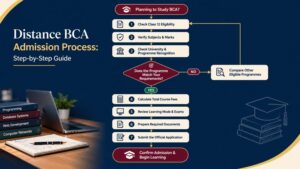
- Shortlist programmes. Identify courses that match your academic background, preferred learning mode and career plans.
- Verify eligibility. Compare your Class 12 subjects, marks and qualification with the current programme rules.
- Check recognition. Verify the institution and the exact programme for the relevant mode and admission session.
- Review the complete course details. Confirm duration, curriculum, practical work, examinations, fees and completion rules.
- Prepare your documents. Follow the official checklist rather than assuming every college requests identical paperwork.
- Submit the official application. Use the university’s authorised process or the institution’s verified admission channel.
- Pay the applicable fee. Confirm the amount, payment recipient, receipt and refund conditions.
- Monitor admission confirmation. Follow instructions for enrollment, study materials, student access and assessment schedules.
Do not treat an advertisement or an informal message as confirmation of admission. Verify the application route and keep copies of the documents and payment receipts you submit.
Admission dates and availability can change between sessions, so consult the current notice rather than relying on an older article.
Documents Required for Distance BCA Admission
The documents requested depend on the university and the applicant’s educational background. Common examples include:
- Class 10 marksheet or certificate, where requested.
- Class 12 marksheet and passing certificate, or accepted equivalent documents.
- Government-issued identity proof, if required.
- Recent photograph and signature in the specified format.
- Transfer, migration or other certificates, where applicable.
- Category or other supporting certificates if a particular benefit or admission route requires them.
These are typical examples, not a universal list. Some institutions may require additional documents or a different verification process.
Check the official application instructions for acceptable file formats, document clarity, name consistency and submission deadlines. If your name differs between documents, ask the institution how to resolve the discrepancy before completing enrolment.
How Long Does a Distance BCA Take?
The duration of a BCA depends on the specific programme and its applicable academic regulations. A three-year structure is common, but students should not assume that every programme has identical duration or completion rules.
Confirm the normal course duration, number of semesters or academic terms, examination schedule and the maximum period permitted to complete the qualification, where such an extension is allowed.
Also check whether a student who fails a subject must repeat an assessment, re-register for a course or pay an additional fee. These details can affect both the time and cost needed to graduate.
For working learners, a realistic estimate should include study hours, assignments, examination preparation and any practical requirements—not only the number of years printed on a course page.
What Subjects Are Covered in a Distance BCA?
A BCA generally introduces learners to the principles of computing and the use of software applications. The precise syllabus depends on the university, and subjects may be arranged differently across semesters.
Common subject areas may include:
- Programming fundamentals: Learning to express instructions using a programming language and understand variables, conditions, loops and functions.
- Data structures and algorithms: Understanding how information is organised and how computational problems can be solved efficiently.
- Database management: Learning how to store, retrieve and maintain structured data.
- Computer systems and operating systems: Exploring how computer resources and software environments work.
- Computer networks: Understanding communication between connected systems.
- Web development: Learning how websites and web applications are structured.
- Software engineering: Exploring requirements, design, testing and software maintenance.
- Project work and practical applications: Applying concepts to a defined problem or software task.
Some programmes may include subjects such as cloud computing, cybersecurity, data analytics or other electives. Do not assume these are part of every BCA curriculum.
Before enrolling, read the current syllabus and look beyond subject names. Check whether the course includes coding exercises, database assignments, projects and opportunities to practise the concepts being taught.
How Is Distance BCA Different From Online BCA?
Both options can reduce the need for daily campus attendance, but their delivery arrangements may differ.
Distance education traditionally relies on independent study supported by learning materials, assignments and scheduled assessments. Some programmes also provide digital platforms, counselling or contact sessions.
Online education generally uses digital delivery more directly, potentially including learning portals, online resources, virtual interaction or online assessments. However, the actual format varies by programme, and online does not necessarily mean fully self-paced or free from scheduled sessions.
Regular campus study normally involves more structured in-person teaching and direct access to campus facilities. The level of practical access, faculty interaction and timetable flexibility depends on the institution.
Compare the actual arrangements rather than relying on labels. Ask whether lectures are live or recorded, how questions are answered, how assignments are submitted, where examinations take place and whether any in-person practical work is compulsory.
A distance programme with good study resources may suit an independent learner, while someone who needs regular live interaction may prefer a more structured online or campus-based option.
How to Verify Recognition and Programme Credibility
Recognition is one of the most important checks when choosing a distance BCA. Do not assume that a university’s general status automatically confirms that every programme it advertises is approved for every delivery mode.
Check these details before paying:
- Identify the actual degree-awarding university.
- Confirm the exact programme name.
- Verify the learning mode—open and distance learning or online.
- Check the applicable admission session and recognition or entitlement status.
- Read the university’s official programme documentation and admission notice.
- Confirm that the programme’s assessment and completion arrangements match the published rules.
The UGC’s Distance Education Bureau maintains information on recognised or entitled institutions and programmes. Students can use the official DEB programme to investigate the relevant institution, programme, mode and session. The records should be checked for the admission year that applies to the student.
If you are considering a correspondence college in India, also clarify the college’s role. Is it the awarding university, a study centre, an admission facilitator or an education consultancy? These roles are not identical.
Ask for the name of the awarding institution and the official programme link in writing. Do not rely only on phrases such as “government approved” or “recognised degree” without confirming what they refer to.
Career Opportunities After Distance BCA
A BCA can provide a foundation for entry-level computing and IT work, but employment depends on the role, employer requirements, practical skills and the candidate’s experience. Completing a degree does not guarantee a job.
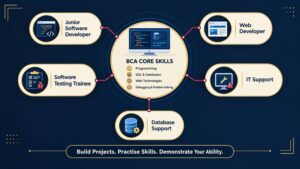
Students should use their course to build technical knowledge and then develop evidence of their abilities through projects, internships, practical exercises or other relevant experience.
Career options after distance BCA
| Job role | Typical responsibilities | Relevant skills | Preparation that may be needed |
| Junior software developer | Build, test and maintain application features | Programming, debugging, data structures | Coding practice and a small portfolio |
| Web developer | Create and maintain websites or web applications | HTML, CSS, JavaScript and basic backend concepts | Working website projects |
| IT support technician | Help users resolve software, device and access issues | Troubleshooting, operating systems, communication | Practical support exercises and systems knowledge |
| Software testing trainee | Test software and document defects | Test cases, attention to detail, basic SQL | Testing exercises and defect reports |
| Database support assistant | Help maintain data, run queries and check records | SQL, database concepts, accuracy | Small database projects |
| Technical support executive | Diagnose product or application issues | Product knowledge, problem-solving, clear communication | Support scenarios and customer-facing practice |
These are possible pathways, not guaranteed outcomes. Some employers accept candidates with a BCA for entry-level positions, while others may ask for specific skills, experience, certifications or a different qualification.
Roles in advanced cybersecurity, AI engineering, data science or senior software development often require additional specialised preparation. Students interested in those areas should identify the job requirements and build the relevant foundations before applying.
For broader career exploration and job-search assistance, the Government of India’s National Career Service portal provides employment and career services. It is a resource for exploring opportunities, not a guarantee of placement for any degree holder.
Skills to Build Alongside a BCA
A course provides structure, but practical ability grows through regular application. Students should aim to finish their studies with examples of what they can actually build, troubleshoot or explain.
Start with one programming language and learn its fundamentals properly. Practice writing small programs, reading error messages, testing different inputs and explaining how your solution works.
Build a foundation in SQL and database design. Learn how to create tables, retrieve records, join related data and apply basic data validation. These skills can be useful across development, support and data-related roles.
Web technologies are another practical area to explore. A basic website can demonstrate page structure, styling, form handling and an understanding of how a user interacts with an application.
Useful beginner projects include:
- A student record application that stores and retrieves information.
- A personal portfolio website.
- A simple inventory or library database.
- A small expense tracker with reports.
- A basic issue-reporting or help-desk application.
Document each project with a short explanation of the problem, technologies used, important features and lessons learned. Where appropriate, use version control to record changes and make your work easier to review.
Students exploring IT distance education should also plan a regular practice schedule. Even a few focused sessions each week can help reinforce programming and database concepts better than leaving all practical work until examination time.
For additional career reading, UCC publishes articles such as its guide to a data engineering career after BCA and MCA. Use career articles as starting points for research, then compare their advice with actual job descriptions and your own skill level.
Can You Pursue MCA After Distance BCA?
Yes, MCA can be a possible postgraduate route after BCA, provided the student meets the eligibility requirements of the specific MCA programme.
Universities may specify an accepted undergraduate degree, minimum marks, subject prerequisites, entrance requirements or other conditions. Some programmes may have additional mathematics or computing requirements. These details must be verified individually.
If you are exploring MCA distance education in Bangalore, check the awarding university, mode of study, applicable recognition status, curriculum, fees and examination requirements. A course’s regional marketing description is not a substitute for its official admission rules.
UCC publishes information about its MCA programme options. Prospective students should confirm the current programme details and eligibility directly before making a decision. The existence of an MCA listing does not mean that every BCA graduate qualifies automatically.
Students who are not ready for a master’s degree may also consider targeted technical learning, projects or other relevant qualifications, depending on their goals and the requirements of the roles they want to pursue.
How to Choose the Right Distance BCA College in India
The right programme is the one that meets your academic needs, is appropriately recognised for the relevant mode and session, fits your budget, and gives you a workable route to complete your studies.
Use the following framework when comparing options:
- Institutional credibility: Identify the awarding university and verify the programme’s status.
- Eligibility: Make sure your qualification and subjects satisfy the current admission rules.
- Total cost: Calculate the full amount payable, including additional compulsory fees.
- Curriculum: Review the subjects, practical components and project requirements.
- Learning resources: Find out how study materials are provided and where you can ask academic questions.
- Assessments: Check examination locations, schedules, assignments and practical evaluations.
- Completion rules: Understand the normal duration, maximum completion period and rules for failed subjects.
- Career fit: Compare the curriculum with the knowledge and skills required for your intended roles.
Students searching for distance education colleges in Bangalore should apply the same checks to regional options. A nearby office or counsellor may help with enquiries, but the student should still verify the awarding university and official programme documentation.
Avoid choosing a programme solely because it appears first in search results or uses a familiar institution’s name in promotional material. Make the decision using verifiable information.
Is Distance BCA Suitable for Working Professionals?
Distance study can be helpful for employees who want to continue working while pursuing a qualification. It may reduce daily commuting and offer more control over when to study.
However, flexibility does not remove the workload. Assignments, examination preparation, practical coding and project deadlines still need time. A demanding job or unpredictable work schedule can make consistent study difficult.
Before enrolling, estimate how many hours you can realistically set aside each week. Check whether the course has fixed online sessions, compulsory contact activities, practical attendance or examinations that require travel.
It can help to create a weekly routine with separate time for reading, coding, assignments and revision. If you already work in an IT-related role, you may be able to connect academic concepts with practical situations at work, subject to your employer’s policies and confidentiality requirements.
UCC has also published a relevant article on balancing work and BCA studies through distance education. Treat flexibility as a planning advantage, not as a promise that the course will fit every work schedule automatically.
Exploring Relevant Learning Options With UCC
United Correspondence College’s current website lists IT and computer-related education among its areas of focus, including BCA and MCA programme listings on its IT courses. The site also provides a contact channel for course enquiries.
These published listings are a starting point for discussion, not a replacement for checking the awarding university, programme details, delivery mode, eligibility and applicable recognition for the intended admission session. Fees and availability should also be confirmed directly.
If you are considering a BCA, prepare your educational details and ask UCC to clarify which specific programme options match your background. Request the official university programme page and current fee schedule before making a payment.
You can also explore UCC’s published course and education articles to research related study and career topics. The most suitable next step depends on your qualification, learning preferences, budget and intended career.
For individual guidance, use the official UCC contact page to ask about currently available options. Confirm all material course details before enrolling.
Common Mistakes to Avoid When Choosing Distance BCA
Several avoidable mistakes can create problems after admission.
Comparing only the advertised fee: Check the complete cost, including examinations and other compulsory charges.
Assuming every stream is accepted: Verify your subjects, marks and qualification against the programme’s actual eligibility rules.
Confusing online and distance education: Ask how teaching, practical work, assessments and examinations are delivered.
Ignoring recognition checks: Verify the awarding university, programme, mode and admission session before paying.
Underestimating practical work: Coding and database skills need regular practice, not only theoretical study.
Expecting a degree to guarantee employment: Prepare for your intended role through relevant skills, projects and experience.
Choosing without a career goal: You do not need to decide on a lifelong specialisation before starting BCA, but an initial direction can help you select projects and optional learning.
A careful decision before admission can prevent unnecessary expense and help you use your study time more effectively.
Frequently Asked Questions
1. What is BCA distance education?
BCA distance education is a way to pursue a Bachelor of Computer Applications through an approved open and distance learning arrangement. The curriculum, learning resources and assessment process depend on the university and programme.
2. Who is eligible for a distance BCA in India?
Many programmes require Class 12 or an accepted equivalent qualification. Subject requirements, minimum marks and other conditions vary, so students must check the current eligibility rules of their chosen programme.
3. Is mathematics compulsory for distance BCA?
Not necessarily for every programme. Some institutions may require mathematics or specify related subject conditions, while others may accept applicants with different academic backgrounds. Check the official eligibility criteria before applying.
4. How much does a distance BCA course cost?
Fees vary by university and programme. Compare the full programme cost, including tuition, registration, examinations, practical components and other applicable charges. Do not assume a semester fee represents the total cost.
5. Is a distance BCA degree valid for employment?
The qualification’s status depends on the awarding institution and the programme’s applicable recognition and mode requirements. Employers may also have their own eligibility criteria. Verify the programme before enrolment and check the requirements of the jobs you intend to pursue.
6. Can I study distance BCA while working?
It may be possible if you meet the admission criteria and can manage the study workload. Review attendance, examination and practical requirements, then assess whether you can consistently complete assignments and technical practice alongside work.
7. What jobs can I pursue after distance BCA?
Depending on your skills and employer requirements, possible entry-level pathways include junior software development, web development, IT support, software testing and database support. Projects and practical experience can help demonstrate your readiness.
8. Can I pursue MCA after completing BCA through distance education?
Potentially, yes. You must meet the specific MCA programme’s eligibility conditions and verify the status of the programme you plan to join. Requirements can differ between universities.
Conclusion
A distance BCA can be an option for students who want to study computer applications while managing other commitments. The key is to look beyond the course title and evaluate eligibility, total fees, recognition, learning arrangements, practical work and completion requirements.
BCA distance education should be approached as a structured academic commitment, supported by consistent technical practice and a realistic plan for future employment or higher study.
If you are exploring suitable options, review the available programme documentation carefully and ask questions before paying. You can start by exploring UCC’s IT course information and contacting the college to clarify which current options match your educational background and goals.