
When students think about an Electric Vehicle career, mechanical engineering is often the first qualification that comes to mind. However, an electric vehicle is not simply a car or scooter with a different power source. It is a combination of electrical systems, batteries, electronic controllers, software, sensors, charging networks, data and business operations.
This wider ecosystem creates several possible career directions for students who enjoy computers, mathematics, electronics, business analysis or energy technology. A student interested in coding may prefer vehicle software, while someone with an electrical background may be more interested in charging systems or power electronics. Graduates from business-related fields may also find relevant opportunities in supply chains, fleet operations and product management, depending on the position’s requirements.
Understanding these differences is important before choosing a qualification. An interest in electric mobility does not automatically mean that you need to pursue a specialised EV engineering degree. In some cases, a relevant foundational qualification followed by focused training and practical experience may be a more appropriate starting point.
This guide explores electric vehicle careers in India beyond mechanical engineering, the qualifications that may support different paths, and how students and working professionals can evaluate suitable educational options.
Understanding the Electric Vehicle Industry Beyond the Vehicle
An electric vehicle uses an electric motor to drive the vehicle, drawing energy from a battery or another electrical energy source, depending on the vehicle design. Unlike a conventional petrol or diesel vehicle, its operation depends heavily on electrical energy conversion, electronic control and battery management.
But the industry extends well beyond the vehicle itself.
Consider what happens when a customer buys an electric scooter. The vehicle needs a battery pack, a motor, electronic controllers, embedded software, charging equipment, diagnostic systems, manufacturing processes and after-sales support. The charging network needs electrical infrastructure, and the business may need software to manage vehicle fleets, payments and battery performance.
Each part involves different knowledge and responsibilities.
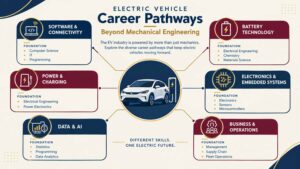
| Part of the EV ecosystem | Example of the work involved | Relevant background |
| Battery systems | Monitoring battery condition and performance | Electrical, electronics, chemical or materials engineering |
| Power electronics | Controlling the flow of electrical energy | Electrical and electronics engineering |
| Embedded software | Programming electronic controllers | Electronics, computer science or embedded systems |
| Vehicle connectivity | Processing information from connected vehicles | IT, software engineering or data systems |
| Charging infrastructure | Planning, installing and maintaining charging equipment | Electrical engineering and power systems |
| Data analytics | Analysing energy use, faults and fleet performance | Computer science, statistics or analytics |
| Business operations | Managing fleets, suppliers, service networks and costs | Management, operations or supply chain |
These categories overlap. A battery management engineer may work closely with software developers, while a fleet analyst may collaborate with charging infrastructure teams.
The important lesson for students is that the industry has multiple entry routes, but the right route depends on the work involved and the qualifications required for it.
Why Electric Vehicle Careers Matter to Students and Working Professionals
Electric mobility is relevant to more than people who want to design vehicles. It also intersects with electricity distribution, manufacturing, software services, logistics, transport and energy management.
India’s official PM E-DRIVE programme includes support for several vehicle categories, charging infrastructure and testing-agency upgrades. Its scope illustrates how electric mobility involves an ecosystem rather than one engineering specialisation.
For students, this creates an opportunity to explore the relationship between their interests and an evolving technical sector.
For example:
- A student who enjoys programming may investigate embedded software, vehicle connectivity or fleet analytics.
- Someone interested in physics and electrical circuits may prefer power electronics or charging systems.
- A graduate with a background in computer applications may investigate data analysis or software support roles.
- An experienced automobile service professional may explore EV diagnostics and high-voltage safety training.
- A business graduate may look at procurement, fleet operations or product coordination.
These are possible directions, not guarantees of employment. Job availability, eligibility and demand vary by employer, location and experience.
The useful question is not simply whether the EV sector is growing. It is which part of that sector fits your existing strengths, and what you need to learn to become a credible candidate.
3. Electric Vehicle Software Careers for IT and Computer Science Students
Software plays an important role in modern electric vehicles. Electronic controllers use software to manage functions, diagnostic tools interpret fault information, and connected systems may transmit vehicle data to cloud platforms.
This creates potential opportunities for people with relevant software, computer science and electronics backgrounds.
Embedded software developer
Embedded software runs on specialised electronic hardware rather than only on a general-purpose computer. In an electric vehicle, it may help control charging, monitor sensors or coordinate electronic components.
Relevant foundations include C or C++, programming logic, microcontrollers, debugging and basic electronics. Employers may also expect familiarity with real-time operating systems, communication protocols or automotive software standards, depending on the position.
Vehicle software and application developer
Some EV-related software work takes place outside the vehicle itself. Applications may help drivers locate charging stations, check charging status or monitor vehicle information.
A developer working on these products may need mobile application development, APIs, databases, testing and user-interface knowledge.
Cloud and connected-vehicle developer
Connected vehicles can produce information about usage, faults and performance. Software systems may collect and process this information for fleet operators, service teams or product engineers.
Skills may include backend development, cloud platforms, database management, networking and cybersecurity.
A learner interested in this area can explore UCC’s IT course options to understand its published IT programme categories. A general IT qualification may provide useful foundations, but specialized automotive software work often requires additional programming practice, electronics knowledge or industry-specific training.
4. Battery Technology and Battery Management Careers
The battery is one of the most important components of an electric vehicle. Its performance affects driving range, charging behaviour, cost, safety and the usable life of the vehicle.
Battery-related careers are not limited to manufacturing battery cells. They can involve monitoring, testing, electronics, software, quality assurance and research.
Battery management system engineer
A battery management system, commonly called a BMS, monitors information such as cell voltage, temperature and battery operating conditions. Depending on its design, it may help estimate the battery’s state of charge and state of health and provide protection against unsafe operating conditions.
This work can involve electronics, control systems, embedded programming, testing and data interpretation.
Battery testing and validation professional
Testing teams examine battery performance under defined conditions. They may investigate charging behaviour, temperature changes, durability and compliance with relevant safety or performance requirements.
The precise work depends on the facility and role. Some positions require specialised engineering qualifications and laboratory experience.
Battery materials and research roles
Battery research may involve chemistry, materials science, electrochemistry and laboratory testing. These positions can have more specific academic requirements than general EV support roles.
Students interested in this area should examine the qualifications specified by employers before choosing a programme. A broad engineering degree is not automatically equivalent to a specialised battery research qualification.
Battery technology is an excellent example of why students should distinguish between an interest in EVs and the actual work they want to perform. Both may involve electric mobility, but their educational requirements can be very different.
5. Electrical Engineering, Power Electronics and Charging Infrastructure
Electric vehicles need systems that convert, regulate and distribute electrical energy. Electrical engineering is therefore a relevant background for several EV-related career paths.
Power electronics involves electronic circuits and devices used to control electrical power. Depending on the application, this can include converters, inverters, charging equipment and motor-drive systems.
Charging infrastructure also creates work outside vehicle manufacturing. Charging stations need appropriate electrical connections, equipment installation, maintenance, monitoring and operational planning.
Possible roles include:
- Electrical design or project engineer.
- Charging infrastructure installation professional.
- Power electronics engineer.
- Electrical testing and maintenance engineer.
- Energy management or charging operations analyst.
The qualifications required depend on the role. An electrical design position may require an engineering degree and relevant design experience, while certain installation or maintenance positions may have different technical and licensing requirements.
Practical training is especially important where work involves electrical hazards. Learners must understand isolation procedures, electrical protection, equipment ratings and applicable safety standards before performing such work.
Students comparing electrical engineering programmes should investigate laboratory facilities, practical components and assessment requirements. A course that provides theoretical knowledge alone may not provide all the hands-on experience needed for charging infrastructure work.
6. EV Data Analytics and Artificial Intelligence Careers
Electric vehicles can generate operational data through sensors, controllers, charging systems and fleet platforms. When collected and analysed appropriately, this data can help teams investigate faults, monitor performance and make operational decisions.
Data-related work may suit graduates who enjoy mathematics, statistics, programming or problem-solving.
EV data analyst
An analyst may study vehicle utilisation, charging patterns, energy consumption, service records or fleet performance. The work can involve cleaning datasets, creating dashboards, identifying trends and communicating findings to non-technical teams.
Useful skills include spreadsheets, SQL, data visualisation and statistical reasoning. Python may be valuable for automation and more advanced analysis.
Predictive maintenance analyst
Predictive maintenance uses data to identify patterns that may indicate a developing fault. In an EV fleet, an analysis might investigate recurring charging interruptions, unusual temperature readings or repeated service visits.
However, finding a useful pattern requires good data, careful validation and an understanding of the equipment. A dashboard alone does not make someone an automotive diagnostics expert.
AI and machine learning professional
Machine learning may be applied to selected problems involving fault detection, energy-use estimation, demand forecasting or fleet optimisation.
These roles generally require a stronger foundation in programming, mathematics, data preparation and model evaluation. Automotive-specific applications may also require engineering knowledge.
A learner exploring IT distance education should therefore ask whether a programme builds core computing knowledge and whether they can supplement it with practical projects. A general IT qualification can support the foundation, but it does not automatically provide the specialist experience required for AI engineering in the automotive sector.
7. Electronics, Sensors and Vehicle Communication Careers
Modern vehicles use electronic components to measure conditions, exchange information and coordinate different systems.
Sensors can measure temperature, position, speed or other operating conditions. Electronic controllers process signals and use them to make decisions. Communication networks allow components to exchange information.
These systems create opportunities for students interested in electronics and embedded technology.
Possible areas include:
- Electronics design and testing.
- Sensor integration.
- Embedded systems development.
- Electronic control unit validation.
- Vehicle network testing.
- Hardware troubleshooting and diagnostics.
Students may need foundations in analogue and digital electronics, circuit theory, microcontrollers, signal processing and programming. Depending on the role, knowledge of vehicle communication protocols may also be useful.
For example, an engineer investigating a sensor-related fault must understand more than the software message displayed on a diagnostic tool. They may need to establish whether the sensor is producing the correct signal, whether the wiring is sound and whether the controller is interpreting the information correctly.
This is why electronics-focused EV roles should not be treated as ordinary IT support positions. They may require laboratory work, specialised tools and experience with physical hardware.
8. Manufacturing, Quality Assurance and EV Testing
Electric vehicles contain many components that must be manufactured, assembled, inspected and tested consistently. Production facilities need people who can maintain quality, identify defects and improve manufacturing processes.
Mechanical engineering remains relevant in this area, but manufacturing and quality roles may also draw on electrical engineering, electronics, industrial engineering and materials knowledge.
Examples include:
Quality assurance professional: Checks whether components and production processes meet documented requirements.
Production or process engineer: Studies production flow, process efficiency, equipment use and recurring manufacturing issues.
Test engineer: Carries out defined tests, records results and investigates deviations from expected performance.
Supplier quality professional: Works with component suppliers to assess defects, documentation and corrective actions.
Reliability engineer: Investigates failure patterns and helps determine how systems can perform consistently over time.
The appropriate academic background depends on the specific job description. Some quality roles accept diploma holders or graduates from related disciplines, while specialised validation and engineering positions may require a degree and relevant technical experience.
Students should also understand that testing is not simply driving a vehicle and reporting whether it works. Formal testing can require controlled procedures, measurement equipment, safety practices, documentation and the ability to interpret results.
9. EV Business, Supply Chain and Fleet Operations Careers
Not every electric vehicle role requires a technical engineering degree. The industry also depends on people who can coordinate suppliers, manage vehicles, analyse costs and organise operations.
Supply chain and procurement
EV manufacturers and service organisations purchase components, equipment and services from suppliers. Procurement and supply chain teams may compare vendors, monitor delivery schedules, manage inventory and coordinate quality documentation.
Business, operations, logistics and supply chain qualifications may be relevant, depending on the role.
Fleet operations
Fleet operators may manage electric two-wheelers, delivery vehicles, buses or other commercial vehicles. Their responsibilities can include vehicle allocation, charging schedules, maintenance coordination, operating costs and service availability.
A fleet analyst may combine business knowledge with spreadsheets, dashboards and operational data.
Product management and business analysis
Product teams connect customer needs with technical and commercial decisions. They may research user requirements, document product features, coordinate with developers and track performance after launch.
These positions can suit candidates with suitable business, technology or industry experience. More technical product roles may require a strong understanding of electrical or software systems.
EV sales and customer solutions
Businesses that sell charging equipment, fleet services or EV-related products need staff who can understand customer requirements and explain product capabilities accurately.
A sales role may value communication and commercial skills, while technical sales positions may require an engineering background.
For students, the key is to avoid assuming that a business qualification alone provides entry to every EV company role. Instead, identify the function, study the relevant requirements and build experience that demonstrates your suitability.
Which Qualifications Can Help You Enter the EV Industry?
There is no single qualification that suits every electric vehicle career. The appropriate pathway depends on whether you want to work with software, electrical systems, batteries, testing, data or business operations.
| Career interest | Relevant educational foundations | Additional learning to consider |
| Embedded software | Computer science, electronics or electrical engineering | C/C++, microcontrollers, debugging |
| Battery systems | Electrical, electronics, chemical or materials engineering | Battery fundamentals, testing and safety |
| Charging infrastructure | Electrical engineering or an appropriate electrical technical qualification | Charging systems, protection and installation safety |
| EV data analytics | Computer science, IT, mathematics, statistics or analytics | SQL, Python, dashboards and data projects |
| Electronics testing | Electronics or electrical engineering | Instrumentation, sensors and troubleshooting |
| Manufacturing quality | Engineering or a relevant technical diploma, depending on the role | Quality methods, measurement and documentation |
| Fleet operations | Business, logistics, operations or relevant technical experience | Fleet analytics, charging operations and cost analysis |
| Product coordination | Business, technology or a relevant domain background | Requirements analysis and project coordination |
These are indicative pathways, not universal eligibility rules. Employers may require specific degrees, certifications, practical experience or knowledge of regulated processes.
Is a B.Tech the only route?
No. A B.Tech can provide a broad engineering foundation for many technical roles, but it is not the only possible starting point across the EV ecosystem.
A diploma may suit certain technician, maintenance, testing or support positions, subject to employer requirements. A computer science or IT background may be appropriate for some software and data roles. Business qualifications may be relevant to operations and commercial functions.
Students should choose their qualification based on the role they are targeting, rather than selecting a course only because the industry sounds promising.
Can a Diploma Holder Build a Career in Electric Vehicles?
A diploma can be a useful starting point for some technical and support careers, particularly where the role emphasises practical knowledge and hands-on capability. However, eligibility varies by employer and job function.
A diploma holder with an electrical background might investigate suitable electrical maintenance or charging-equipment support roles. Someone with electronics training may explore testing, diagnostics or equipment troubleshooting. A mechanical diploma holder might consider manufacturing, assembly, quality inspection or service-related opportunities.
The next step is to compare the responsibilities of real job openings with the knowledge already acquired.
A useful preparation plan includes:
- Review job descriptions for entry-level positions in your preferred EV-related area.
- Identify repeated requirements such as electrical fundamentals, electronics, programming or diagnostic tools.
- Choose a practical short course or supervised training opportunity that addresses a genuine gap.
- Build a record of completed projects, practical exercises and relevant experience.
- Investigate whether a higher qualification would be needed for the roles you want to pursue later.
Students researching a Diploma in Engineering through UCC can review the published programme information and listed engineering disciplines. The page identifies areas such as mechanical, electrical, electronics and computer science. It does not establish that a dedicated EV diploma is available.
Before applying, confirm the exact awarding institution, approved programme, delivery mode, eligibility requirements and practical components. A programme that is suitable for one technical role may not satisfy the entry requirements for another.
Can Working Professionals Transition into EV Careers?
Working professionals may already possess skills that transfer into parts of the electric vehicle ecosystem. A career change does not always require starting from the beginning, but it does require identifying which knowledge can be reused and which gaps must be addressed.
Consider three examples.
Example 1: An IT support professional
Someone with experience troubleshooting software, managing systems and documenting incidents might investigate software testing, technical support or data operations in an EV-related business. Moving into embedded software development would generally require more specialised programming and hardware knowledge.
Example 2: An electrical maintenance professional
Someone experienced in electrical systems may have relevant foundations for selected charging infrastructure or electrical maintenance roles. However, EV charging equipment, installation standards and safety procedures must be learned before taking on new responsibilities.
Example 3: A business operations executive
A professional who coordinates vendors, schedules deliveries or analyses operational costs might explore fleet coordination, supply chain or EV operations. Building knowledge of charging schedules, vehicle utilisation and electric mobility economics could make the transition more credible.
For a working professional, a sensible transition plan has four stages:
- Assess existing strengths: Identify the technical, analytical or business skills you already use.
- Choose a specific role: Avoid trying to learn every EV technology at once.
- Close the skills gap: Study the required concepts and practise them through suitable projects or supervised training.
- Validate your progress: Compare your skills with job requirements and seek feedback from people familiar with the target role.
Continuing education may support this process, but a qualification should be chosen for its relevance to the desired role rather than its name alone.
Engineering Distance Education: What Students Must Check Before Enrolling
For students who need to manage work, family responsibilities or location constraints, flexible learning may be worth investigating. However, engineering education requires particular care because some qualifications involve laboratories, workshops, supervised practical work or other requirements that cannot be replaced by reading study material alone.
The phrase Engineering distance education is often used broadly in course searches. Students must distinguish between the way a course is advertised and the programme’s actual authorised mode of delivery.
Before enrolling, verify:
- The exact name of the awarding institution.
- The specific programme and specialisation.
- Whether the institution is authorised to offer that programme in the proposed mode.
- Whether the relevant regulator permits the programme through that mode.
- How practical training, laboratory work and examinations are conducted.
- Whether the qualification satisfies the eligibility requirements of your intended career or further study.
- The complete fee structure, academic schedule and student support arrangements.
The UGC Distance Education Bureau’s official programme helps learners check approved or recognised open and distance learning and online programmes. For engineering, students must also verify the applicable technical-education requirements rather than assuming that UGC information alone settles every question.
Important: Do not assume that an engineering qualification can legally or academically be completed through distance learning simply because a website advertises it as a correspondence course. Verify the exact programme, awarding institution, academic session and permitted mode before paying fees.
How to Compare B.Tech and Diploma Options for EV-Related Goals
Students often compare a diploma with a bachelor’s degree without first deciding what they want to do in the industry. A better approach is to start with the intended role and work backwards to the qualification.
A diploma may provide a technical foundation for selected technician, maintenance, production support or testing roles. A bachelor’s engineering degree may be required for particular graduate engineer positions, design responsibilities or opportunities where employers specify a degree.
Neither option guarantees entry to an EV job. The value of the qualification depends on its validity, the subjects studied, the practical experience gained and the employer’s requirements.
When comparing a B.Tech correspondence college in India, ask for clear documentation of the awarding university and the exact programme’s approved delivery mode. Do not rely only on the phrase “AICTE approved” in a headline or advertisement; check what the approval actually covers.
Similarly, if you are looking for a Diploma in Engr correspondence college in India, clarify whether the advertised programme is a recognised engineering diploma, which institution awards it and what further study or employment options it may support.
Students in Bengaluru researching an Engineering correspondence college in Bangalore should apply the same checks. Location and convenience do not replace the need to verify academic validity and programme suitability.
For any programme, obtain written answers to the questions that matter before making a financial commitment.
Building Practical Skills: Projects That Help Turn Learning into Evidence
Academic learning is important, but many technical EV roles also require practical ability. Students can strengthen their understanding by completing projects that match their current skill level and do not expose them to unsafe equipment.
The best project is not necessarily the most complicated one. It is one that demonstrates clear thinking, correct methods, documented results and an understanding of limitations.
Project ideas for IT and data learners
- Create a dashboard using a sample dataset to compare vehicle usage and charging sessions.
- Write a simple program to calculate energy consumption from hypothetical trip data.
- Build a small application that records charging sessions and summarises costs.
- Use a sample dataset to investigate recurring maintenance reports.
Clearly label simulated or public datasets. Do not present fictional results as actual vehicle performance.
Project ideas for electronics learners
- Simulate a basic sensor-reading circuit using a suitable educational platform.
- Study how a microcontroller reads and reports temperature from a low-voltage sensor.
- Document a simulated battery-monitoring concept and explain its limitations.
- Practice analysing sample voltage and temperature readings.
These projects should use safe, low-voltage educational setups. They are not substitutes for supervised high-voltage EV training.
Project ideas for business and operations learners
- Create a spreadsheet comparing hypothetical fleet operating costs.
- Design a charging schedule for a small sample fleet, stating all assumptions.
- Build a simple supplier comparison framework.
- Analyse a sample inventory dataset to identify stock-management issues.
For each project, record the problem, the method, the tools used, the result and what you learned. A portfolio becomes more useful when it explains how decisions were made rather than displaying screenshots without context.
How to Evaluate Distance, Online and Regular Learning Options
There is no universally best learning mode for every student. The appropriate choice depends on the course, the student’s circumstances and the skills required for the intended role.
| Learning mode | Potential advantages | Questions to consider |
| Regular or campus-based | Access to scheduled laboratories, workshops and direct interaction where provided | Can you attend consistently? Are the relevant facilities available? |
| Open and distance learning | May provide a more flexible arrangement for suitable recognised programmes | Is the exact programme permitted in ODL mode? How are assessments and practical requirements handled? |
| Online learning | May help learners study theory or computing subjects remotely | Are the programme and institution properly authorised for online delivery? |
| Part-time or work-integrated learning | May help some learners combine employment and structured learning | Does the course genuinely support working schedules? Are practical and attendance requirements manageable? |
| Short technical training | Can target a specific skill gap | Is the training credible, safe and relevant to the intended role? Does the employer recognise it? |
These categories are not interchangeable. An online IT programme, for instance, may be suitable for learning programming fundamentals, but that does not make it equivalent to a laboratory-based engineering programme.
For students researching distance education in Bangalore, the practical question is whether the particular programme can be completed in a way that meets its academic and regulatory requirements while fitting the student’s circumstances.
A flexible schedule is useful only when the qualification itself is appropriate and the learner can meet its actual requirements.
Exploring Relevant UCC Education Options
United Correspondence College provides published information about engineering-related and IT programme categories. These may be useful starting points for learners who need to compare educational pathways, but students must establish whether a specific programme suits their intended EV role.
UCC’s B.Tech Course lists several engineering disciplines, including computer science, mechanical, electrical and electronics engineering. Its Diploma in Engineering lists related technical disciplines, while the IT courses describe computer and IT programme options.
These are general educational categories rather than confirmation of a dedicated electric vehicle qualification.
For example, a learner interested in vehicle software may wish to investigate relevant computing or electronics foundations. Someone interested in electrical systems may need to compare the academic content of electrical engineering programmes. A learner targeting battery research may require a more specialised academic route.
Before choosing a programme through UCC, ask the college to confirm:
- The awarding university or institution.
- The exact course title and specialisation.
- Current approval or recognition for the relevant academic session and mode.
- Entry requirements and any restrictions on progression.
- Practical, laboratory and examination arrangements.
- Fees, duration and applicable academic rules.
- Whether the qualification meets the requirements of your intended role or further study.
UCC’s published programme information should be treated as the starting point for this discussion, not as a guarantee of employment or eligibility for every EV career.
For learners who are still comparing technical pathways, UCC’s previous article, How to Become a Mechatronics Engineer in 2026?, offers a related introduction to the overlap between mechanical systems, electronics, automation and software. Its renewable energy project engineering guide may also be useful for readers exploring the relationship between electric mobility and the wider energy sector.
If you need help comparing the available options, you can contact UCC for course information and ask for the relevant programme documentation before making a decision.
Finding Relevant Opportunities and Preparing for Applications
Once you have identified a career direction and the qualifications it may require, the next step is to examine actual job descriptions. This helps distinguish between skills that are useful in general and requirements that employers specifically expect.
Look for entry-level roles, trainee positions, internships and technical support openings relevant to your background. Compare several descriptions rather than treating one vacancy as the standard for the entire industry.
Record the following information:
- Required degree, diploma or other qualification.
- Essential technical skills.
- Preferred tools, software or certifications.
- Practical experience or project requirements.
- Location, travel, shift or site-work expectations.
- Safety training or other role-specific conditions.
A student interested in embedded software might find that employers repeatedly ask for C programming, microcontroller knowledge and debugging experience. An applicant interested in fleet analytics may see greater emphasis on SQL, spreadsheets, dashboards and communication skills.
These observations can help you build a realistic study plan.
The Government of India’s National Career Service portal provides career guidance, job-search facilities and other employment-related resources. It can be one starting point for researching opportunities and comparing role requirements. Always check the details and authenticity of individual vacancies, and do not assume that a job listing represents the whole market.
When applying, explain your relevant academic knowledge and practical work clearly. A small, well-documented project that demonstrates the skills required for a role can be more informative than a long list of unrelated courses.
Common Mistakes to Avoid When Choosing an EV Career
Students can lose time and money by choosing an educational pathway before understanding the actual job they want to pursue. The following mistakes are worth avoiding.
Choosing a course only because EVs are popular. Industry interest does not make every course suitable. Start with the role and work backwards to its educational requirements.
Assuming mechanical engineering is compulsory for all EV careers. Many roles involve software, electronics, electrical systems, data or business operations. However, technical positions still require the appropriate foundations.
Assuming IT skills are enough for every automotive software job. General programming skills may be useful, but embedded systems and vehicle control work can require hardware knowledge, specialised tools and additional training.
Believing that a distance qualification automatically qualifies you for a technical role. Programme validity, employer requirements and practical competence all matter.
Ignoring safety and hands-on experience. Working with high-voltage systems, charging equipment or battery packs can involve serious hazards. Use appropriate supervised training and safety procedures.
Collecting certificates without building evidence of skill. Short courses can fill gaps, but projects, practical work and clear explanations of what you can do help demonstrate your capabilities.
Trusting broad placement or salary promises. Employment outcomes depend on many factors. Verify claims and avoid making an educational decision based on guaranteed-job language.
Failing to check the exact programme approval. A college’s general recognition does not automatically prove that every programme it advertises is authorised in every learning mode.
A careful choice does not need to be complicated. It requires matching the target role, qualification, practical requirements and personal circumstances.
A Practical Roadmap for Students Planning an EV Career
The following roadmap can help students and working professionals turn a broad interest in electric vehicles into a more focused plan.
Step 1: Choose a career direction
Decide whether you are most interested in software, batteries, electronics, charging systems, testing, data or business operations.
Step 2: Identify the required foundation
Compare the academic qualifications, subjects and experience requested in relevant job descriptions.
Step 3: Evaluate educational options
Compare relevant degree, diploma, online, regular or other permitted study routes. Verify the exact programme and its recognition.
Step 4: Build practical evidence
Complete relevant projects, supervised technical exercises, internships or work-based learning where available.
Step 5: Review and apply
Compare your skills with actual vacancies, address the most important gaps and prepare applications that show relevant evidence.
A student who follows this process is more likely to choose a course for a clear reason instead of trying to predict which technology will become the next big opportunity.
Frequently Asked Questions
1. Can I build an electric vehicle career without a mechanical engineering degree?
Yes. Depending on the role, relevant backgrounds can include electrical engineering, electronics, computer science, IT, data analytics, materials science and business operations. However, specialised positions may require specific qualifications, technical training or relevant experience.
2. Which course is best for an electric vehicle career in India?
There is no single best course for everyone. Electrical or electronics engineering may suit students interested in power systems and vehicle electronics, while computer science or IT may be relevant to selected software and data roles. Battery research can require more specialised science or engineering education. Start by identifying the job you want and checking its actual requirements.
3. Can IT graduates work in the electric vehicle industry?
IT graduates may investigate opportunities in software development, data analysis, cloud systems, software testing and connected-vehicle services. Embedded software and vehicle-control positions may require additional knowledge of electronics, microcontrollers and automotive systems.
4. Is engineering distance education suitable for EV careers?
It depends on the exact programme and intended career. Some learning pathways may be suitable for acquiring theoretical knowledge, but many technical roles also require practical training. Verify that the awarding institution and programme are authorised for the proposed learning mode and that the qualification meets the role’s requirements.
5. Can diploma holders enter the EV industry?
Some employers recruit diploma holders for eligible technician, maintenance, manufacturing, testing support or related positions. Requirements vary by job. A diploma holder should compare vacancies carefully and determine whether additional training, experience or a higher qualification is needed for the desired role.
6. Which skills should a beginner learn first?
Begin with the fundamentals relevant to your chosen path. Software learners can start with programming and problem-solving; electrical learners should strengthen circuit and electrical safety fundamentals; data learners can practise spreadsheets, SQL and basic statistics. Add specialised EV knowledge after establishing the appropriate foundation.
7. Can working professionals study for an EV-related career while employed?
Potentially, yes. Working professionals can investigate suitable part-time study, online learning, recognised distance programmes or targeted technical training. They should verify attendance, assessment, laboratory and practical requirements before committing. A course’s advertised flexibility should not be assumed to mean that every component can be completed remotely.
8. How can I find a suitable course through UCC?
Start by identifying the type of EV-related work you want to pursue. Then review UCC’s published engineering and IT programme information and ask for confirmation of the exact awarding institution, programme, learning mode, eligibility and practical requirements. Do not assume that a general engineering or IT course is a dedicated EV qualification.
Conclusion: Choose an EV Career Based on Your Strengths, Not Just the Industry Trend
Electric vehicle careers in India extend beyond mechanical engineering. Software, electronics, battery systems, electrical infrastructure, data analytics, manufacturing quality and business operations all contribute to the wider electric mobility ecosystem.
The most useful starting point is to identify which part of that ecosystem interests you. Then determine the qualifications, foundational subjects, practical experience and safety knowledge needed for your intended role. Students should compare recognised educational options carefully, while working professionals should identify transferable skills and the gaps they need to address.
If you are exploring Engineering distance education, a diploma or an IT qualification, check that the specific programme fits your academic background and intended career. A course can support your learning, but it cannot guarantee employment or replace every form of practical experience.
United Correspondence College can be a starting point for exploring its published engineering and IT programme options. Review the details, verify the awarding institution and permitted study mode, and ask for clarification before enrolling.
Your next step: Identify your preferred EV career area, shortlist two or three relevant job roles, and compare their requirements with your current qualifications. You can then explore UCC’s available programme information and contact Education Counselors to clarify whether any published option fits your educational goals.