
Think about the last time you searched Google for a course, read a blog before buying a product, or followed a brand on social media. Someone created those words to answer your questions, share information, or help you make a decision. That is where Content Writing becomes more than just putting sentences together. It becomes a skill that connects businesses with people.
Today, content writers contribute to websites, educational platforms, digital marketing agencies, technology companies, media publications and many other industries. For students, graduates and working professionals, this field offers several ways to turn writing skills into a career. If you are also exploring a BA correspondence college in Bangalore while planning your professional journey, understanding the relationship between education, communication and digital skills can help you make a more informed choice.
The interesting part is that you do not have to be a novelist or a professional journalist to begin. Curiosity, a willingness to learn, consistent practice and an understanding of your readers can give you a strong starting point.
So, what does a content writer actually do? Which courses are useful? Where can you find jobs, and how can you build experience when you are just starting? Let us explore the answers step by step.
What Does a Content Writer Actually Do?
A content writer creates written material that serves a specific purpose. That purpose might be educating readers, explaining a complicated topic, improving a website’s visibility, promoting a product or helping customers understand a service.
For example, an educational institution may need a blog explaining career opportunities after graduation. An online store may need product descriptions that help customers compare products. A software company may need straightforward instructions explaining how to use its application.

Although these tasks look different, they share one important goal: making information useful to a particular audience.
A content writer’s daily responsibilities may include:
- Researching a subject using reliable sources.
- Understanding the intended audience and the purpose of the content.
- Creating outlines before writing longer articles.
- Writing blogs, website pages, social media posts, email campaigns or product descriptions.
- Applying search engine optimisation (SEO) principles where relevant.
- Editing drafts for clarity, accuracy, grammar and readability.
- Working with designers, marketers, editors and subject experts.
- Updating published content when information becomes outdated.
The work is not simply about writing more words. It is about choosing the right information, organising it logically and communicating it in a way that readers can understand.
Writers also need to recognise that different formats demand different approaches. A blog can explain a topic in detail, while an advertisement may need only a short, memorable message.
Discover the Different Career Paths Within Content Writing
One of the biggest advantages of this profession is the variety of specialisations available. You can begin with general writing and gradually discover the type of work that suits your interests and strengths.
Blog and article writer
Blog writers create informative articles, guides, educational resources and opinion pieces. Their work often involves research, outlining, fact-checking and explaining subjects in a reader-friendly manner.
This path can suit people who enjoy learning about new topics and turning complicated information into clear explanations.
SEO content writer
SEO writers create content designed to help users find relevant information through search engines. They work with search intent, keywords, headings, internal links and page structure while prioritising useful, original content.
For example, someone searching for career options after graduation needs a different answer from someone looking for admission requirements. Understanding this difference helps writers create more relevant articles.
Google’s SEO Starter Guide is a useful resource for learning how search engines discover and understand web content.
Copywriter
Copywriters focus on persuasive communication. They may write advertisements, landing pages, promotional emails, product descriptions and campaign messages.
Their goal is to encourage an appropriate action, such as exploring a service, registering for an event or learning more about a product. Good copywriting requires an understanding of the audience’s needs rather than exaggerated promises.
Technical writer
Technical writers explain products, processes and systems that may otherwise be difficult to understand. They create user manuals, product documentation, troubleshooting guides and software instructions.
People with backgrounds in engineering, IT, science or other specialised subjects may find this path particularly interesting because their existing knowledge can become a professional advantage.
Social media content writer
Social media writers create captions, short posts, campaign messages and platform-specific content. They must understand how audiences interact with different platforms and how to communicate a message within limited space.
The work often involves collaboration with graphic designers, video editors and social media managers.
UX writer and content designer
UX writers create the words people encounter while using websites, applications and digital products. These include button labels, error messages, onboarding instructions and confirmation messages.
The challenge is to make each interaction clear and helpful. A short sentence can make the difference between a confusing experience and a smooth one.
As you explore these paths, remember that you do not need to master every format at once. Begin with the kind of writing you enjoy, develop the fundamentals and expand your skills as you gain experience.
Which Courses and Qualifications Can Help You Get Started?
There is no single educational route that every content writer must follow. Some professionals enter the field after studying English, journalism or mass communication. Others bring knowledge from commerce, science, management, technology or entirely different disciplines.
What matters is finding an educational pathway that develops your communication skills, subject knowledge and ability to produce reliable work.
Bachelor’s degree options
A bachelor’s degree can help you develop language proficiency, research habits, analytical thinking and subject knowledge. Depending on your interests, you could explore programmes such as:
- BA English or another language-related programme.
- Journalism and mass communication.
- Media studies or communication.
- Business administration or commerce.
- Computer science or other subject-specific degrees for specialised writing.
Students comparing a BA correspondence college in Bangalore should review the programme’s eligibility requirements, recognition status, syllabus, assessment pattern and study arrangements before making a decision.
A degree does not automatically make someone a skilled writer, but it can provide a valuable academic foundation. The next step is to practise writing for real audiences and build samples that demonstrate your abilities.
Certificate courses in content writing
Short-term courses can help you learn practical skills without committing to another full degree. Depending on the syllabus, useful topics may include:
- Fundamentals of writing and editing.
- SEO and keyword research.
- Blog and website content development.
- Copywriting and advertising.
- Digital marketing fundamentals.
- Content strategy and analytics.
- Technical writing or documentation.
Before enrolling, check whether the course includes practical assignments, feedback, portfolio projects and current examples. A certificate is more useful when you can demonstrate what you learned through actual work.
Postgraduate study and specialisation
If you already hold a bachelor’s degree, postgraduate education may help you deepen your knowledge in a related area. Depending on your career goals and eligibility, you could consider English, journalism, communication, marketing or a subject-specific postgraduate programme.
People researching an MA correspondence college in India should check the exact programme, mode of delivery and applicable recognition requirements rather than relying on the institution’s name alone.
Flexible learning for students and working professionals
Not everyone can attend classes on a fixed daily schedule. Working professionals may need to balance employment with education, while students may want to explore internships or practical projects alongside their studies.
Traditional distance education in Bangalore can be worth considering for learners who need flexibility. However, programme availability, eligibility, examinations, practical requirements and recognition vary by institution and course.
When evaluating correspondence degree colleges in Bangalore, compare the academic programme with your long-term goals. If you want to become a content writer, look for opportunities to improve language skills, research, communication and subject expertise while making time for regular writing practice.
The Skills That Turn an Ordinary Writer into a Valuable One
Good writing is not simply about knowing grammar. Professional writers must understand what readers need, determine which information is trustworthy and present it in a way that makes sense.
Here are the skills worth developing early in your journey.
Research and fact-checking
Before writing, learn how to distinguish reliable information from unsupported claims. Read original sources, compare evidence and check dates when dealing with changing information.
This is particularly important when writing about education, finance, healthcare, technology or public policy. Readers should be able to trust that your work is accurate and responsibly prepared.
Clear and natural communication
A useful article does not try to impress readers with complicated vocabulary. It helps them understand the subject.
Practice replacing unnecessary jargon with everyday language. Use examples when an idea feels abstract, and break long explanations into smaller sections.
Storytelling and audience awareness
Every piece of content should have a reason for existing. Before you start writing, ask yourself three questions:
- Who will read this?
- What are they trying to understand or achieve?
- What should they know or do after reading?
These questions help you choose relevant examples, establish a logical flow and avoid filling the article with unnecessary information.
SEO and search intent
Writers who understand SEO can connect useful information with the people searching for it. Learn how to interpret keywords, identify the reader’s intent, organise headings and write descriptive page titles.
However, keywords should support the content rather than control every sentence. Repeating a phrase excessively can make an article awkward and less useful.
Editing and proofreading
First drafts rarely represent your best work. Effective writers review their content for repetition, unclear explanations, unsupported claims and abrupt transitions.
Read your article aloud to identify sentences that sound unnatural. Check names, dates, links, punctuation and formatting before submitting the final draft.
Time management and collaboration
Professional assignments often involve deadlines, revisions and feedback from several people. Writers must plan their workload, communicate when requirements are unclear and make changes without losing sight of the original purpose.
Responsible use of AI tools
AI writing tools can help with brainstorming, outlining and identifying possible gaps in a draft. However, they may also produce incorrect facts, generic explanations or misleading references.
Use these tools as assistants rather than substitutes for judgement. Verify factual claims, add original insights, protect confidential information and follow the client’s or employer’s policies.
Writers who combine technology with independent thinking, subject knowledge and strong editing are better positioned to create work that offers genuine value.
Build a Portfolio Before Waiting for Your First Job
Imagine two candidates applying for the same entry-level writing position. One says they enjoy writing. The other presents three carefully prepared articles, a sample landing page and a short explanation of the audience each piece was designed for.
The second candidate gives the employer something concrete to evaluate.
That is why a portfolio matters, even if you have never worked professionally.
What should your first portfolio contain?
Start with four or five strong samples covering different formats. For example:
- One informative blog post.
- One SEO-focused article.
- One product or service description.
- One set of social media captions.
- One short email or landing-page draft.
Choose topics you understand or are willing to research thoroughly. Each sample should demonstrate a particular skill rather than simply increase the number of items in your portfolio.
Where can you publish your samples?
You can create a simple portfolio using a personal blog, a professional networking profile, an online publishing platform or a shareable document.
Organise the work by format or subject. Add a short description explaining the intended audience and objective of each sample. If a piece was written as a practice exercise, identify it honestly rather than presenting it as commissioned client work.
How can you improve your samples?
After completing a draft, review it as if you were the editor.
- Does the introduction explain why the topic matters?
- Are the claims supported by credible sources?
- Does each heading lead naturally to the next?
- Is the language clear and free from unnecessary repetition?
- Have you used keywords naturally where relevant?
- Does the conclusion provide a useful takeaway?
Ask a teacher, colleague or experienced writer to review your work when possible. Constructive feedback can reveal weaknesses you may not notice yourself.
You do not need a large portfolio to begin applying. A small collection of thoughtful, original samples is a more useful starting point than dozens of rushed articles.
“Students looking to expand their career opportunities after graduation can explore our guide on the best courses to pursue after a BA to discover further study options and career pathways.”
Content Writing Career Roadmap: From Beginner to Specialist
Choosing a content writing career becomes easier when you understand how different skills connect to real workplace responsibilities. You do not have to master everything at once. Start with the basics, gain practical experience and gradually move towards assignments that match your interests.
The following table shows how aspiring writers can approach their career development at different stages.
| Career stage | Skills to focus on | Practical next step |
| Beginner | Grammar, research, writing structure and proofreading | Write two informative articles and create your first portfolio samples. |
| Entry-level writer | SEO basics, keyword research, editing and meeting deadlines | Apply for internships and junior content writing positions. |
| Experienced writer | Subject expertise, audience research and content planning | Build a specialisation in education, technology, business or another industry. |
| Content specialist | Content strategy, performance analysis and advanced editing | Take responsibility for larger projects and collaborate with marketing teams. |
| Senior writer or strategist | Editorial planning, team coordination and content performance | Lead content projects, mentor junior writers or develop a content strategy. |
How can you move to the next stage?
Progress depends on the quality of your work, the experience you gain and your ability to solve communication problems. Keep samples of your strongest projects, request constructive feedback and learn from the results of published content whenever performance data is available.
If you are pursuing a degree alongside your career preparation, make time for practical writing exercises as well as academic study. A recognised qualification can support your educational development, while a strong portfolio helps demonstrate your professional abilities.
The goal is not to rush towards a senior designation. It is to build skills that allow you to handle more complex assignments with confidence.
Where Can Content Writers Find Job Opportunities in India?
Once you have developed your core skills and prepared a few writing samples, the next step is to explore where those abilities are needed.
Content writing is used across many industries, so your options are not limited to publishing houses or advertising agencies.
Digital marketing agencies
Agencies often create website pages, blogs, SEO articles, campaign copy and social media content for multiple clients. These environments can expose beginners to different industries and writing formats.
The pace may be demanding, but the experience can help you understand briefs, deadlines, revisions and client expectations.
Education and e-learning
Schools, colleges, training providers and online learning platforms need content that explains courses, careers, admissions, examinations and learning resources.
Writers in this sector benefit from the ability to explain complex information in simple language without compromising accuracy.
Technology and software companies
Technology businesses need website content, product guides, documentation, tutorials and educational articles. Writers with an interest in software or technical subjects can gradually develop expertise in this area.
E-commerce and consumer brands
Online retailers need product descriptions, buying guides, category pages, email campaigns and promotional content. Writers must understand product features and customer needs while avoiding misleading claims.
Media, publishing and communications
Digital publications, editorial teams and communication departments need writers who can research subjects, interview people, explain developments and edit material for publication.
Freelance and remote opportunities
Freelancing allows writers to work with multiple clients, depending on their skills and availability. Projects may include blog writing, editing, website copy, newsletters and specialised articles.
Remote work can provide flexibility, but freelancers must also manage client communication, project timelines, payments and revisions. Finding consistent work usually takes time.
Common entry-level job titles
You may encounter positions such as:
- Junior Content Writer.
- Content Writing Intern.
- SEO Content Writer.
- Copywriting Trainee.
- Social Media Content Writer.
- Editorial Assistant.
- Junior Technical Writer.
- Content Marketing Executive.
When searching for openings, read the job description carefully. Some positions focus primarily on writing, while others combine writing with SEO, social media management, editing or marketing responsibilities.
Salary Expectations: What Can a Content Writer Earn?
Salary is one of the first questions aspiring writers ask, and understandably so. However, there is no single figure that applies to every content writing role in India.
Earnings depend on several factors, including experience, location, employer, writing quality, subject expertise, employment type and the complexity of the work.
A beginner joining a small agency may earn differently from a technical writer working for a software company. A freelancer’s income may also change considerably from month to month depending on the number and value of projects secured.
Rather than relying on one advertised salary figure, evaluate opportunities according to the following factors:
- Experience: Writers who have demonstrated reliability and quality may qualify for more advanced responsibilities.
- Specialisation: Technical, financial and other subject-specific writing may require additional expertise.
- Portfolio quality: Strong samples can help employers assess your ability to handle real assignments.
- Industry knowledge: Understanding a business or technical subject can make your work more valuable.
- Additional skills: SEO, editing, content strategy and analytics can broaden your responsibilities.
- Employment arrangement: Full-time employment, contract work and freelancing have different income patterns and benefits.
If you are just starting, prioritise learning, feedback and opportunities to build credible experience. Compare salary information from recent job advertisements and reputable career resources before making financial decisions.
As your skills develop, you can explore progression into senior writing, editing, content strategy, technical documentation or team leadership.
Can AI Replace Content Writers? Understanding the Changing Landscape
AI tools have made it easier to produce first drafts, summaries and basic informational content. This has changed how businesses approach content production and what they expect from writers.
It does not mean that every writing role will disappear, nor does it guarantee that demand for writers will continue unchanged. The impact varies by industry, assignment and the quality of work required.
Generic content that offers little original value can be particularly vulnerable to automation. On the other hand, assignments requiring detailed research, interviews, specialist knowledge, editorial judgement or a strong understanding of a specific audience may demand more than automated drafting.
Consider a company launching a new software product. It may use AI to generate a rough outline, but someone still needs to understand the product, confirm its features, interview the relevant team, explain its benefits accurately and check that the final documentation is useful.
To remain adaptable, aspiring writers should focus on skills that strengthen the quality of their work:
- Developing subject expertise instead of writing superficially about everything.
- Checking information against reliable sources.
- Learning to interview people and gather original insights.
- Editing AI-assisted drafts for accuracy, tone and relevance.
- Understanding readers’ needs and business objectives.
- Maintaining originality and respecting copyright.
India’s Copyright Act, 1957, available through India Code, is a useful starting point for understanding the legal framework surrounding creative work. Writers should also follow applicable agreements, licensing conditions and organisational policies when using third-party material or AI-generated output.
The practical lesson is simple: do not build your entire career around producing words quickly. Learn how to create content that is accurate, thoughtful, relevant and genuinely useful.
How to Choose Your Content Writing Niche: Match Your Interests with Market Needs
One of the most important decisions in a content writing career is choosing what you want to write about. You might enjoy explaining educational topics, exploring technology, simplifying business concepts or creating persuasive marketing messages. Finding the right niche can help you develop expertise and stand out in a competitive job market.
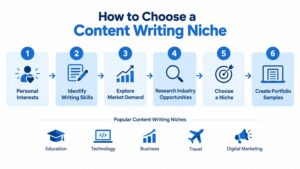
However, you do not need to select a permanent specialisation at the beginning. Experiment with different formats, understand what you enjoy and identify the subjects in which you can consistently produce accurate, useful content.
Here are a few areas worth exploring:
| Writing niche | What you may create | Who may need your skills |
| Education | Course guides, career articles and learning resources | Colleges, training institutes and e-learning companies |
| Technology | Software tutorials, product guides and technical blogs | IT companies, software businesses and technology publications |
| Business and finance | Industry explainers, business blogs and financial education articles | Businesses, publishers and financial service providers |
| Travel and lifestyle | Destination guides, travel articles and lifestyle blogs | Travel companies, tourism platforms and digital publishers |
| Digital marketing | SEO blogs, landing pages and promotional campaigns | Marketing agencies, startups and online businesses |
Three questions to ask before choosing a niche
- Can you stay curious about the subject? Writing regularly becomes easier when you enjoy learning about the topics you cover.
- Can you research it responsibly? A good writer must be willing to verify information, understand unfamiliar concepts and explain them accurately.
- Are there relevant opportunities? Explore job descriptions, company websites and freelance project listings to understand what clients expect from writers in your chosen area.
Once you identify a promising niche, create two or three relevant portfolio samples and ask for feedback. You can then refine your approach based on the quality of your work and the opportunities available.
Remember, specialisation is not about limiting yourself. It is about developing enough knowledge in a particular area to produce content that readers and employers can trust.
Choosing an Education Path That Supports Your Career Goals
A content writing career can begin through several routes, but the right choice depends on your circumstances.
If you are completing school, an undergraduate programme may help you develop a broad academic foundation. If you already have a degree, a short course or postgraduate qualification may be more relevant to your goals. If you are working, a flexible study arrangement could make it easier to balance education with employment.
For learners researching a BA correspondence college in Bangalore, it is important to compare academic recognition, eligibility, course structure and available support before applying. The same care should be taken when researching distance education in Bangalore or programmes offered by institutions in other parts of India.
Your decision should be considered more than convenience. Ask whether the programme suits your interests, provides the qualification you need and leaves enough time to develop practical writing skills.
You can also explore UCC to learn more about the institution and review the information available about its educational offerings. Always confirm current programme details, eligibility and recognition directly before making an admission decision.
Remember that your degree and your writing portfolio serve different purposes. Your education demonstrates academic preparation, while your portfolio shows how you communicate ideas in practice. Combining both can help you present a stronger profile to potential employers.
Conclusion: Start With Curiosity, Build With Practice
A career in content writing is not built by learning a few keywords or completing one certificate. It develops through consistent practice, research, editing, feedback and a genuine interest in helping people understand information.
The opportunities are varied. You could write educational blogs, explain technology products, create advertising campaigns, develop social media content or specialise in technical documentation. The best path is the one that matches your strengths and gives you room to keep learning.
You do not need to have everything figured out before you begin. Start with one subject, write your first sample, improve it and gradually build a portfolio that demonstrates your abilities.
If education is part of your plan, compare suitable programmes carefully and choose one that supports your long-term goals. United Correspondence College encourages learners to explore their educational options thoughtfully and focus on developing the knowledge and skills needed for their chosen careers.
Frequently Asked Questions (FAQs)
1. What qualifications do you need to become a content writer in India?
There is no single mandatory degree for every content writing position. Employers may prefer graduates in English, journalism, mass communication, marketing or related subjects, while some roles welcome candidates from other academic backgrounds. Strong writing, research, editing skills and a relevant portfolio can improve your prospects.
2. Can I become a content writer without experience?
Yes. Begin by learning the basics, writing original sample articles and creating a small portfolio. You can then apply for internships, junior positions or suitable freelance projects. Clearly label practice work and focus on demonstrating your abilities rather than claiming experience you do not have.
3. Which course is best for a content writing career?
The best course depends on your current qualifications and career goals. A language or communication degree can build a foundation, while a short-term certificate may help you learn practical writing and SEO skills. Review the syllabus, assignments, feedback and recognition before enrolling.
4. How much does a content writer earn in India?
Earnings vary according to experience, specialisation, location, employer and employment arrangement. Beginners and experienced specialists may receive very different offers. Check recent job listings and compare the responsibilities, benefits and skills required instead of relying on one general salary estimate.
5. Is content writing a good career for beginners?
It can be a suitable option for people who enjoy researching, explaining ideas and communicating with different audiences. Beginners should expect to practise consistently, accept feedback and develop a portfolio. The field can be competitive, so continuous learning and specialisation can help.
6. Can I work as a freelance content writer?
Yes. Freelancers may write blogs, website pages, social media posts, product descriptions and other material for clients. However, freelance work requires more than writing: you must also find clients, agree on project requirements, meet deadlines and manage payments.
7. Is SEO necessary for content writers?
SEO is useful for many digital writing roles, especially blog and website content. Understanding search intent, keyword research, headings and internal links can help you create relevant material. However, not every writing job requires the same level of SEO knowledge.
8. Will AI tools replace content writers?
AI is changing how content is researched and drafted, but its impact differs across roles. Writers who develop subject expertise, fact-checking, original research, editing and audience understanding can offer value beyond basic automated text generation. Learning to use AI responsibly can also be beneficial.
9. Can I study through distance education while preparing for a writing career?
Depending on the programme and institution, distance learning may offer flexibility for students and working professionals. Check eligibility, recognition, examination arrangements and course requirements before enrolling. You should also reserve time for writing practice and portfolio development.
10. How can I choose the right correspondence degree college?
Compare the institution’s recognition status, programme-specific approvals, eligibility criteria, curriculum, fees, assessment process and student support. Verify details through official sources and confirm that the qualification meets your academic and career requirements before making a decision.
Ready to take the next step? Explore UCC, review the available educational information and choose a learning pathway that fits your aspirations. For programme-related questions, visit the website and use its available contact options to seek clarification before applying.