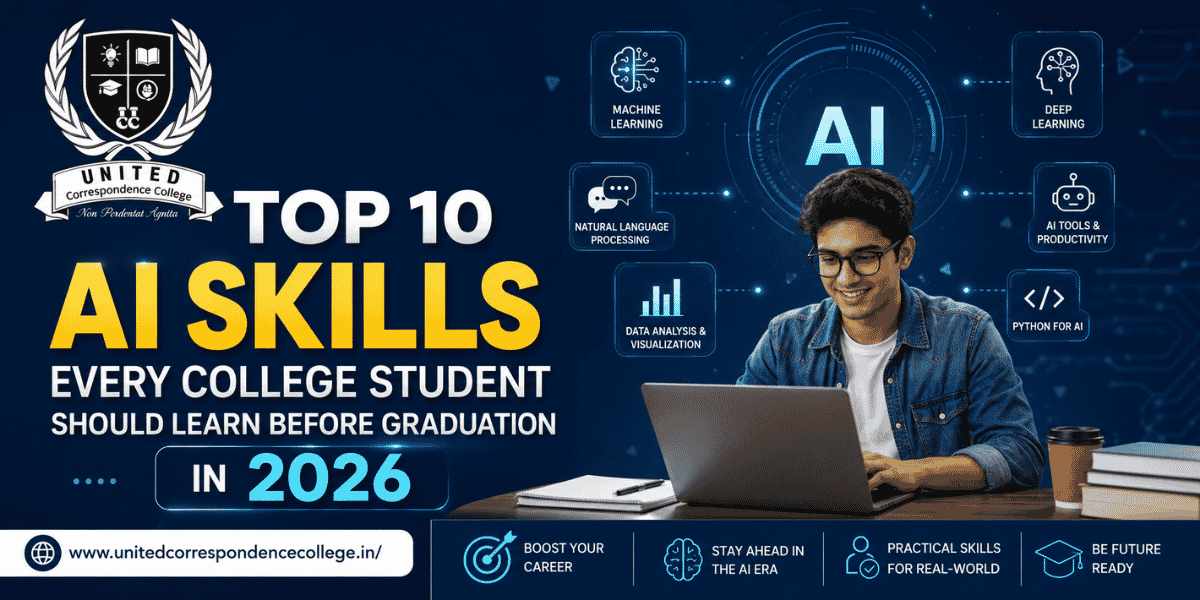
The Top 10 AI Skills every college student should learn are no longer optional—they are becoming essential for building a successful career in 2026 and beyond. Whether you’re studying engineering, management, commerce, science, or computer applications, Artificial Intelligence (AI) is transforming every industry. Employers today seek graduates who understand AI tools, automation, data analysis, and problem-solving rather than relying solely on academic scores. Learning the Top 10 AI Skills before graduation helps students become job-ready, increases internship opportunities, and improves earning potential. This guide explores the most valuable AI skills, learning resources, career paths, and practical tips to help students stay ahead in today’s competitive job market.
Why AI Skills Matter More Than Marks in 2026?
The employment landscape has changed dramatically over the past few years. Companies now value practical skills, adaptability, and technology awareness alongside academic qualifications. Artificial Intelligence is no longer limited to software companies—it has become an integral part of healthcare, banking, manufacturing, education, retail, finance, marketing, logistics, and even government services.
Graduates who master the Top 10 AI Skills gain a significant advantage because they can solve real-world problems using modern technologies. AI-powered tools improve productivity, automate repetitive tasks, and support better decision-making. Recruiters increasingly prioritize candidates who demonstrate AI proficiency through certifications, projects, and portfolios.
Some reasons why AI skills matter include:
- Growing demand for AI-enabled professionals
- Higher starting salary packages
- Better internship opportunities
- Increased productivity in every profession
- Stronger resume and LinkedIn profile
- Improved problem-solving capabilities
- Future-proof career opportunities
Whether you’re pursuing technical or non-technical education, learning AI before graduation can significantly improve your employability.
Why Students Should Learn AI Before Graduation?
| Benefit | Career Impact |
| AI Knowledge | Better employability |
| Automation Skills | Higher workplace productivity |
| Practical Projects | Stronger resume |
| AI Certifications | Improved interview performance |
| Prompt Engineering | Better use of AI tools |
| Portfolio Building | Competitive advantage |
What is Artificial Intelligence?
Artificial Intelligence (AI) refers to computer systems designed to perform tasks that typically require human intelligence. These tasks include learning, reasoning, decision-making, language understanding, image recognition, and problem-solving.
Today, AI powers many technologies students use every day, such as:
- ChatGPT
- Claude AI
- Google Gemini
- Microsoft Copilot
- Siri
- Alexa
- Netflix Recommendations
- Google Maps
- Amazon Shopping Suggestions
- Self-driving vehicle technologies
Understanding AI basics is the first step toward mastering the Top 10 AI Skills needed in modern workplaces.
Artificial Intelligence includes several important areas:
- Machine Learning (ML)
- Deep Learning
- Natural Language Processing (NLP)
- Computer Vision
- Robotics
- Generative AI
- Predictive Analytics
Students don’t need to become AI researchers immediately. Instead, learning how AI works and how to use AI-powered tools effectively is enough to create a competitive advantage before graduation.
Artificial Intelligence Skills
The demand for AI professionals is increasing every year, but employers are not only looking for software developers. Marketing executives, business analysts, engineers, healthcare professionals, finance graduates, and managers are all expected to understand AI technologies.
Below are the first five of the Top 10 AI Skills every student should develop before completing their degree.
1. Prompt Engineering
Prompt Engineering is one of the fastest-growing AI skills in 2026. It involves writing clear and effective instructions for AI tools to generate accurate, useful, and creative outputs.
Students should learn how to use tools like:
- ChatGPT
- Claude AI
- Google Gemini
- Microsoft Copilot
Strong prompt engineering skills help with:
- Writing reports
- Coding assistance
- Research
- Resume building
- Presentation creation
- Business planning
- Assignment drafting
Mastering prompts significantly increases productivity regardless of your academic background.
2. AI Productivity Tools
Every college student should become familiar with AI-powered productivity tools.
Popular tools include:
- ChatGPT
- Claude AI
- Notion AI
- Grammarly AI
- Canva AI
- Perplexity AI
- Microsoft Copilot
These applications help students:
- Save time
- Improve writing
- Conduct faster research
- Organize notes
- Generate presentations
- Brainstorm ideas
Learning to use AI tools responsibly is one of the easiest ways to develop the Top 10 AI Skills before graduation.
3. Python Programming
Python remains the most popular programming language for Artificial Intelligence.
Students should understand:
- Variables
- Loops
- Functions
- Libraries
- Data Structures
- Basic Object-Oriented Programming
Popular AI libraries include:
- NumPy
- Pandas
- Matplotlib
- Scikit-learn
- TensorFlow
- PyTorch
Even beginners can start with basic Python and gradually move toward machine learning.
Students pursuing BCA distance education often begin learning Python early because it serves as the foundation for AI, automation, and data science careers.
4. Data Analysis
Artificial Intelligence depends heavily on data.
Students should learn:
- Excel
- SQL
- Power BI
- Tableau
- Google Sheets
- Data Cleaning
- Data Visualization
Organizations rely on data-driven decisions, making analytical skills valuable across industries.
Whether you become a software developer, business analyst, marketing executive, or entrepreneur, understanding data improves decision-making.
5. Machine Learning Fundamentals
Machine Learning enables computers to learn from data without being explicitly programmed.
Students should understand concepts such as:
- Supervised Learning
- Unsupervised Learning
- Classification
- Regression
- Model Training
- Feature Engineering
A deep mathematical understanding isn’t necessary initially. Instead, students should focus on practical applications and simple projects.
Learners enrolled in MCA distance education in Bangalore often explore these concepts in greater depth while building advanced programming and AI development skills.
6. Generative AI Applications
Generative AI is one of the fastest-growing technologies transforming education, business, healthcare, engineering, and software development. It enables computers to generate text, images, videos, presentations, code, and even music using advanced AI models.
College students should learn how to use Generative AI responsibly for:
- Content creation
- Academic research
- Coding assistance
- Business presentations
- Resume writing
- Email drafting
- Marketing campaigns
- Graphic design
- Video scripting
Popular Generative AI tools include:
- ChatGPT
- Claude AI
- Google Gemini
- Microsoft Copilot
- Canva AI
- Adobe Firefly
- Midjourney
Understanding Generative AI is now one of the Top 10 AI Skills because almost every modern workplace integrates AI-powered productivity tools into daily operations.
7. AI Automation (No-Code & Low-Code)
Automation is becoming an essential workplace skill. Students no longer need advanced programming knowledge to automate repetitive tasks.
Popular no-code automation platforms include:
- Zapier
- Make (Integromat)
- Microsoft Power Automate
- n8n
- Airtable Automations
Examples of AI automation include:
- Automatically replying to emails
- Generating reports
- Managing customer support
- Scheduling meetings
- Creating social media posts
- Data synchronization
Learning automation allows students to save time while improving efficiency, making it one of the most practical Top 10 AI Skills.
8. Responsible AI & Data Ethics
As Artificial Intelligence becomes more powerful, ethical use becomes equally important.
Students should understand:
- AI bias
- Data privacy
- Responsible AI usage
- Copyright issues
- AI transparency
- Security concerns
- Ethical decision-making
Employers increasingly value professionals who understand both AI capabilities and its limitations.
Learning responsible AI helps students use technology ethically while protecting user privacy and organizational data.
9. Cloud AI Platforms
Most AI applications today run on cloud platforms rather than local computers.
Students should become familiar with:
- Microsoft Azure AI
- Google Cloud AI
- Amazon Web Services (AWS AI)
- IBM Watson
- Hugging Face
Basic cloud knowledge helps students understand how AI applications are deployed and managed in real-world environments.
This knowledge becomes especially valuable for careers in software development, cloud computing, DevOps, cybersecurity, and AI engineering.
10. AI Communication & Problem Solving
Technical knowledge alone is not enough.
Employers expect graduates to:
- Explain AI solutions clearly
- Solve business problems
- Think critically
- Collaborate with teams
- Present AI-driven insights
- Adapt to changing technologies
Strong communication combined with AI literacy makes graduates highly valuable across industries.
The ability to solve practical problems using AI tools is the final and perhaps most important skill among the Top 10 AI Skills every student should develop.
AI Course
Students frequently ask whether they need a dedicated AI degree to learn Artificial Intelligence. The answer is no. Today, there are many flexible ways to develop AI expertise alongside your regular studies.
You can strengthen your AI knowledge through:
- Online certification programs
- Practical AI projects
- Coding bootcamps
- Internship experiences
- Open-source contributions
- Industry workshops
- AI hackathons
If you’re already pursuing a computer applications or IT program, you can integrate AI learning into your academic journey. Students enrolled in an IT correspondence college in Bangalore can complement their coursework with AI certifications and hands-on projects to improve their career prospects.
Similarly, learners opting for distance education in Bangalore have access to flexible learning opportunities that allow them to build AI skills without disrupting their existing academic or professional commitments.
How To Become AI Engineer?
Many students believe becoming an AI Engineer requires years of advanced mathematics or a specialized AI degree. While technical knowledge is important, a structured learning approach can help students from various academic backgrounds build a successful AI career.
Step 1: Learn Programming
Start with:
- Python
- SQL
- Git
- Basic Algorithms
Python remains the most widely used language for AI development.
Step 2: Understand Mathematics
Focus on:
- Linear Algebra
- Statistics
- Probability
- Basic Calculus
These concepts help in understanding machine learning algorithms.
Step 3: Learn Machine Learning
Study topics like:
- Classification
- Regression
- Decision Trees
- Clustering
- Model Evaluation
Practice using Scikit-learn.
Step 4: Learn Deep Learning
Understand neural networks using:
- TensorFlow
- PyTorch
- Keras
Deep Learning powers applications such as computer vision and natural language processing.
Step 5: Build Real Projects
Examples include:
- AI Chatbots
- Image Classifiers
- Resume Screening Systems
- Recommendation Engines
- Sentiment Analysis
- Voice Assistants
Projects strengthen your portfolio and demonstrate practical expertise to recruiters.
Step 6: Earn AI Certifications
Recommended certifications:
- Google AI Essentials
- Microsoft AI Engineer
- IBM AI Professional Certificate
- AWS AI Practitioner
- DeepLearning.AI Courses
- NVIDIA AI Certifications
Step 7: Build Your Portfolio
Upload projects to:
- GitHub
- Kaggle
- Personal Website
Recruiters often value practical work more than theoretical knowledge.
Students pursuing IT distance education can build these skills alongside their academic programs by consistently working on AI projects and earning recognized certifications.
Best Free AI Tools Every Student Should Use
Students don’t need expensive software to start learning AI. Many powerful AI tools offer free versions suitable for learning, productivity, and project development.
| AI Tool | Best Use |
| ChatGPT | Learning, writing, coding |
| Claude AI | Research, summaries, reports |
| Google Gemini | Google Workspace productivity |
| Perplexity AI | AI-powered research |
| GitHub Copilot | Programming assistance |
| Canva AI | Design and presentations |
| Grammarly AI | Grammar and writing improvement |
| Notion AI | Notes, planning, productivity |
Using these tools regularly helps students apply the Top 10 AI Skills in real-world scenarios and become more efficient learners.
AI Skills by Degree
Artificial Intelligence is no longer limited to Computer Science students. Every academic discipline can benefit from AI knowledge.
BCA Students
Students pursuing bca distance education in Bangalore should focus on:
- Python
- Machine Learning
- SQL
- Prompt Engineering
- AI Projects
- GitHub Portfolio
These skills prepare them for roles such as AI Developer, Data Analyst, and Software Engineer.
MCA Students
Students enrolled in MCA distance education in Bangalore can build advanced expertise in:
- Deep Learning
- Natural Language Processing
- Computer Vision
- Cloud AI
- AI System Design
These skills support careers in AI Engineering, Machine Learning Engineering, and AI Research.
Engineering Students
Engineering students should focus on:
- Robotics
- AI Automation
- IoT
- Embedded AI
- Industrial AI Applications
MBA Students
Management students should learn:
- AI for Business Analytics
- Predictive Analytics
- AI Marketing Tools
- Customer Intelligence
- AI Strategy
Commerce Students
Useful AI skills include:
- Financial Analytics
- AI Accounting Tools
- Excel Automation
- Business Intelligence
Science Students
Science graduates should focus on:
- Data Science
- AI Research
- Bioinformatics
- Scientific Computing
Students pursuing distance education in Bangalore can combine flexible academic programs with AI certifications and practical projects to stay competitive in today’s evolving job market.
Recommended AI Skills by Degree
| Degree | AI Skills to Learn |
| BCA | Python, Prompt Engineering, SQL |
| MCA | Deep Learning, NLP, Cloud AI |
| Engineering | Robotics, IoT, AI Automation |
| MBA | AI Analytics, Business Intelligence |
| Commerce | Financial AI, Excel Automation |
| Science | Data Science, Research AI |
How to Build an AI Portfolio Before Graduation?
Learning Artificial Intelligence is important, but showcasing your skills is equally essential. Recruiters often prefer candidates who can demonstrate practical experience through projects rather than only listing certifications on a resume. A well-structured portfolio highlights your ability to solve real-world problems and significantly improves your chances of landing internships and full-time roles.
Here are some effective ways to build a strong AI portfolio:
Create Real AI Projects
Work on projects that solve practical problems, such as:
- AI Chatbot using ChatGPT API
- Image Classification System
- Student Attendance Predictor
- Resume Screening Tool
- AI-Powered Expense Tracker
- Fake News Detection Model
- Recommendation System
- AI Voice Assistant
- Smart Healthcare Prediction
- Customer Sentiment Analysis
These projects help demonstrate your understanding of AI concepts and tools.
Build a GitHub Profile
Upload all your AI projects to GitHub with:
- Well-written documentation
- Source code
- Installation guide
- Screenshots
- Demo videos
Recruiters frequently review GitHub profiles before interviews.
Participate in Kaggle Competitions
Kaggle provides datasets and competitions where students can practice solving real machine learning problems.
Benefits include:
- Practical experience
- Global rankings
- Portfolio enhancement
- Exposure to industry datasets
Optimize Your LinkedIn Profile
Share:
- AI certifications
- Project updates
- Technical articles
- Learning milestones
- Hackathon participation
An active LinkedIn profile improves visibility among recruiters.
Build a Personal Website
Create a simple portfolio website that includes:
- About Yourself
- Projects
- Certifications
- Resume
- Contact Information
- GitHub Profile
- LinkedIn Profile
A personal website creates a professional impression.
Common Mistakes Students Make While Learning AI
Many students spend months learning AI but fail to secure opportunities because they focus on the wrong approach.
Avoid these common mistakes:
Learning Without Practice
Watching videos alone isn’t enough.
Every concept should be followed by:
- Coding
- Mini Projects
- Practical Assignments
Ignoring Python
Python remains the most widely used programming language in Artificial Intelligence.
Students who skip Python often struggle with advanced AI concepts.
Copy-Pasting AI Responses
AI tools like ChatGPT and Claude are learning assistants—not replacements for critical thinking.
Students should understand concepts instead of simply copying generated answers.
Skipping Mathematics Completely
While advanced mathematics isn’t required initially, basic knowledge of:
- Statistics
- Probability
- Linear Algebra
helps in understanding Machine Learning models.
Building No Portfolio
Recruiters prefer:
- GitHub Projects
- Kaggle Work
- AI Applications
- Technical Blogs
over certificates alone.
Ignoring Communication Skills
Many technically strong students struggle during interviews because they cannot explain their projects effectively.
Communication is equally important.
Best AI Certifications in 2026
Certifications validate your knowledge and strengthen your resume. While they do not replace practical experience, they demonstrate continuous learning and industry awareness.
Some of the most recognized AI certifications include:
- Google AI Essentials
- Microsoft AI Engineer Associate
- IBM AI Professional Certificate
- AWS Certified AI Practitioner
- DeepLearning.AI Machine Learning Specialization
- NVIDIA Deep Learning Institute Courses
- TensorFlow Developer Certificate
- Coursera Generative AI Programs
- Udemy AI Bootcamps
- LinkedIn Learning AI Courses
Choose certifications that include practical projects rather than only theoretical content.
Future Scope of AI Skills
The demand for AI professionals is expected to grow rapidly between 2026 and 2035. Artificial Intelligence is no longer confined to the technology sector. Industries worldwide are integrating AI into their daily operations to improve efficiency, reduce costs, and enhance customer experiences.
Professionals with expertise in the Top 10 AI Skills will find opportunities across various sectors, including:
- Healthcare
- Banking & Finance
- Education
- Manufacturing
- Retail
- Agriculture
- Logistics
- Marketing
- Cyber Security
- Government Services
Some of the fastest-growing AI career roles include:
- AI Engineer
- Machine Learning Engineer
- Prompt Engineer
- AI Product Manager
- Data Scientist
- AI Consultant
- AI Business Analyst
- Computer Vision Engineer
- NLP Engineer
- AI Research Scientist
According to industry reports, AI-related roles continue to offer competitive salaries and long-term career stability. Students who start developing AI skills before graduation will be better prepared for these opportunities.
Why Choose UCC?
Building AI skills becomes even more valuable when combined with a recognized academic qualification. UCC (United Correspondence College) supports students and working professionals by offering flexible learning options that help them continue their education while preparing for future-ready careers.
Whether you’re interested in BCA distance education, MCA distance education in Bangalore, or looking for an IT correspondence college in Bangalore, UCC provides academic guidance that allows learners to balance education with skill development. Students can simultaneously pursue AI certifications, work on projects, and strengthen their technical knowledge without interrupting their studies.
For professionals seeking flexibility, IT distance education and distance education in Bangalore programs make it easier to upgrade qualifications while staying aligned with emerging technologies like Artificial Intelligence. By combining formal education with the Top 10 AI Skills, learners can significantly improve their employability and career growth.
Conclusion
Artificial Intelligence is no longer a futuristic concept—it is a practical skill that every student should develop before entering the workforce. Mastering the Top 10 AI Skills helps college students improve productivity, strengthen problem-solving abilities, build impressive portfolios, and stay competitive in an evolving job market. Whether your goal is to become an AI Engineer, Data Scientist, Software Developer, Business Analyst, or Entrepreneur, learning AI early gives you a significant advantage.
Students should focus on building practical projects, learning Python, understanding Machine Learning fundamentals, mastering prompt engineering, and using AI tools responsibly. Combining these skills with recognized academic qualifications creates a strong foundation for long-term career success.
If you’re planning to upgrade your education while preparing for technology-driven careers, programs like BCA distance education, MCA distance education in Bangalore, and IT distance education provide the flexibility to learn at your own pace. Along with continuous learning, certifications, and hands-on projects, these programs help students become industry-ready.
With proper guidance from UCC (United Correspondence College), you can balance your academic journey while developing future-ready AI skills that employers value across industries.
Ready to Build Your AI Career Before Graduation?
The demand for AI-skilled professionals is growing across every industry. Don’t wait until after graduation to start learning.
At UCC (United Correspondence College), students can pursue flexible academic programs while simultaneously developing practical AI skills, certifications, and technical expertise. Whether you’re looking for BCA distance education, MCA distance education in Bangalore, or an IT correspondence college in Bangalore, UCC provides the support you need to prepare for tomorrow’s technology careers.
Contact UCC today and take the first step toward becoming an AI-ready professional in 2026.
FAQs
1. What are the most important AI skills every college student should learn?
The Top 10 AI Skills every college student should focus on include prompt engineering, Python programming, machine learning, data analysis, AI automation, cloud computing, Generative AI, problem-solving, communication, and responsible AI practices. These skills prepare students for careers in software development, data science, cybersecurity, business analytics, and AI engineering. Instead of relying only on theoretical knowledge, students should build practical projects, complete online certifications, and participate in hackathons to gain real-world experience. Those pursuing BCA distance education can strengthen their technical foundation while learning AI alongside their academic curriculum, making them more competitive for internships and high-paying technology roles after graduation.
2. Can non-technical students learn Artificial Intelligence?
Yes, non-technical students can successfully learn Artificial Intelligence with the right approach. AI is no longer limited to engineering or computer science graduates, as professionals in business, commerce, healthcare, education, marketing, and finance increasingly use AI tools in their daily work. Beginners can start by learning prompt engineering, AI productivity tools, basic data analysis, and no-code automation before progressing to more advanced concepts. Online courses, practical projects, and AI applications make learning accessible to everyone. Students pursuing distance education in Bangalore can combine flexible academic programs with AI certifications, enabling them to build future-ready skills without changing their degree or career path.
3. Is Python necessary to learn Artificial Intelligence?
Python is considered the most important programming language for Artificial Intelligence because of its simplicity, flexibility, and extensive collection of AI libraries such as TensorFlow, PyTorch, Pandas, NumPy, and Scikit-learn. While some AI tools allow users to work without coding, Python provides greater control over developing machine learning models, automation scripts, and data analysis projects. Learning Python also opens opportunities in data science, robotics, and software engineering. Students pursuing MCA distance education in Bangalore often study Python extensively while working on AI-based applications, helping them build strong technical expertise that employers highly value in today’s competitive job market.
4. Which AI tools should college students use daily?
College students should regularly explore AI tools that improve learning, productivity, creativity, and technical skills. Popular tools include ChatGPT for writing and coding assistance, Claude AI for research and summarization, Google Gemini for productivity, GitHub Copilot for programming, Canva AI for presentations, Grammarly AI for writing improvement, Notion AI for note-taking, and Perplexity AI for research. Using these platforms consistently helps students complete assignments faster while gaining practical AI experience. Students studying at an IT correspondence college in Bangalore can integrate these AI tools into daily coursework and projects, preparing themselves for technology-driven workplaces where AI proficiency is increasingly expected.
5. How long does it take to learn AI skills?
The time required to learn AI depends on your goals, background, and dedication. Students can understand AI fundamentals, prompt engineering, and productivity tools within one to three months through consistent practice. Developing advanced expertise in machine learning, deep learning, computer vision, and AI engineering usually requires six months to one year of project-based learning. Regular coding practice, certifications, and real-world applications accelerate the learning process. Students enrolled in IT distance education programs can comfortably balance academic studies with AI learning, allowing them to develop technical expertise gradually while maintaining flexibility in their education and professional commitments.
6. Are AI certifications worth it?
Yes, AI certifications are highly valuable because they validate your knowledge, demonstrate continuous learning, and strengthen your resume. Certifications from organizations like Google, Microsoft, IBM, AWS, NVIDIA, and DeepLearning.AI are widely recognized by employers across the technology industry. However, certifications alone are not enough. Recruiters also expect candidates to showcase practical AI projects, GitHub repositories, and real-world problem-solving abilities. Students pursuing bca distance education in Bangalore can significantly improve their employability by combining recognized AI certifications with hands-on experience, internships, and technical projects that demonstrate their ability to apply AI concepts effectively.
7. Can AI skills help students get better jobs?
Absolutely. AI skills are becoming one of the most valuable qualifications employers seek across industries, including software development, finance, healthcare, manufacturing, marketing, education, consulting, and e-commerce. Students with AI knowledge often stand out during campus placements because they can automate tasks, analyze data, and solve business problems using modern technologies. Employers also appreciate candidates who have practical AI portfolios, certifications, and project experience. Students pursuing BCA distance education while learning Artificial Intelligence gain a strong competitive advantage, making them eligible for internships, higher starting salaries, and faster career growth in today’s technology-driven employment market.
8. What is the future scope of AI careers?
The future of AI careers is exceptionally promising as Artificial Intelligence continues transforming nearly every industry worldwide. Organizations are investing heavily in Generative AI, machine learning, automation, robotics, cybersecurity, healthcare technologies, and intelligent business solutions. Career opportunities continue expanding for AI Engineers, Machine Learning Engineers, Data Scientists, AI Consultants, Prompt Engineers, Robotics Specialists, and AI Product Managers. Governments and private organizations are also increasing investments in AI research and innovation. Students pursuing MCA distance education in Bangalore while building AI skills, certifications, and practical project experience can prepare themselves for globally recognized careers offering excellent salaries, long-term stability, and continuous professional growth.