
Choosing a degree through distance education in Bangalore is no longer simply about finding a college with low fees and flexible classes. In 2026, students can compare hundreds of programmes across management, IT, commerce, science, teaching, engineering-related fields, arts, and professional disciplines. The bigger problem is knowing which course, university, learning mode and qualification actually fit your career plan.
A course can look attractive on a website and still be the wrong choice if its recognition does not match the admission session, its curriculum is outdated, its delivery model does not suit your schedule, or the qualification does not support your intended career path.
That is why the right approach is not:
“Which is the cheapest distance course?”
It is:
“Which recognised programme gives me the right qualification, learning flexibility, academic support and career value for my situation?”
This guide gives you a practical 10-point framework for making that decision. It also explains what students should verify before enrolling, how to compare correspondence colleges in Bangalore, where UCC can help, and how to shortlist courses such as BCA, MCA, BBA, MBA, B.Com, M.Com, BA, MA, B.Sc and other programmes.
Start With the Outcome, Not the College
One of the most common mistakes students make is beginning their search with a college name.
They search:
- Best distance college in Bangalore
- Distance education colleges in Bangalore
- Correspondence colleges in Bangalore
- Distance degree college near me
- Affordable online degree
- Best MBA distance course
Those searches are useful for discovery, but they should not determine the final decision.
Start with the outcome you want.
Ask yourself:
What should this qualification help me do two or three years from now?
For example:
| Your current situation | More relevant direction |
| 12th-pass student interested in technology | BCA / relevant IT degree |
| Graduate looking for management growth | MBA / management specialisation |
| Commerce graduate | M.Com / MBA / finance-oriented programme |
| Working IT professional | MCA / technology-focused postgraduate programme |
| Graduate preparing for a career switch | Specialised PG programme or relevant master’s |
| Teacher or education professional | Relevant teacher-education qualification, subject to eligibility and regulatory requirements |
| Working professional who cannot attend daily classes | Flexible ODL/online programme |
| Student looking for a general bachelor’s degree | BA / B.Com / BBA / B.Sc, depending on career objective |
This changes the entire search process.
Instead of comparing 20 colleges randomly, you can eliminate unsuitable programmes before spending time comparing them.
The 10-Point Distance Education Course Selection Test
Think of these ten checks as a filter.
A course should not move to your final shortlist simply because it has a familiar university name or an attractive fee.
It should pass the checks that matter to your qualification, career objective and admission session.
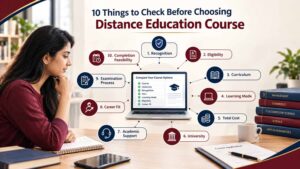
1. Verify Recognition for the Exact Admission Session
This should be your first serious check.
Do not assume that because a university offered a particular programme last year, the same programme automatically has the same recognition for your admission session.
The UGC specifically advises students to verify the recognition status of the higher educational institution and programme for the session in which they are taking admission. Previous-year recognition should not be treated as automatic recognition for the next session.
This distinction matters because distance and online education operate within regulatory frameworks that can change by academic year and programme.
What should you verify?
Before paying, check:
- Name of the awarding university
- Exact programme name
- Learning mode — ODL or Online
- Academic session
- Recognition/entitlement status
- Applicable regulatory approval
- Eligibility requirements
- Whether the programme is permitted in that mode
The safest source for checking ODL/online recognition is the UGC Distance Education Bureau.
The UGC currently publishes recognition and entitlement information for ODL and online programmes, including 2026-27 information.
Why this matters
A student should never evaluate a distance degree only on the basis of a counsellor’s statement such as “UGC approved.”
Ask:
Approved for which programme, which mode and which session?
That is a much stronger question.
The UGC regulations also provide for equivalence of recognised undergraduate and postgraduate degrees obtained through ODL/online modes with corresponding conventional-mode qualifications, subject to the applicable requirements.
2. Separate the College You Contact From the University That Awards Your Degree
This is an important distinction that students often overlook.
When researching distance education in Bangalore, you may communicate with a counselling centre, admission consultant, learning support organisation or education platform.
But the awarding university is the institution that ultimately governs matters such as:
- Admission
- Examination
- Evaluation
- Results
- Mark sheets
- Degree certificate
- Academic regulations
This is particularly important when comparing different correspondence degree colleges in Bangalore.
UCC, for example, describes itself as an education consultancy that helps students and working professionals enrol in flexible programmes offered by approved universities. Its website also states that final authority over admission, examinations, results and certification rests with the awarding university.
That gives you a useful question to ask any provider:
“Who exactly will award my degree?”
Then verify that university and programme independently.
3. Don’t Choose a Course Because Its Name Sounds Career-Friendly
“Technology,” “AI,” “Business Analytics,” “Management,” and “International Business” can sound impressive.
But the course title is only the surface.
Look underneath it.
Check the curriculum
For an IT-related course, investigate whether the curriculum covers areas relevant to the role you want.
For example, a student targeting software or IT careers may want to examine subjects such as:
- Programming
- Database management
- Computer networks
- Web technologies
- Software development
- Data structures
- Operating systems
- Cloud or emerging technologies, where relevant
For management, look at areas such as:
- Finance
- Marketing
- Human resources
- Operations
- Business analytics
- Strategic management
- Entrepreneurship
For commerce, investigate the depth of:
- Accounting
- Taxation
- Economics
- Corporate finance
- Business law
- Auditing
- Financial management
The important point is simple:
Do not compare course names. Compare what you will actually study.
4. Decide Whether You Need ODL, Online or Another Flexible Format
Students often use “distance education” and “online education” interchangeably.
They are related, but the actual learning experience can differ.
A programme may involve:
- Printed study material
- Digital study material
- LMS access
- Recorded lectures
- Online academic support
- Online classes
- Physical or designated examination arrangements
- Hybrid elements
Before admission, ask exactly how the course works.
Ask these questions
How do I receive study materials?
Are classes live, recorded or both?
How are doubts handled?
Where are examinations conducted?
How frequently do I need to attend any physical activity?
Is there an LMS?
What happens if I miss a live session?
The best mode depends on your circumstances.
A full-time employee may prioritise asynchronous learning.
A fresh graduate may prefer more structured academic interaction.
A student preparing for competitive exams may need a programme with predictable academic schedules.
The right mode is the one you can realistically complete.
5. Calculate the Real Cost — Not Just the Advertised Course Fee
A low headline fee does not automatically mean a low-cost degree.
Before comparing distance education colleges in Bangalore, calculate the total expected cost.
Consider:
| Cost component | What to check |
| Tuition fee | Total programme fee or annual fee |
| Examination fee | Included or separate? |
| Study material | Included? |
| Application fee | One-time or recurring? |
| University charges | Any additional charges? |
| Practical/lab charges | Applicable to your programme? |
| Project fee | Applicable in final semester/year? |
| Travel | Required for exams or activities? |
| EMI | Available? |
| Refund policy | What happens after payment/enrolment? |
This prevents a common problem: comparing one institution’s annual tuition with another institution’s complete programme cost.
UCC currently highlights flexible fee options and EMI availability on its course pages, but students should still ask for the complete fee structure applicable to their chosen university and programme before making payment.
A Search Map: What Students Are Actually Looking For
Students rarely search only for the exact phrase “distance education course.”
Their searches become more specific as they move closer to admission.
| Search type | Example query | What the student is trying to find |
| Discovery | distance education in Bangalore | Available options |
| Local | distance education colleges in Bangalore | Institutions/providers |
| Course-specific | BCA distance education | A particular qualification |
| Provider-specific | correspondence colleges in Bangalore | Flexible study providers |
| Proximity | distance degree college near me | Local support/admission |
| Career-focused | distance MBA for working professionals | Career compatibility |
| Recognition | UGC approved distance degree | Validity |
| Cost | affordable distance MBA | Budget fit |
| Support | distance education admission assistance | Application help |
| Comparison | online vs distance degree | Learning-mode decision |
This is why a good course-selection strategy should not focus only on the institution.
It should connect search intent → programme → university → career objective → admission decision.
6. Check Whether the Course Fits Your Current Qualification
Do not assume every distance course is open to every student.
Eligibility can vary significantly by programme and university.
Generally, undergraduate programmes require a recognised 10+2 qualification, while postgraduate programmes usually require a bachelor’s degree. However, exact eligibility can vary by programme and awarding university. UCC also states that programme-specific eligibility should be checked with the selected university.
Before applying, confirm:
- Required previous qualification
- Required subjects
- Minimum marks
- Entrance requirements, if any
- Work-experience requirements, if applicable
- Age requirements, if applicable
- Special eligibility conditions
This becomes particularly important for regulated or professionally oriented programmes.
For example, students considering teacher education should not assume that a generic “online education” listing automatically makes them eligible. NCTE maintains recognised institution information and specific regulatory requirements for teacher-education programmes.
7. Examine the University Behind the Course, Not Just Its Advertisement
A good-looking course page can answer “what is being offered.”
It does not necessarily answer “who is awarding it and how strong is the academic structure?”

When comparing correspondence colleges in Bangalore, investigate the university itself.
Look for:
- Institutional recognition
- Programme recognition
- Academic reputation
- Faculty/support structure
- Examination system
- Student services
- Learning platform
- Study materials
- Previous academic track record
- Availability of the exact specialisation you want
Do not rely solely on badges such as “approved,” “recognised,” or “government certified.”
Ask for the exact regulatory basis.
This is especially important because UGC has recently warned students about misleading EdTech and franchise arrangements involving ODL/online degrees. Its 2026 public notice says students should check recognition or entitlement status on the UGC DEB website before enrolling.
That single verification step can eliminate many risky options.
You can naturally add this sentence in the career/course selection section:
“Students planning a career in technology can also explore the top distance education courses for IT jobs in 2026 to compare suitable study options and career pathways.”
8. Check What Support Exists After You Pay
This is where many comparisons become too shallow.
Two programmes can have similar fees and similar academic structures but deliver very different student experiences.
Distance learners do not have a classroom where they can simply walk up to a teacher after a lecture.
So support becomes a practical part of course quality.
Ask about:
Admission support
Who checks your documents?
Academic support
Who helps when you have questions?
Learning support
How do you access study material?
Examination support
Where do you get exam information?
Administrative support
Who helps with university-related procedures?
Career support
Is there career guidance or placement assistance?
Student communication
How are important announcements communicated?
UCC positions its student support around admission through graduation and offers counselling based on educational background, career goals, available time and budget.
That type of support can be particularly useful for working professionals who do not have the time to resolve every administrative issue themselves.
9. Compare the Course With Your Career Timeline
A distance degree is not useful simply because you finish it.
The better question is:
What can I do with the qualification while I am studying and after I graduate?
Imagine two students.
Student A
A working executive wants to move into management.
An MBA may fit the career direction better than starting another unrelated undergraduate qualification.
Student B
A graduate wants to move into software development.
An IT-oriented postgraduate programme may make more sense than choosing a general management programme simply because it is popular.
Student C
A commerce graduate wants broader career options.
An M.Com or MBA could be considered depending on whether the student wants deeper commerce knowledge or a management-oriented career path.
The programme should support the next career move.
This is why UCC’s current catalogue covers multiple academic categories rather than limiting students to one type of qualification. Its website lists management, IT, science, commerce, traditional, teaching, engineering and other course categories.
10. Which Courses Should You Consider in 2026?
There is no universally “best” distance course.
There is only a better fit for a particular student.
UCC currently lists programmes including BBA, MBA, BCA, MCA, B.Sc, M.Sc, BA, MA, B.Com, M.Com, PG Diploma and various other programmes.
Here is a practical way to think about them.
BCA
A potential option for students who want to build an academic foundation in computer applications and technology.
UCC currently lists BCA as a three-year UGC-approved programme on its website.
MCA
A postgraduate option for graduates who want to deepen their computer applications and technology education.
UCC currently lists MCA among its IT programmes.
BBA
Suitable for students looking for an undergraduate management foundation covering business-oriented subjects.
MBA
A common choice for graduates and working professionals who want a management-focused postgraduate qualification.
UCC currently lists MBA as a two-year programme with specialisations including areas such as marketing management.
B.Com
A useful route for students interested in accounting, finance, commerce, business and related fields.
UCC describes its B.Com as a three-year undergraduate programme covering areas including accounting, finance, business management, economics and taxation.
M.Com
A postgraduate commerce option for graduates who want to continue in commerce, finance, accounting or related academic/corporate pathways.
BA / MA
Traditional degree routes can work well when the student’s career or higher-study plans align with humanities, social sciences or related disciplines.
PG Diploma
A PG Diploma may be useful when a student wants focused postgraduate-level learning rather than another full degree.
UCC currently lists PG Diploma options across areas such as technology, management, finance, HR, international business, operations, IT management and business analytics. Explore PG Diploma options at UCC
Ask One Final Question: “Can I Actually Finish This Course?”
This may be the most practical test of all.
Distance learning gives flexibility, but flexibility is not the same as zero commitment.
Before enrolling, think about your weekly reality.
If you work from 9 AM to 7 PM:
- When will you study?
- How will you prepare for exams?
- How will you complete assignments?
- When will you attend required sessions?
- How will you manage project work?
- What happens during busy work periods?
A programme that looks perfect on paper is not the right programme if its academic requirements consistently conflict with your lifestyle.
Try this before admission
Take your preferred course and create a simple weekly schedule.
For example:
| Activity | Weekly commitment |
| Reading/study | 5–7 hours |
| Recorded/live learning | 2–4 hours |
| Assignment/project work | 2–3 hours |
| Revision | 2 hours |
| Exam preparation | Additional during exam period |
The exact workload varies by university and programme, but the exercise is valuable.
If you cannot realistically create time for the course, reconsider the programme before paying.
A Better Way to Compare Distance Education Colleges in Bangalore
Once you have shortlisted two or three options, stop comparing them based on advertisements.
Create a decision sheet.
| Checkpoint | College/Provider A | College/Provider B | UCC-guided option |
| Awarding university verified | ✓ / ✗ | ✓ / ✗ | ✓ / ✗ |
| Exact programme verified | ✓ / ✗ | ✓ / ✗ | ✓ / ✗ |
| Session recognition checked | ✓ / ✗ | ✓ / ✗ | ✓ / ✗ |
| Eligibility confirmed | ✓ / ✗ | ✓ / ✗ | ✓ / ✗ |
| Learning mode suitable | ✓ / ✗ | ✓ / ✗ | ✓ / ✗ |
| Total fee understood | ✓ / ✗ | ✓ / ✗ | ✓ / ✗ |
| Examination process clear | ✓ / ✗ | ✓ / ✗ | ✓ / ✗ |
| Academic support available | ✓ / ✗ | ✓ / ✗ | ✓ / ✗ |
| Career objective matches | ✓ / ✗ | ✓ / ✗ | ✓ / ✗ |
| Admission assistance | ✓ / ✗ | ✓ / ✗ | ✓ / ✗ |
The winner is not necessarily the institution with the most features.
It is the option with the fewest unanswered questions.
Where UCC Fits Into the Decision
Students searching for distance education in Bangalore often face a practical problem: there are too many programmes and universities to compare independently.
UCC’s role is positioned around helping students identify suitable flexible-learning programmes and supporting the admission process.
Its current website lists 500+ courses across categories including:
- Engineering
- Management
- IT and Computer Science
- Science
- Commerce
- Traditional degrees
- Teaching
- Library Science
- Diploma and other programmes
The website also states that programmes are sourced through approved universities and that students can receive guidance based on their educational background, career goals, time availability and budget.
The advantage for a student is not simply having a large course catalogue.
The useful part is being able to narrow the catalogue down.
For example:
12th pass → career objective → preferred field → eligibility → university → programme → mode → fees → admission
That is a much more useful decision path than simply browsing a long list of courses.
What Should You Ask a UCC Counsellor Before Admission?
If you are considering a programme through UCC, do not limit your questions to:
“What is the fee?”
Instead, ask:
- Which university awards the degree?
- What is the exact programme name?
- Is the programme ODL, online or hybrid?
- What is the recognition status for my admission session?
- What is the eligibility criteria?
- What is the complete fee structure?
- Are examination fees separate?
- How will I receive study material?
- How are examinations conducted?
- What academic support is provided?
- What is the cancellation/refund policy?
- What career options align with this programme?
- Are there any mandatory physical requirements?
- What documents are required?
- What is the expected admission timeline?
A provider that answers these questions clearly gives you much more useful information than one that only sends a brochure.
Don’t Make These 7 Distance Education Mistakes
Mistake 1: Choosing by fee alone
The cheapest programme is not automatically the best-value programme.
Mistake 2: Checking only the university name
Recognition should be checked for the relevant programme, mode and session.
Mistake 3: Assuming online and ODL are identical
Ask how learning, assessments and examinations actually work.
Mistake 4: Selecting a course because everyone else is doing it
A popular MBA is still the wrong choice if your career requires a different qualification.
Mistake 5: Ignoring eligibility
A course you cannot legitimately enrol in is not an option.
Mistake 6: Not asking who awards the degree
The provider and awarding university may not be the same entity.
Mistake 7: Waiting until admission to understand the process
Know the fee, eligibility, examination, learning and documentation requirements before paying.
A 15-Minute Pre-Admission Audit
If you have already shortlisted a programme, use this quick audit.
Minute 1–3: Recognition
Open the UGC DEB website and verify the university/programme for the relevant session.
Minute 4–5: Eligibility
Read the university’s eligibility conditions.
Minute 6–8: Curriculum
Download or review the syllabus.
Ask:
Does this actually teach what I need?
Minute 9–10: Delivery
Check LMS, classes, study materials, examinations and academic support.
Minute 11–12: Fees
Calculate the full programme cost.
Minute 13–14: Career fit
Write down three roles or career directions the qualification should support.
If you cannot connect the course to a realistic career or higher-study objective, pause before applying.
Minute 15: Final verification
Confirm the awarding university, programme, mode and admission session one more time.
This small process can prevent a major academic mistake.
Frequently Asked Questions About Choosing Distance Education in 2026
Is distance education valid in India in 2026?
Recognised ODL and online programmes can be valid, but students should verify the recognition/entitlement status of the specific higher educational institution and programme for the admission session they are entering. The UGC maintains the official DEB information for this purpose.
How do I choose the best distance education course?
Start with your career objective, then compare eligibility, programme recognition, curriculum, learning mode, total fees, examination process, academic support and university reputation. Do not select a course only because it is inexpensive or popular.
Are correspondence colleges in Bangalore the same as distance universities?
Not necessarily. A student may deal with a local education provider or support centre while the actual degree is awarded by a university. Always identify and independently verify the awarding university and programme.
What should I check before joining a distance degree college near me?
Check the awarding university, exact programme, recognition for your admission session, eligibility, fees, learning mode, examinations, support and cancellation/refund conditions. Physical proximity should be a secondary consideration if most learning is remote.
Is an MBA through distance education suitable for working professionals?
It can be suitable when the programme is recognised, the curriculum fits the student’s career objective and the learning schedule can be managed alongside work. UCC currently offers MBA options designed around flexible learning for professionals.
Is BCA a good distance education option for an IT career?
BCA can provide an undergraduate foundation in computer applications and related areas. However, students should evaluate the curriculum and their intended career path rather than assuming that the degree alone guarantees employment. UCC currently lists BCA among its IT programmes.
Should I choose online or correspondence learning?
Choose based on how you learn and how much structure you need. Online programmes may provide stronger digital interaction, while ODL may offer a different combination of self-study, materials and academic support. Verify the exact delivery model before enrolling.
Can I work while studying through distance education?
That is one of the main reasons students choose flexible programmes. However, the course still requires regular study, assignment/project work and examination preparation. Check the actual academic schedule before assuming the workload will be minimal.
The Final Decision: Choose the Course You Can Defend, Not Just the Course You Can Afford
The strongest distance education decision in 2026 is not based on a single factor.
It is the result of several checks working together:
Recognition + Eligibility + Career Fit + Curriculum + Learning Mode + Total Cost + University + Support + Completion Feasibility
If all nine make sense, you have a much stronger basis for admission.
For students researching distance education in Bangalore, the large number of available programmes can make the first step confusing. But the solution is not to collect more brochures. It is to ask better questions.
If you are considering BCA, MCA, BBA, MBA, B.Com, M.Com, BA, MA, B.Sc, PG Diploma or another flexible programme, UCC can help you compare available options according to your qualification, career objective, budget and preferred learning format.
Talk to UCC about course options and admission
UCC’s current admission information states that counselling is available to help students evaluate their educational background, career goals, time availability and budget before selecting a programme.
The goal should not be to find any distance degree.
The goal is to find a recognised programme that makes sense for where you are now and where you want to go next.