

Finance careers are no longer limited to accounting departments, banks or stock-market roles. Companies now need professionals who can interpret financial data, evaluate risk, understand business performance, support investment decisions and connect numbers with strategy. That is why MBA in Finance continues to attract commerce graduates, working professionals and career switchers.
But the degree alone does not determine where you will end up. Your outcome depends on the finance area you target, the quality of your management education, your analytical skills, practical exposure, communication ability and the type of organisation you join.
For students comparing MBA distance education in Bangalore, the more useful question is not simply “Is an MBA in Finance good?” It is:
Which finance career do I want, what skills does that career require, and can my MBA programme help me build them without interrupting my current career?
This article answers that question through the career paths, job roles, salary realities, skills, learning requirements and flexible-study options available to students through UCC.
MBA in Finance Is a Career Map, Not a Single Job
One reason students misunderstand the value of finance specialisation is that they treat “finance” as one profession.
It is not.
A finance graduate could work in:
- Corporate finance
- Financial analysis
- Banking
- Credit analysis
- Investment banking
- Equity research
- Risk management
- Treasury
- Wealth management
- Financial planning and analysis (FP&A)
- Insurance
- FinTech
- Financial consulting
- Business finance
- Valuation and transaction advisory
These roles can look very different from one another.
For example, a Financial Analyst may spend significant time interpreting financial statements and building reports, while an investment-banking professional may work on valuation, fundraising, mergers and acquisitions. A credit analyst focuses on borrower risk, whereas an FP&A professional may work closely with business teams on budgets, forecasts and performance.
Current career research also reflects this breadth. Finance-related MBA opportunities span banking, corporate finance, investments, insurance, consulting, taxation, financial analysis and risk management.
So the strongest way to evaluate an MBA in Finance is to look at the career tracks it can open, rather than assuming the degree automatically leads to one particular designation.
Where Can You Work After an MBA in Finance?
The finance function exists inside almost every serious organisation. That gives finance graduates an advantage: they are not restricted to one industry.
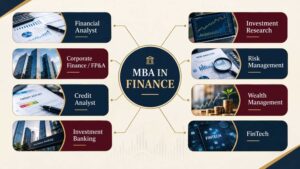
| Career area | Possible job roles | What the work involves |
| Corporate Finance | Financial Analyst, Finance Executive, Business Finance Analyst | Budgets, forecasting, reporting and business decisions |
| Banking | Credit Analyst, Relationship Manager, Banking Operations | Lending, financial products, customer/business analysis |
| Investment | Investment Analyst, Investment Banking Associate | Valuation, transactions, capital markets and research |
| Risk | Risk Analyst, Credit Risk Analyst | Identifying, measuring and managing financial risks |
| FP&A | FP&A Analyst, Planning Analyst | Forecasting, budgeting and management reporting |
| Wealth Management | Wealth Manager, Investment Advisor | Portfolio and client financial planning |
| Insurance | Financial Analyst, Underwriting-related roles | Risk evaluation, pricing and financial assessment |
| FinTech | Finance Analyst, Product Finance, Risk Analyst | Finance combined with technology and data |
| Consulting | Financial Consultant, Business Consultant | Financial and strategic problem-solving |
| Manufacturing/Services | Finance Manager, Cost Analyst, Controller-track roles | Cost control, profitability and operational finance |
This is particularly useful for students who are already working.
A person employed in IT, sales, operations, manufacturing or administration does not necessarily have to leave their industry after completing an MBA in Finance. Instead, the qualification can help them move toward finance-oriented responsibilities within the same sector.
That makes the degree relevant not only for fresh graduates but also for professionals planning a functional or managerial transition.
Which Jobs Are Most Relevant After an MBA in Finance?
Rather than presenting a generic “top 10 jobs” list, consider the jobs according to the type of work you actually enjoy.
1. Financial Analyst
Financial analysts study company performance, financial statements, budgets, forecasts and business information to support decisions.
This can be a suitable starting point for someone who enjoys:
- Numbers
- Excel and financial models
- Business research
- Financial statements
- Data interpretation
- Reporting
The important point is that an MBA does not create a fixed salary. The job function, previous experience and practical skills matter.
2. Finance Manager
Finance managers are responsible for broader financial activities such as planning, budgeting, reporting, cost management and supporting business decisions.
This is generally a role people grow into rather than a guaranteed first job after graduation.
Experience in accounting, financial analysis, reporting or business finance can become the foundation for moving toward managerial responsibility.
That difference matters when students research MBA in Finance salary. A salary figure without an experience level can create unrealistic expectations.
3. Investment Banking
Investment banking is one of the most visible finance careers, but it should not be treated as the default outcome of an MBA.
Professionals in this area can work on:
- Company valuation
- Fundraising
- Mergers and acquisitions
- Financial modelling
- Capital-market transactions
- Transaction documentation
- Due diligence
The work can be demanding and technically intensive.
Students targeting this route should build valuation, financial modelling, accounting and presentation skills alongside the MBA.
4. Credit Analyst
Credit analysts evaluate whether an individual or organisation is financially capable of meeting its borrowing obligations.
Typical work can include:
- Analysing financial statements
- Reviewing cash flow
- Assessing debt
- Understanding business risk
- Preparing credit recommendations
- Monitoring borrower performance
This career can be attractive for students who enjoy structured analysis and risk assessment more than sales-oriented finance roles.
5. Risk Management
Risk has become a major finance function because businesses must understand what could negatively affect capital, cash flow, investments and operations.
Finance graduates can explore:
- Credit risk
- Market risk
- Operational risk
- Financial risk
- Enterprise risk
- Compliance-related functions
A student interested in this route should develop stronger analytical ability, statistics, financial markets knowledge and an understanding of regulatory frameworks.
6. Financial Planning & Analysis (FP&A)
FP&A is particularly relevant to professionals who want to work inside companies rather than investment institutions.
FP&A teams often help management answer questions such as:
- Are we meeting our revenue targets?
- Why did expenses increase?
- What will cash flow look like next quarter?
- Which business unit is performing best?
- What happens if costs increase?
- How much can the company invest?
This makes FP&A a useful bridge between finance and business strategy.
For students who eventually want senior corporate-finance or business-management positions, this combination can be valuable.
7. Equity Research and Investment Research
Equity research involves studying companies, industries and financial information to develop investment-related analysis.
Skills include:
- Financial statement analysis
- Valuation
- Industry research
- Ratio analysis
- Report writing
- Market awareness
- Presentation of investment arguments
Students interested in securities markets should also develop a responsible understanding of financial products and regulation. SEBI provides investor education resources covering securities markets, investment products, due diligence and financial planning.
What Is the Salary After an MBA in Finance?
There is no single “MBA in Finance salary” because employers do not pay for the degree alone.
They pay for the combination of:
Qualification + role + skills + experience + industry + location + employer + performance.
A graduate entering a Financial Analyst position and a professional entering an investment-banking role may have completely different compensation even though both hold an MBA.
Indicative salary picture
| Role | Current salary reference | What can influence compensation |
| Financial Analyst | Around ₹5.6 lakh average base salary in Indeed’s 2026 data | Experience, analytics skills, company and location |
| Credit Analyst | Around ₹8.26 lakh average base salary in Indeed’s October 2026 sample | Credit expertise, experience and employer |
| Finance Manager | Around ₹5.8 lakh average base salary in Indeed’s 2026 data | Seniority, industry and management responsibility |
| Investment Banker | Around ₹30,000/month average in Indeed’s reported 2026 sample | Deal exposure, employer, experience and role |
These figures are market reference points, not guaranteed UCC salaries or guaranteed post-MBA packages. Indeed’s datasets are based on reported salary information and can have relatively small samples for some job titles.
A better career question is therefore:
What skills will help me move from my current role to the next finance role?
That question produces a much more realistic career plan.
The Skills That Actually Increase the Value of an MBA in Finance
A finance qualification gives you the academic foundation. Employers still need evidence that you can use that knowledge.

Think of your skill set in three layers.
Layer 1: Finance fundamentals
You should understand:
- Accounting principles
- Financial statements
- Corporate finance
- Financial markets
- Investment concepts
- Risk and return
- Budgeting
- Cost management
- Tax fundamentals
- Business economics
Without this foundation, advanced finance tools become difficult to apply.
Layer 2: Analytical and technical skills
This is where many finance careers increasingly differentiate themselves.
Useful skills include:
Advanced Excel
Excel remains highly relevant for:
- Financial analysis
- Forecasting
- Budgeting
- Scenario analysis
- Reporting
- Financial modelling
A finance graduate who can explain a spreadsheet but cannot build or interpret one may struggle against more practically prepared candidates.
Financial Modelling
Financial modelling helps translate business assumptions into financial projections.
Depending on the role, you may work with:
- Revenue projections
- Expense assumptions
- Cash flows
- Valuation
- Debt schedules
- Sensitivity analysis
- Scenario modelling
Data Analytics
Finance professionals increasingly work with data rather than isolated spreadsheets.
Knowledge of tools such as:
- Power BI
- SQL
- Advanced Excel
- Tableau
- Python for analytics
can complement an MBA, particularly in business finance, FP&A, FinTech and analytics-heavy roles.
Modern MBA finance programmes increasingly combine financial knowledge with analytics and technology. For example, IIM Mumbai’s current MBA Finance structure includes finance, analytics, digital transformation, AI/ML and practical components.
Layer 3: Business and communication skills
A finance professional does not work with numbers alone.
You may have to explain:
“Why did profitability decline?”
to someone who does not understand financial terminology.
That requires:
- Business communication
- Presentation skills
- Decision-making
- Negotiation
- Problem-solving
- Stakeholder management
- Leadership
- Commercial awareness
This is one reason an MBA in Finance can be different from a purely accounting-focused qualification. The objective is not simply to calculate numbers; it is to understand what those numbers mean for a business.
What Do You Study in an MBA in Finance?
Curriculum varies by university, but a finance-focused management programme commonly combines management foundations with finance subjects.
Typical areas may include:
| Foundation | Finance-focused learning | Modern skill areas |
| Business Economics | Corporate Finance | Financial Analytics |
| Marketing | Investment Management | Data Analysis |
| Organisational Behaviour | Financial Markets | Excel Modelling |
| Business Strategy | Risk Management | Business Intelligence |
| Operations | Portfolio Management | Digital Finance |
| Accounting | Valuation | FinTech |
| Business Law | International Finance | Decision Analytics |
Contemporary finance curricula increasingly include financial modelling, valuation, risk management, portfolio management and analytics rather than focusing exclusively on traditional accounting.
That is a useful benchmark when comparing management distance education in Bangalore. Do not compare programmes only by the title “MBA Finance.” Compare the actual subjects, delivery mode, assessment pattern and academic support.
Is Distance MBA in Finance Suitable for Working Professionals?
For someone already employed, the biggest obstacle to postgraduate education is often not academic ability.
It is time.
Leaving a job for two years may mean:
- Lost salary
- Career interruption
- Relocation
- Daily commuting
- Fixed classroom schedules
- Additional living expenses
This is why MBA distance education in Bangalore can be considered by professionals who need to continue working while pursuing a postgraduate qualification.
The advantage is not that distance learning makes an MBA easier.
The advantage is that the learning structure can be more compatible with an existing professional schedule.
Students should still evaluate:
- University recognition for the relevant academic session
- Programme structure
- Learning mode
- Examination process
- Curriculum
- Academic support
- Fees
- Assignment requirements
- Admission eligibility
- Degree-awarding university
UGC specifically advises students to confirm recognition for the session in which they are taking admission rather than assuming that recognition from a previous year automatically carries forward.
How UCC Fits Into the MBA Finance Decision
United Correspondence College provides flexible higher-education options across management, commerce, IT, science and other fields.
Its MBA offering is structured as a two-year postgraduate programme and lists Finance Management alongside specialisations such as Marketing Management, Human Resource Management, International Business, Operations Management, IT Management, Business Analytics and Hospital & Healthcare Management. The UCC course page also describes online/hybrid learning options and support for working professionals.
For a student searching for MBA distance education in Bangalore, the practical value of UCC is therefore the ability to explore a management qualification without treating a career break as the only route to postgraduate study.
UCC’s wider course portfolio also makes it relevant to students at different stages. Its current course listings include BBA, MBA, PGDM, BCA, MCA, B.Com, M.Com, BA, MA, M.Sc and other programmes.
For example, a commerce graduate considering postgraduate finance can also compare an MBA pathway with an M.Com pathway. UCC’s existing resource on M.Com vs MBA in Finance provides a useful comparison of the different academic and career orientations.
MBA in Finance vs M.Com: Which Direction Makes More Sense?
The two qualifications can overlap in finance-related careers, but their emphasis is different.
| If you want to focus on… | Consider |
| Corporate management | MBA |
| Leadership and business strategy | MBA |
| Investment and corporate finance | MBA with Finance |
| Accounting and taxation depth | M.Com |
| Academic/research-oriented commerce | M.Com |
| Finance + management | MBA Finance |
| Broader business functions | MBA |
| Advanced commerce concepts | M.Com |
There is no universal winner.
Someone planning to become a finance manager, business-finance professional or corporate leader may prefer the management orientation of an MBA.
Someone interested in accounting, taxation, commerce academics or deeper theoretical commerce studies may find M.Com more aligned with the goal.
What Should Students Check Before Choosing MBA Distance Education in Bangalore?
Instead of choosing a programme because an advertisement says “best MBA,” use a seven-point commercial decision test.
1. Check the awarding university
Know exactly which university awards the degree.
A counselling centre, education platform and degree-awarding university are not automatically the same entity.
2. Verify recognition for your admission session
UGC maintains year-wise information concerning recognised/entitled institutions and programmes. Students should verify the relevant programme and academic session before admission.
3. Compare the actual finance curriculum
Look beyond the words “Finance Management.”
Check whether the programme gives you exposure to:
- Corporate finance
- Financial markets
- Investment
- Risk
- Financial analysis
- Business strategy
- Analytics
4. Calculate the complete cost
Do not compare only tuition fees.
Consider:
- Admission fees
- Examination fees
- Study materials
- Travel, if applicable
- Additional certifications
- Learning tools
- Other university charges
5. Examine academic support
Ask who helps you when you have questions about:
- Assignments
- Examinations
- University procedures
- Documentation
- Study materials
- Results
6. Match the MBA to your career stage
A fresher may need strong foundational skills and entry-level job preparation.
A working professional may be more interested in:
- Promotion
- Management responsibility
- Functional switching
- Salary growth
- Qualification requirements
7. Decide whether you can actually complete it
Distance education gives flexibility, but flexibility requires self-management.
If you cannot consistently allocate study time, even an affordable programme can become expensive because the qualification remains unfinished.
Which MBA Finance Career Path Matches Your Strengths?
An MBA in Finance does not lead to one fixed career. The better approach is to choose the type of finance work that matches your interests, existing experience and long-term goals.
For example, someone who enjoys analysing company performance may be better suited to financial analysis, while a professional interested in lending and risk may prefer credit analysis. Someone who wants to work closely with business leadership could consider corporate finance or FP&A.
Use the table below as a starting point:
| If you enjoy… | You could explore… | Skills worth developing |
| Analysing company performance | Financial Analyst | Excel, financial statements, financial modelling |
| Working with budgets and forecasts | FP&A / Corporate Finance | Forecasting, budgeting, Excel, business analysis |
| Evaluating borrowers and financial risk | Credit Analyst | Credit analysis, accounting, risk assessment |
| Studying investments and markets | Investment Research | Valuation, financial markets, research |
| Working on business transactions | Investment Banking | Valuation, modelling, presentations |
| Managing financial risk | Risk Management | Statistics, risk analysis, financial markets |
| Working with clients and investments | Wealth Management | Financial products, communication, portfolio concepts |
| Combining finance with technology | FinTech | Data analytics, finance, digital tools |
A useful way to plan your MBA
Instead of waiting until graduation to decide what you want to do, choose a target career area during your MBA and build your skills around it.
For example:
B.Com graduate → MBA Finance → Financial Analysis → Senior Financial Analyst → Finance Manager
or
Working professional → MBA Finance → Corporate Finance/FP&A → Business Finance Manager
or
Commerce graduate → MBA Finance → Credit Analysis → Risk Management
These are possible career directions, not guaranteed outcomes. Your previous experience, practical skills, employer, location and job market will influence the actual progression.
This approach also helps you choose the right programme more intelligently. When comparing MBA distance education in Bangalore, don’t look only at the MBA title or specialisation name. Examine whether the curriculum gives you subjects and learning opportunities relevant to the finance career you want to pursue.
6 Practical Ways to Build a Stronger Finance Career During the MBA
1. Build one finance skill deeper than the curriculum
Do not try to learn every finance tool simultaneously.
Choose one area such as:
- Financial modelling
- FP&A
- Credit analysis
- Investment research
- Financial analytics
and develop demonstrable competence.
2. Build a small finance portfolio
A portfolio does not have to be complicated.
You could create:
- A company financial analysis
- A three-year financial model
- A budgeting dashboard
- A ratio-analysis report
- A valuation case study
- A credit-risk assessment
This gives you something concrete to discuss during interviews.
3. Become strong in Excel
A surprising amount of finance work still depends on spreadsheet competence.
Learn:
- XLOOKUP
- INDEX/MATCH
- Pivot Tables
- SUMIFS
- IF logic
- Data validation
- Charts
- Scenario analysis
- Financial modelling structure
4. Learn how businesses make money
Do not study financial statements in isolation.
Take a company and ask:
How does it generate revenue?
Then:
What are its largest costs?
Then:
What affects margins?
Then:
What happens to cash flow if sales decline?
That way, accounting numbers become business information.
5. Follow financial-market and regulatory developments responsibly
Students interested in investment-related roles should develop an informed understanding of financial markets rather than relying on social-media trading advice.
SEBI’s investor education resources cover securities markets, investment products, due diligence and risk-related topics.
For broader banking and financial-sector context, students can also use RBI’s published banking and financial-sector reports.
6. Improve communication alongside technical ability
A finance professional may need to present:
- Why revenue changed
- Why costs increased
- Why a project should be funded
- Why a borrower represents higher risk
- Why a particular investment requires further analysis
If you cannot communicate the conclusion, technical knowledge becomes less useful.
Can an MBA Finance Graduate Work in FinTech?
Yes.
FinTech has expanded the range of finance-related roles available to professionals who understand both business and technology.
Possible areas include:
- Digital payments
- Lending technology
- Credit analytics
- Fraud and risk
- Financial products
- Wealth-tech
- Financial data
- Digital banking
- Business analytics
An MBA in Finance can provide the business and financial foundation, while additional analytics or technology skills can make the profile more relevant for technology-led finance roles.
This combination is particularly useful for professionals who do not want to remain in traditional accounting or banking functions.
What Makes an MBA in Finance Valuable in the Long Term?
The strongest value of the qualification is not the letters “MBA” on the resume.
It is the ability to move from reporting numbers to understanding decisions.
Consider the progression:
Accounting information → Financial analysis → Business interpretation → Strategic decision-making
An entry-level employee might prepare a financial report.
A financial analyst might explain the variance.
A finance manager may decide what corrective action is required.
A senior finance leader may influence investment, expansion, pricing or capital-allocation decisions.
The MBA’s management component becomes increasingly relevant as responsibility increases.
That is why students should think about the qualification as a career platform rather than a guaranteed job title.
Is MBA in Finance a Good Choice for You?
It can be a strong option if you:
- Enjoy working with numbers and business information
- Want a management-oriented career
- Are interested in banking or corporate finance
- Want to move toward financial analysis
- Want to transition into business finance
- Are interested in investment or risk
- Want to combine finance with management
- Are a working professional seeking a postgraduate qualification
- Want broader business knowledge beyond accounting
It may require reconsideration if you strongly dislike numbers, financial analysis or business decision-making.
Likewise, if your primary goal is highly technical software development, an IT-focused postgraduate programme may align more directly with your intended role. UCC also offers IT-oriented programmes such as BCA and MCA, allowing students to compare pathways instead of choosing an MBA simply because it is popular.
Why Flexible Management Education Matters for Working Professionals
A working professional does not necessarily need to choose between career and education.
The more practical approach can be to build the qualification around the career already in progress.
For example:
Current role: Accounts Executive
→ MBA Finance
→ Financial Analyst
→ Senior Financial Analyst
→ Finance Manager
Or:
Current role: Sales Executive
→ MBA Finance
→ Business Finance / Banking role
→ Relationship or Credit function
→ Finance/Business Management
Or:
Current role: Operations Executive
→ MBA Finance
→ Business Analyst / FP&A
→ Business Finance Manager
These are examples, not guaranteed career outcomes. The actual path depends on experience, skills, vacancies and employer requirements.
That is precisely why distance education in Bangalore is relevant for professionals who cannot pause employment to study.
Choosing Between UCC and Other Correspondence Colleges in Bangalore
When comparing correspondence colleges in Bangalore, avoid making the decision based entirely on advertisements or fee discounts.
Create a comparison sheet containing:
| Factor | What to verify |
| Degree | Which university awards it? |
| Recognition | Is the programme recognised for the relevant session? |
| Specialisation | Is Finance actually available? |
| Duration | How long is the programme? |
| Mode | ODL, online or hybrid? |
| Curriculum | Does it match your intended career? |
| Support | What happens after admission? |
| Exams | How are examinations conducted? |
| Fees | What is the total cost? |
| Career objective | Does it support your next career move? |
Students researching a management correspondence college near me should also remember that physical proximity is not necessarily the most important criterion for a flexible programme. University recognition, programme structure, support and suitability for your career objective deserve greater attention.
For broader options, UCC’s course ecosystem includes management, commerce, IT, science and traditional degree programmes.
UCC Courses for Students Exploring Different Career Directions
The decision does not always start with an MBA.
A student may begin with B.Com and later choose MBA Finance.
A BBA graduate may use an MBA to move toward management.
A BCA graduate may choose between MCA and MBA depending on whether they prefer technical or management-oriented work.
UCC currently lists programmes such as:
- BBA
- MBA
- PGDM
- BCA
- MCA
- B.Com
- M.Com
- BA
- MA
- B.Sc
- M.Sc
- PG Diploma programmes
Its B.Com distance education programme is particularly relevant for students interested in accounting, finance, banking and commerce before progressing toward postgraduate management.
Students considering the technical-management decision can also read UCC’s MBA vs MCA comparison before selecting a postgraduate path.
For learners exploring institution-specific options, UCC also provides information on programmes associated with universities such as Sikkim Manipal distance education and Gujarat University distance education.
The right choice should still be verified against the current university and programme requirements before admission.
Frequently Asked Questions
Is MBA in Finance a good career option in 2026?
Yes, it can be a strong option for students interested in corporate finance, banking, financial analysis, risk, investments, FP&A and management. However, the degree itself does not guarantee a particular salary or job title. Practical skills and experience strongly influence outcomes.
What is the salary after an MBA in Finance in India?
There is no universal salary. Current Indeed salary data shows approximately ₹5.6 lakh per year as an average base salary for Financial Analysts and about ₹5.8 lakh for Finance Managers in its available 2026 datasets, while investment-banking and credit roles show different compensation patterns. Employer, experience, location and role can change the figure significantly.
What skills are required for MBA Finance jobs?
Important skills include financial analysis, accounting, Excel, financial modelling, data interpretation, business communication, problem-solving, decision-making and an understanding of financial markets. Analytics and technology skills can further strengthen a finance profile.
Can I pursue MBA Finance through distance education?
Yes, flexible MBA programmes are available through distance and online learning routes. Students should verify the exact programme, learning mode, awarding university and recognition for the admission session before enrolling. UCC currently lists Finance Management among its MBA specialisations.
Is MBA Finance better than M.Com?
Neither is universally better. MBA Finance has a stronger management and business orientation, while M.Com is generally more focused on advanced commerce and related academic areas. Your career objective should determine the choice.
Can a B.Com graduate pursue MBA Finance?
Yes, a B.Com graduate can pursue an MBA and may find the finance specialisation particularly relevant because of their existing exposure to accounting, commerce and business subjects. Eligibility requirements should be checked against the specific university and programme.
Can working professionals pursue an MBA in Finance?
Yes. Flexible learning formats are designed to make postgraduate study more compatible with professional commitments. The student still needs a consistent study schedule and must meet the university’s academic and examination requirements.
Does an MBA Finance guarantee a high salary?
No. An MBA is a qualification, not a salary guarantee. Higher compensation generally depends on the role, experience, employer, technical skills, communication ability and career progression. Students should be cautious about institutions or advertisements promising guaranteed salaries.
Final Takeaway: Choose the Finance Career Before Choosing the MBA
The best reason to pursue an MBA in Finance is not simply that finance is considered a high-paying field.
The stronger reason is that finance sits close to important business decisions.
Companies need people who can understand:
money → performance → risk → investment → strategy.
If you want to build that capability, an MBA can provide the management foundation while practical tools such as Excel, financial modelling, analytics and business communication make the qualification more useful in the workplace.
For students and working professionals comparing MBA distance education in Bangalore, the decision should therefore move beyond fees and advertisements. Compare the awarding university, recognition, finance curriculum, learning format, academic support, total cost and your intended career path.
UCC’s MBA programme includes Finance Management as a specialisation and is positioned around flexible learning for working professionals. Its wider portfolio also allows learners to explore management, commerce, IT, science and other academic pathways.
Before enrolling, verify the programme and university details for your admission session through the official UGC information available for ODL/online education.
“The goal should not be simply to earn an MBA. The goal should be to use the MBA to move into the finance role you actually want.”