
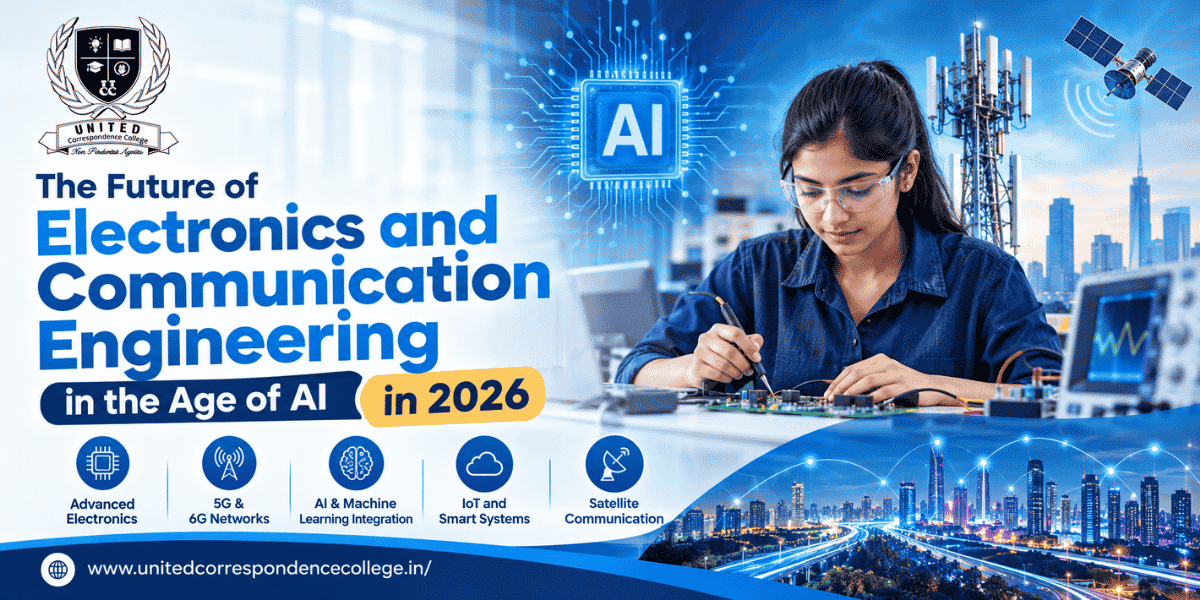
Electronics and Communication 2026 is no longer a field that sits quietly behind smartphones, television sets, or communication towers. In 2026, it is moving into a much bigger role as artificial intelligence, semiconductors, IoT, robotics, 5G, smart devices, and automation become part of everyday life. For students considering engineering and professionals planning their next qualification, the future of Electronics and Communication looks closely connected with intelligent technology.
The interesting part is that AI is not replacing the engineering foundation. Instead, it is changing how engineers use that foundation. Modern systems need people who understand signals, circuits, embedded platforms, communication networks, sensors, and the hardware that allows AI applications to work in the real world. Current 2026 career discussions around ECE increasingly point toward AI, embedded systems, VLSI, 5G, IoT, and semiconductor opportunities.
Why 2026 Is an Important Year for Electronics and Communication 2026?
For learners comparing career directions, Electronics and Communication 2026 is best understood as a field in transition, not a field being replaced.
A decade ago, many people associated Electronics and Communication mainly with telecom, electronics manufacturing, and traditional hardware roles. Those areas still matter, but the industry has expanded.
Today, an electronic product may contain sensors, processors, wireless connectivity, embedded software, and an AI model working together. A vehicle can interpret its surroundings. A factory can identify equipment problems before a breakdown. A wearable can collect and analyse health-related signals. A communication network can use intelligent systems to optimise performance.
That is why Electronics and Communication Engineering is becoming increasingly multidisciplinary.
For learners, this creates an important shift: knowing only the theory is no longer enough. The strongest profiles combine engineering fundamentals with programming, AI awareness, practical projects, and an understanding of modern digital infrastructure.
How AI Is Changing Electronics and Communication 2026 Engineering?
For Electronics and Communication 2026, AI is becoming a practical engineering tool rather than a separate subject.
The biggest story behind Electronics and Communication 2026 is the growing connection between physical engineering and intelligent software.
1. Smarter Embedded Systems
Electronics and Communication 2026 increasingly depends on devices that can sense, process, and respond.
Embedded devices are becoming more capable of interpreting information locally. Instead of simply collecting sensor data, a device can identify patterns, make decisions, and respond quickly.
This is especially useful in automobiles, medical devices, industrial machines, consumer electronics, and smart appliances.
2. AI-Powered Communication Networks
For Electronics and Communication 2026, network intelligence is becoming as important as network speed.
Communication networks generate huge amounts of information. AI can help analyse network behaviour, predict congestion, identify unusual patterns, and support optimisation.
This makes AI knowledge increasingly useful for engineers working with wireless communication and next-generation networks.
3. Intelligent Signal Processing
Another important Electronics and Communication 2026 direction is the use of AI to interpret complex signals.
Signals are at the heart of communication engineering. AI and machine learning can assist with recognising patterns in audio, images, wireless signals, and other forms of data.
For an ECE student, this creates an interesting bridge between mathematical concepts and practical AI applications.
4. Semiconductor and Chip Innovation
Electronics and Communication 2026 also has a strong connection with the semiconductor ecosystem.
AI needs computing power, and computing power depends on advanced semiconductor technology. This has increased attention on chip design, VLSI, processors, accelerators, and hardware optimisation.
The connection between Electronics and Communication and AI therefore runs deeper than simply adding a programming language to an engineering curriculum.
The Biggest Technology Areas to Watch
These technologies give Electronics and Communication 2026 its wider career relevance.
| Technology | Why It Matters |
| AI & Machine Learning | Makes electronic and communication systems more intelligent |
| Embedded Systems | Connects hardware, software, sensors and real-time control |
| VLSI & Semiconductors | Supports processors, AI chips and advanced electronic products |
| IoT | Connects sensors, devices and intelligent systems |
| 5G & Future Networks | Enables faster and more connected digital infrastructure |
| Robotics | Combines sensing, control, electronics and intelligent decision-making |
These areas are not isolated. A modern product can use several of them at the same time. A connected vehicle, for example, may involve embedded electronics, sensors, wireless communication, AI, signal processing, and semiconductor technology.
What Happens to the Role of an ECE Engineer?
The changing expectations around Electronics and Communication 2026 are visible in the way engineers now work across hardware and software.
The role is changing from a purely hardware-focused position into a broader system-oriented role.
An engineer may be expected to understand how a sensor collects information, how an embedded processor handles it, how a communication system transfers it, and how AI can extract useful insights from it.
This does not mean every engineer needs to become a machine learning specialist. It means engineers should understand where AI fits into the systems they design.
For example, a traditional engineer might design a monitoring device that records temperature. A modern engineer may help build a system that records temperature, detects abnormal behaviour, predicts equipment failure, and communicates the warning automatically.
That is the kind of transformation making Electronics and Communication more relevant to emerging industries.
Career Opportunities Are Becoming More Diverse
For Electronics and Communication 2026, career variety is one of the most attractive features of the field.
Students can explore:
- Embedded Systems Engineer
- VLSI Design Engineer
- Semiconductor Engineer
- Firmware Engineer
- IoT Engineer
- RF Engineer
- Wireless Communication Engineer
- Signal Processing Engineer
- Robotics Engineer
- Automotive Electronics Engineer
- Network Engineer
- AI Hardware Engineer
- Electronics Design Engineer
- Technical Research roles
Recent 2026 career discussions also highlight software, VLSI, embedded systems, telecom, government opportunities, and AI/ML as possible routes for ECE graduates.
The important point is that career growth depends on skills, projects, specialisation, and experience—not simply the name of the degree.
Is Electronics and Communication 2026 Still Relevant in the AI Era?
That question sits at the heart of Electronics and Communication 2026 because the field is evolving alongside AI.
The answer is especially important when evaluating Electronics and Communication 2026 as a long-term career choice.
Yes, and there is a simple reason.
AI does not exist only inside software. It needs processors, memory, sensors, communication systems, cameras, microphones, edge devices, data centres, networks, and power-efficient hardware.
Someone has to design, integrate, test, and improve those systems.
This is where Electronics and Communication continues to have an important place. Universities and industry-focused programmes are increasingly combining core ECE subjects with AI, machine learning, embedded systems, wireless communication, and intelligent electronic systems, reflecting this convergence.
The Skills Students Should Build in 2026
A practical Electronics and Communication 2026 roadmap starts with fundamentals and gradually adds digital intelligence.
A future-ready learner can think of skills in three layers.
Core Engineering Skills
Build a strong base in:
- Digital electronics
- Analog electronics
- Signals and systems
- Communication systems
- Microprocessors
- Microcontrollers
- Digital signal processing
- Control systems
Digital and AI Skills
Add:
- Python
- Machine learning fundamentals
- Data analysis
- Computer vision basics
- AI model deployment
- Edge AI concepts
- Basic cloud and networking knowledge
Practical Industry Skills
Then move toward one or more areas such as:
- PCB design
- Embedded programming
- VLSI tools
- IoT platforms
- Robotics
- Wireless communication
- Semiconductor design
- Automotive electronics
This combination can make a graduate more adaptable because it connects academic knowledge with actual technology applications.
Two-Block Comparison: Traditional vs AI-Enabled ECE
| Traditional Approach | AI-Enabled Approach |
| Device collects data | Device can interpret data |
| Manual monitoring | Predictive monitoring |
| Fixed system behaviour | Adaptive system behaviour |
| Hardware-focused development | Hardware + software + AI |
| Conventional signal analysis | AI-assisted signal processing |
| Standalone devices | Connected intelligent devices |
| Basic automation | Intelligent automation |
| Network monitoring | AI-assisted network optimisation |
The table does not mean traditional engineering has become outdated. Instead, it shows how existing engineering knowledge can become more powerful when combined with modern technologies.
Where Can These Skills Be Used?
The industry reach of Electronics and Communication 2026 extends far beyond traditional telecom companies.
Automotive
Electric vehicles, connected vehicles, driver-assistance systems, sensors, and autonomous technology require sophisticated electronics and communication systems.
Healthcare
Wearable devices, patient monitoring systems, medical imaging, sensors, and intelligent diagnostic equipment create opportunities for engineers who understand both hardware and data.
Telecommunications
5G deployment and future communication technologies require engineers who understand wireless systems, RF technologies, network infrastructure, and optimization.
Semiconductor Industry
The growth of AI increases demand for processors and specialised chips. This creates opportunities in VLSI, chip design, verification, testing, and semiconductor manufacturing.
Industrial Automation
Factories are increasingly using sensors, robotics, connected machines, predictive maintenance, and intelligent control systems.
Consumer Electronics
Smartphones, wearables, smart televisions, home automation devices, and connected appliances all depend on advanced electronic systems.
These applications are also reflected in current ECE programme and career discussions, where semiconductors, IoT, AI-enabled electronics, robotics, 5G and embedded systems are repeatedly identified as important areas.
What About Higher Education?
For Electronics and Communication 2026, postgraduate study can help learners develop deeper expertise in selected technology domains.
Students who want deeper technical knowledge can consider postgraduate study in relevant specialisations. Areas such as VLSI, embedded systems, communication engineering, signal processing, robotics, and AI-integrated electronics can support specialised career paths.
For working professionals, choosing a programme requires extra care. Before enrolling in any distance or correspondence engineering programme, always verify the current recognition, approval status, mode of delivery, eligibility rules, and whether the specific engineering qualification is permitted through that mode. Engineering education is a regulated area, so the recognition of a programme should never be assumed merely because an institution advertises it online.
This is particularly important when comparing an Engineering distance education option with a conventional engineering programme.
Can Distance or Correspondence Learning Fit Working Professionals?
When exploring flexible education related to Electronics and Communication 2026, recognition and programme suitability should come before convenience.
Flexible learning can be useful for professionals who want to build knowledge without leaving employment. However, the right programme depends on the qualification, regulatory requirements, practical components, and the learner’s career objective.
People researching an Engineering correspondence college in Bangalore or an Engineering distance education option should therefore compare recognition, curriculum, academic support, examinations, practical exposure, and career relevance before making a decision.
Similarly, anyone searching for an M.Tech correspondence college in Karnataka should independently verify whether the exact programme and delivery mode are approved for the intended qualification.
The same careful approach applies to searches such as B.Tech correspondence college in India. Do not choose a programme only because it promises flexibility. Check the official regulatory and university information first.
For learners exploring technology-related programmes, IT distance education may appear alongside engineering options. However, the two are not interchangeable. The right choice depends on whether the learner wants a hardware-and-electronics pathway, a software pathway, or a combination of both.
What About Engineering Distance Education in Bangalore?
Bangalore is closely associated with technology, startups, electronics, software, telecommunications, and research. That makes it an attractive location for learners interested in technology careers.
But location alone does not determine the value of a programme.
If you are comparing distance education in Bangalore options or looking for flexible engineering study, focus on the actual qualification, recognition, delivery format, curriculum, practical exposure, faculty support, and how the programme fits your career plan.
A good programme should answer a basic question clearly:
What will I be able to do after completing it?
That question is more useful than choosing a course simply because it is flexible or advertised as career-oriented.
How UCC Can Fit Into the Learning Journey
For learners exploring flexible higher education pathways, UCC can be considered as part of the comparison process. Before choosing any programme, students should review the exact course details, eligibility, recognition, academic structure, and learning format and match them with their long-term goals.
The growing connection between Electronics and Communication, AI, embedded technology, semiconductors, and communication systems also means that learners should think beyond a single job title. Building a strong foundation and continuously adding relevant technical skills can create more options over time.
A Simple Roadmap for Future ECE Professionals
The Electronics and Communication 2026 career roadmap can be approached step by step:
Step 1: Build strong electronics fundamentals
↓
Step 2: Learn programming basics
↓
Step 3: Understand embedded systems
↓
Step 4: Explore AI and machine learning
↓
Step 5: Choose a specialisation
↓
Step 6: Build practical projects
↓
Step 7: Complete internships or industry training
↓
Step 8: Keep updating your skills
The goal is not to learn every technology available. The goal is to build a strong core and then develop depth in a field where your interests and market demand overlap.
What Will the Future Look Like?
Looking ahead, Electronics and Communication 2026 is likely to evolve through deeper integration with AI, advanced chips, connected devices, and intelligent networks.
The future of Electronics and Communication 2026 is likely to become increasingly connected with intelligent computing.
Devices will become smarter. Networks will become more adaptive. Chips will become more specialised. Sensors will become more capable. Factories will become more automated. Vehicles will communicate with their surroundings. Healthcare devices will generate more useful data.
Behind all of this will be engineers who understand how physical systems and digital intelligence work together.
That is why Electronics and Communication is moving toward a multidisciplinary future rather than disappearing because of AI.
Why Choose UCC for Your Next Learning Step?
UCC can be considered by learners looking for flexible higher education options and a structured way to continue their academic journey. Before enrolling, review the exact programme information and verify that the qualification meets your academic and career requirements.
A smart education decision is not simply about choosing the easiest route. It is about choosing a recognised and suitable pathway that supports where you want to go next.
Conclusion
The direction of Electronics and Communication 2026 is clear: the field is becoming more connected, intelligent, and multidisciplinary.
The future of Electronics and Communication is being shaped by a powerful combination of hardware and intelligence. AI, semiconductors, IoT, embedded systems, robotics, and advanced communication networks are creating new ways for engineers to solve real-world problems.
For students and professionals, the message is simple: do not look at AI as something separate from engineering. Learn how it connects with the systems you want to build.
The engineers who can understand both the physical technology and the intelligence running through it will be in a strong position for the next stage of the industry.
If you are planning your next academic step, compare programmes carefully, verify recognition, build practical skills, and choose a learning path that matches your long-term career goals. UCC can be one option to explore as you evaluate flexible higher-education pathways.
Ready to Build Your Future in Technology?
Explore your learning options, compare the right programme for your career goals, and take the next step toward a future shaped by electronics, communication, AI, and intelligent technology.
Start your academic journey with United Correspondence College and explore the opportunities waiting in tomorrow’s technology landscape.
FAQs
1. What is the future of Electronics and Communication 2026?
The field has strong relevance across AI-enabled electronics, embedded systems, semiconductors, IoT, robotics, telecommunications, automotive technology, and smart devices. The strongest opportunities are increasingly found where electronics connect with software and intelligent systems.
2. Will AI replace Electronics and Communication engineers?
AI is more likely to change engineering roles than eliminate them. Engineers are still needed to design hardware, integrate systems, validate products, manage safety, and connect physical devices with intelligent software.
3. Is Electronics and Communication 2026 a good career choice?
It can be a strong choice for students interested in electronics, communication, semiconductors, embedded systems, AI hardware, robotics, or telecommunications. The key is to develop practical skills alongside academic knowledge.
4. Which skills should ECE students learn in 2026?
Students can start with electronics and communication fundamentals, then add programming, embedded systems, Python, AI/ML basics, IoT, signal processing, VLSI, or wireless communication depending on their career goal.
5. What are the major career areas after ECE?
Major pathways include embedded systems, VLSI, semiconductors, telecommunications, IoT, robotics, automotive electronics, signal processing, firmware, networking, and AI-integrated hardware.
6. Is AI useful for Electronics and Communication engineers?
Yes. AI can be applied to signal processing, embedded systems, network optimisation, predictive maintenance, computer vision, intelligent sensors, robotics, and hardware design.
7. Is an M.Tech useful after ECE?
An M.Tech can be useful for learners targeting advanced technical roles, research, specialised engineering domains, or academic careers. The value depends on the specialisation, institution, recognition, and career objective.
8. Can ECE graduates move into AI-related careers?
Yes. ECE graduates can build AI-related careers by combining their engineering foundation with programming, mathematics, machine learning, data handling, and practical AI projects.