Choosing a healthcare career is not always about becoming a doctor or nurse. Many students are drawn to healthcare because they want to help people recover, regain movement and return to their everyday lives. This is where a Bachelor of Physiotherapy becomes an interesting career option. The programme combines medical science, human anatomy, movement, exercise and practical patient care to prepare students for careers in rehabilitation and physical healthcare.
If you are exploring a Bachelor of Physiotherapy after Class 12, you may have questions about its subjects, eligibility, duration, practical training and career opportunities. This guide explains Bachelor of Physiotherapy in simple language so that students can understand what they will actually learn and where the degree can take them in 2026.
Why Are More Students Looking at Physiotherapy as a Healthcare Career?
Healthcare is much broader than diagnosis and medicines. Recovery is also an important part of patient care.
A person recovering from an accident may need help to regain movement. An athlete may need rehabilitation after an injury. Someone recovering from surgery may require exercises and mobility training. Older adults may need support to maintain physical independence.
This is where physiotherapists contribute.
A Bachelor of Physiotherapy prepares students to understand movement, physical limitations and rehabilitation techniques. The course combines scientific knowledge with practical learning, making it suitable for students who enjoy both healthcare concepts and direct interaction with people.
Current BPT programmes generally include academic study along with clinical exposure and internship components, although the exact duration and structure can vary between institutions.
What Is a Bachelor of Physiotherapy?
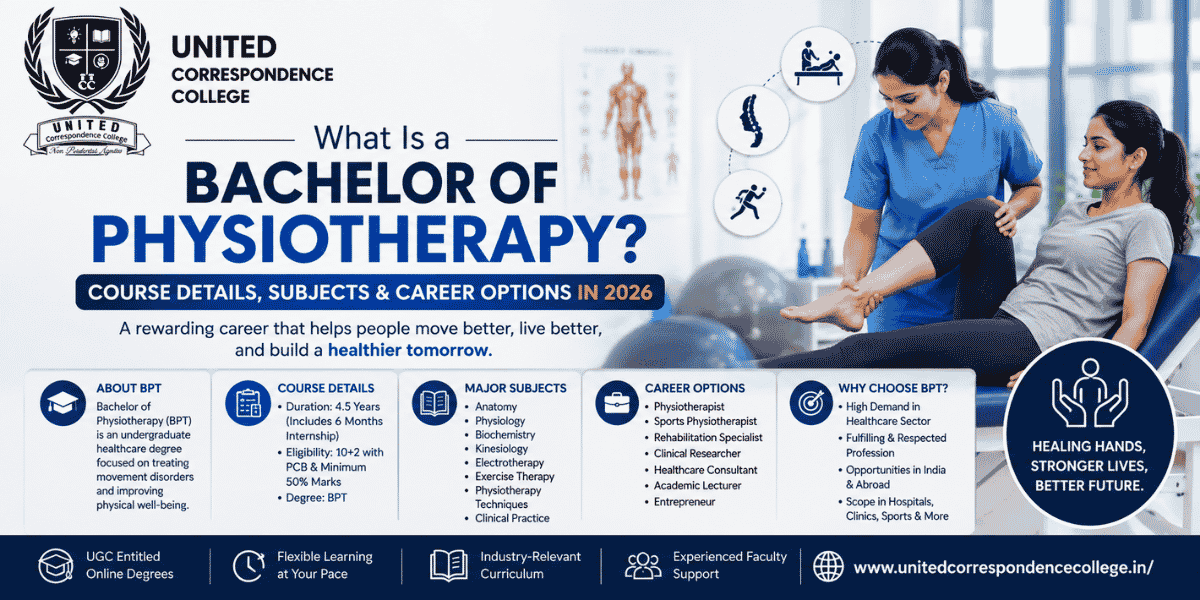
A Bachelor of Physiotherapy is an undergraduate healthcare programme focused on physical rehabilitation, movement, mobility and functional recovery.
Students learn how the human body works and how physiotherapy techniques can support people experiencing injuries, movement limitations, disabilities or physical conditions.
Unlike a course that is entirely classroom-based, a Bachelor of Physiotherapy usually involves practical and clinical learning. Students gradually move from understanding anatomy and physiology to applying physiotherapy techniques under professional supervision.
In simple terms, the course teaches students to understand:
- How the human body moves
- Why movement can become restricted
- How injuries affect muscles, joints and other body systems
- How exercise can support recovery
- How physiotherapy techniques are used in rehabilitation
- How to communicate with and assess patients
- How to monitor recovery and functional improvement
Bachelor of Physiotherapy Course at a Glance
| Course Factor | Simple Details |
| Course Name | Bachelor of Physiotherapy |
| Common Abbreviation | BPT |
| Level | Undergraduate |
| Main Area | Physiotherapy and Rehabilitation |
| Typical Eligibility | 10+2 with relevant science subjects |
| Key Subjects | Anatomy, Physiology, Exercise Therapy, Electrotherapy, Biomechanics and more |
| Learning Style | Theory + Practical + Clinical Training |
| Career Areas | Hospitals, Clinics, Sports, Rehabilitation, Home Healthcare and Wellness |
The exact programme structure, internship duration and admission requirements should always be checked with the institution before applying.
What Will You Study in a Bachelor of Physiotherapy?
One of the most important things students want to know before choosing a course is the syllabus.
A Bachelor of Physiotherapy starts with foundational healthcare subjects and gradually introduces students to specialised physiotherapy concepts. The curriculum can vary between universities, but common areas include anatomy, physiology, pathology, biomechanics, exercise therapy and electrotherapy.
1. Anatomy
Anatomy helps students understand the structure of the human body.
You may learn about:
- Bones
- Muscles
- Joints
- Organs
- Nervous system
- Musculoskeletal structures
This foundation becomes important when students later study movement and rehabilitation.
2. Physiology
Physiology focuses on how different systems of the body function.
Students learn how the:
- Heart works
- Lungs function
- Nervous system operates
- Muscles contract
- Body responds to physical activity
3. Biomechanics
Biomechanics connects science with movement.
Students learn how forces, posture, joints and muscles influence human movement. This knowledge becomes particularly useful when assessing movement-related problems.
4. Exercise Therapy
Exercise is an important part of physiotherapy.
Students learn how specific exercises can be used to improve:
- Strength
- Flexibility
- Balance
- Mobility
- Coordination
- Functional movement
5. Electrotherapy
Electrotherapy introduces students to therapeutic modalities that may be used as part of physiotherapy treatment.
6. Orthopaedic Physiotherapy
This area deals with conditions involving muscles, bones and joints.
Students may learn about rehabilitation following:
- Fractures
- Joint injuries
- Sports injuries
- Surgeries
- Musculoskeletal conditions
7. Neurological Physiotherapy
This area focuses on rehabilitation for people affected by neurological conditions and movement difficulties.
8. Cardiopulmonary Physiotherapy
Students learn about physiotherapy related to cardiovascular and respiratory rehabilitation.
These different areas show why a Bachelor of Physiotherapy is not limited to basic exercise instruction. It is a structured healthcare programme requiring scientific knowledge, clinical understanding and practical skills.
Bachelor of Physiotherapy Subjects: A Simple View
| Subject Area | What It Helps Students Understand |
| Anatomy | Structure of the human body |
| Physiology | Functions of body systems |
| Biomechanics | Principles of human movement |
| Pathology | Disease and physical conditions |
| Exercise Therapy | Therapeutic exercises |
| Electrotherapy | Physiotherapy modalities |
| Orthopaedics | Musculoskeletal rehabilitation |
| Neurology | Neurological rehabilitation |
| Cardiopulmonary | Heart and respiratory rehabilitation |
| Paediatrics | Physiotherapy for children |
| Community Rehabilitation | Rehabilitation in community settings |
The subjects listed above are representative areas; universities may organise them differently across semesters.
How Long Does a Bachelor of Physiotherapy Take?
The Bachelor of Physiotherapy course duration can vary depending on the institution and programme structure.
Many Indian institutions structure BPT as four years of academic study followed by clinical internship or practical training. Some current programmes describe the overall structure as approximately 4.5 years, while others use a different internship duration.
Therefore, students should not assume that every college follows exactly the same schedule.
A typical learning journey may look like:
Foundation Science → Physiotherapy Subjects → Clinical Learning → Internship → Graduation → Career / Higher Studies
Who Can Apply for Bachelor of Physiotherapy?
The Bachelor of Physiotherapy eligibility criteria depend on the institution and applicable regulations.
For the 2026–27 academic year, current national guidance states that the mandatory NEET requirement for BPT admissions has been deferred to 2027–28, while admissions for 2026–27 follow the applicable basic eligibility criteria. The notified criteria include 10+2/equivalent with Physics, Chemistry and Biology/Botany-Zoology, along with the prescribed marks and English requirement.
For example, one 2026–27 BPT prospectus specifies 10+2 with Physics, Chemistry and Biology and a minimum 50% aggregate in those subjects.
However, requirements can differ by institution, category and admission route.
Students searching for BPT eligibility should therefore check the official admission notification of the college or university they are considering.
Is a Bachelor of Physiotherapy Suitable for You?
The right course is not simply the course with the most popular career prospects. It should also match your interests.
A Bachelor of Physiotherapy may suit you if you:
- Enjoy biology and healthcare
- Like understanding how the human body works
- Are interested in movement and fitness
- Enjoy interacting with people
- Have patience when helping someone recover
- Prefer practical learning
- Want a patient-facing healthcare career
It may require reconsideration if you strongly prefer a completely desk-based career or do not enjoy regular patient interaction.
This is also why students researching physiotherapy courses after 12th should look beyond course names and understand the actual learning experience.
What Happens During Practical Training?
This is where the Bachelor of Physiotherapy experience becomes more hands-on.
Instead of only reading about muscles, joints or rehabilitation in textbooks, students gradually learn how these concepts relate to real patients.
Clinical training may involve observing or participating under supervision in activities such as:
- Patient assessment
- Mobility evaluation
- Exercise-based rehabilitation
- Therapeutic techniques
- Rehabilitation planning
- Monitoring patient progress
- Clinical documentation
- Patient communication
Practical exposure is important because physiotherapy is a profession where communication, observation and hands-on skills matter alongside academic knowledge.
Where Can You Work After Bachelor of Physiotherapy?
Completing a Bachelor of Physiotherapy does not restrict graduates to one workplace.
Physiotherapists can explore opportunities across healthcare, rehabilitation, sports and wellness. Current career guides identify hospitals, rehabilitation centres, sports facilities, home healthcare, private practice, public health and research among possible work settings.
Possible Workplaces
- Hospitals
- Private clinics
- Rehabilitation centres
- Orthopaedic centres
- Sports clinics
- Fitness and wellness centres
- Home healthcare services
- Community rehabilitation programmes
- Child development centres
- Research organisations
- Educational institutions
- Corporate wellness programmes
This broader range is one reason Bachelor of Physiotherapy can appeal to students who want a healthcare career with different working environments.
Career Options After Bachelor of Physiotherapy
The Bachelor of Physiotherapy career path can develop in different directions depending on a graduate’s interests and additional qualifications.
Physiotherapist
The most direct career route is working as a physiotherapist in hospitals, clinics or rehabilitation environments.
Sports Physiotherapist
Students interested in sports can move toward injury prevention, rehabilitation and recovery for athletes.
Orthopaedic Physiotherapist
This area focuses on musculoskeletal conditions involving bones, joints, muscles and related structures.
Neurological Physiotherapist
This pathway involves rehabilitation for patients with neurological movement difficulties.
Paediatric Physiotherapist
Professionals in this area work with children who require physiotherapy support.
Home Healthcare Physiotherapist
Home-based rehabilitation is another career setting where physiotherapists work directly with patients outside traditional clinical environments.
Rehabilitation Professional
Graduates can also build careers in rehabilitation centres where long-term functional recovery is a major focus.
Research or Academic Path
Students interested in teaching or research may pursue postgraduate education and move toward academic or research roles.
What Skills Can You Build Through a Bachelor of Physiotherapy?
A good Bachelor of Physiotherapy programme is not only about remembering anatomy diagrams.
Students can develop practical professional skills such as:
- Patient communication
- Observation
- Clinical reasoning
- Problem-solving
- Exercise planning
- Teamwork
- Documentation
- Empathy
- Time management
- Professional responsibility
These skills can become increasingly valuable as graduates gain clinical experience.
What Can You Study After a Bachelor of Physiotherapy?
The Bachelor of Physiotherapy can also be the beginning rather than the end of your academic journey.
Graduates may explore:
- Master of Physiotherapy
- Specialised postgraduate programmes
- Sports-related studies
- Rehabilitation studies
- Healthcare management
- Public health
- Research
- Academic careers
- Relevant professional certifications
Specialisation can help graduates develop deeper expertise in areas such as orthopaedics, neurology, sports, paediatrics or cardiopulmonary rehabilitation.
How Is Bachelor of Physiotherapy Different From Other Healthcare Courses?
Students often compare BPT with nursing, pharmacy and other healthcare programmes.
| Course | Primary Focus | Example Career Direction |
| Bachelor of Physiotherapy | Movement and rehabilitation | Physiotherapist |
| B.Sc Nursing | Nursing and patient care | Nurse |
| B.Pharm | Medicines and pharmaceutical science | Pharmacist |
| Occupational Therapy | Functional independence and daily activities | Occupational Therapist |
| MBBS | Medical diagnosis and treatment | Doctor |
The important point is that these are different healthcare professions. Choosing between them should depend on your interests and the type of work you want to do.
How Can Students Choose the Right College?
Before applying for a Bachelor of Physiotherapy, students should look beyond advertisements and compare the actual academic and clinical environment.
Check:
- Course recognition and applicable approvals
- Faculty experience
- Clinical training opportunities
- Hospital or healthcare tie-ups
- Practical facilities
- Internship structure
- Curriculum
- Placement assistance
- Total fees
- Location and accessibility
Students exploring a B.Sc correspondence college in Karnataka or a M.Sc correspondence college in Bangalore should also carefully confirm whether the programme they are considering is appropriate for their intended professional pathway. A healthcare profession such as physiotherapy requires the correct professional qualification and appropriate clinical preparation.
Similarly, people searching for distance education colleges in Bangalore should not automatically assume that a distance or online format is suitable for every healthcare qualification.
If you are comparing Traditional distance education in Bangalore, look carefully at the programme’s delivery mode, practical requirements, recognition and career relevance before making a decision.
Can You Study Physiotherapy Through Distance or Correspondence Mode?
This is an important question because students searching for an Online Traditional Course Correspondence College Near Me may come across many different programmes.
Physiotherapy is a practical healthcare profession. Because the field involves clinical learning, patient interaction and hands-on skills, students should be especially careful about programmes claiming to provide a professional physiotherapy qualification entirely through an online or correspondence format.
For professional healthcare courses, always verify the institution, programme approval, clinical requirements and applicable regulations before enrolling.
For students researching correspondence colleges in Bangalore, the same principle applies: do not choose a programme simply because it is convenient. First check whether its qualification is appropriate for your intended career.
Why Consider UCC While Exploring Your Education Options?
Students today have many learning choices, from traditional classroom programmes to flexible education pathways. UCC can be explored by students who are comparing education options and looking for programmes that match their academic and career goals.
However, when considering a professional healthcare programme, students should always verify the specific course structure, recognition and practical requirements before making an admission decision.
Is Bachelor of Physiotherapy a Good Career Choice in 2026?
For students interested in healthcare, rehabilitation, sports and human movement, Bachelor of Physiotherapy can be a meaningful career direction.
The profession connects science with direct patient care. Career opportunities can extend from hospitals and clinics to sports, rehabilitation, home healthcare, wellness, research and private practice.
The strongest reason to choose the course, however, should not simply be the expectation of a job. Students should genuinely enjoy working with people, learning about the human body and supporting long-term recovery.
What Should You Remember Before Choosing Bachelor of Physiotherapy?
The biggest advantage of Bachelor of Physiotherapy is its combination of scientific education and practical healthcare exposure.
Before enrolling, remember these points:
- Understand the complete syllabus.
- Check the exact course duration.
- Verify current eligibility requirements.
- Ask about clinical exposure.
- Check internship arrangements.
- Understand the admission process.
- Compare colleges carefully.
- Think about your preferred area of specialisation.
- Consider whether you enjoy patient-facing work.
- Look at long-term career and higher-study options.
A thoughtful decision at the beginning can make your academic journey much clearer.
Conclusion
A Bachelor of Physiotherapy is more than a degree focused on exercises. It is a healthcare pathway that combines science, movement, rehabilitation and patient interaction.
If you enjoy understanding the human body, communicating with people and helping patients work toward better physical function, the course may be worth considering. At the same time, choosing the right institution matters just as much as choosing the course.
Before applying, compare the curriculum, practical exposure, internship structure, eligibility requirements and long-term career opportunities. UCC can be part of your wider education research when comparing suitable learning options, but always confirm the exact professional requirements of the programme you intend to pursue.
Ultimately, a Bachelor of Physiotherapy can be a rewarding choice for students who want their healthcare career to be closely connected with movement, recovery and patient care.
Ready to Explore Your Education Options?
If you are planning your next academic step, take time to compare course structure, eligibility, learning format and career outcomes before enrolling. United Correspondence College can help you explore suitable education pathways and make a more informed decision about your future.
FAQs
1. What is Bachelor of Physiotherapy?
Bachelor of Physiotherapy is an undergraduate healthcare programme focused on physical rehabilitation, movement, exercise therapy and helping patients improve their functional abilities.
2. What are the main Bachelor of Physiotherapy subjects?
Common subjects include anatomy, physiology, biomechanics, pathology, exercise therapy, electrotherapy, orthopaedics, neurology, cardiopulmonary physiotherapy and rehabilitation.
3. What is the Bachelor of Physiotherapy course duration?
The duration varies by institution, but many programmes follow an academic study period followed by clinical internship or practical training. Students should verify the exact structure with their chosen college.
4. What is BPT eligibility after Class 12?
Generally, students need 10+2 with relevant science subjects, particularly Physics, Chemistry and Biology, along with the marks and other requirements specified by the institution.
5. Is NEET compulsory for Bachelor of Physiotherapy in 2026?
For 2026–27, the National Commission for Allied and Healthcare Professions notified that the mandatory NEET requirement for BPT admissions was deferred to 2027–28. Students should still check the latest admission rules applicable to their institution and state.
6. What are the career options after Bachelor of Physiotherapy?
Graduates can explore roles in hospitals, clinics, rehabilitation centres, sports settings, home healthcare, wellness organisations, research and private practice.
7. Can I specialise after a Bachelor of Physiotherapy?
Yes. Graduates can pursue higher education and develop expertise in areas such as orthopaedics, neurology, sports, paediatrics and cardiopulmonary rehabilitation.
8. Is Bachelor of Physiotherapy suitable for students interested in sports?
Yes. Sports physiotherapy is one of the possible career directions for graduates interested in injury prevention, rehabilitation and athlete recovery.