
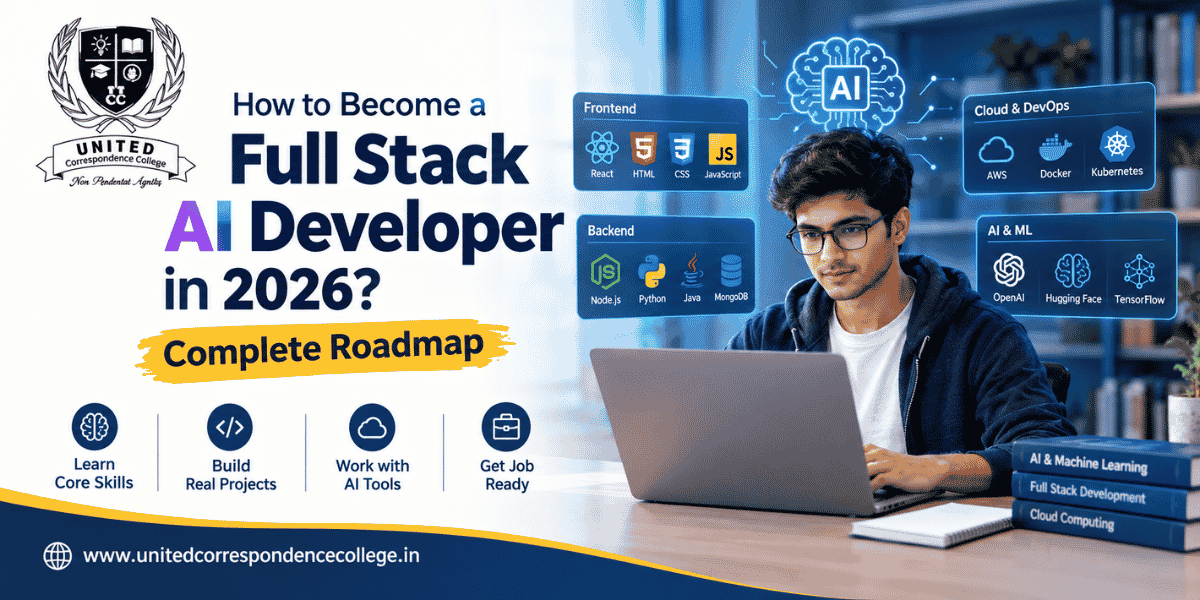
Technology careers evolve at a rapid rate, but there is one thing that remains true — those who can create useful software and understand AI possess a diverse set of skills that can be developed. If your objective is to become a Full Stack AI Developer, it does not mean a necessity to learn every framework and pursue every new AI tool — you need a sensible sequence of actions that will help you achieve your goal of being able to make a complete AI-powered application.
The modern way to Become a Full Stack AI Developer embraces frontend and backend development, databases, API, deployment, and AI. The 2026 roadmap focuses even more on the importance of software fundamentals, data, production skills, and portfolio projects, and learning how to integrate AI into products.
This guide aims to explain how to become a full-stack AI developer, including education, technologies, projects, mistakes, and a practical roadmap to get started.
What Does a Full Stack AI Developer Actually Do?
Before jumping on the tools, getting to know the work ahead is equally important. A Become a Full Stack AI Developer professional works with both the front-end part of an application that users see and the back-end that runs all the processes.
For instance, let’s say you are developing an AI career advice platform. The frontend will be the forms and dashboards that the user interacts with, while the backend will consist of the algorithms that read and interpret the user’s input, the database that stores vital information, and the AI model that provides job recommendations. A full-stack developer will connect these parts together to come up with a working application.
This is why Become a Full Stack AI Developer goes beyond just learning how to prompt. It will enable you to comprehend the workings of an application including designing, developing, connecting, testing, and deploying a working model.
Why Full Stack and AI Skills Work Well Together in 2026
Searches related to the Full Stack AI Developer roadmap 2026 differ only slightly; everyone talks about the same sequence of learning programming, frontend and backend development, databases, AI, deployment, and projects. It is always essential to understand the connection between them.
An AI developer roadmap is not much different from a standard full-stack developer path but adds several stages. A typical full-stack developer is responsible for the frontend and backend parts of a web application, databases, and API development. An AI developer adds knowledge of language-model-powered search, document analysis and processing, recommendation systems, and automation to the stack.
So if you understand how to implement AI solutions as separate features, it will be much easier to learn their integration into the entire system later. In other words, for a modern full-stack developer, AI development now includes not only algorithms but also interfaces, APIs, databases, and security.
Start With the Right Educational Foundation
There may be one best academic course for everyone, but having a solid foundation of computer applications, information technology, or engineering can make it easier.
Students searching for an IT correspondence college in Bangalore may want to learn what programs are covered, such as programming, databases, software development, computer networks, and other subjects. These foundational fields can later lead to a more specialized study of AI application development.
Likewise, an MCA distance education in Bangalore may be relevant to students wanting to learn advanced computer-application knowledge while studying other fields. It is important to not be deceived by a course title, but rather, to see what curriculum, practical experience, projects, and technology are covered in the education program.
For a student studying a B.Tech correspondence college in India, an engineering-rooted study can provide another avenue into the study of programming and software systems. The appropriate academic route will depend on the student’s current qualification and learning goals.
The aim is not solely to accumulate qualifications, but to consider how a student may want to compare a BCA distance education, for example, to gain an academic foundation of computer applications.
The aim is not solely to accumulate qualifications, but to keep building practical coding skills in tandem with academic learning, for example, to Become a Full Stack AI Developer.
The Core Skills You Need to Build
The right full stack developer skills are not limited to knowing a list of frameworks. You need to understand how code, data, APIs, interfaces, and AI services work together. That is also why full stack development provides an important base for AI application development.
Think of the learning journey as a stack. Each layer supports the next one.
1. Programming Fundamentals
Start with Python and JavaScript. These two programming languages are good ways to become a Full Stack AI Developer. You need to know the language basics, learn about variables, functions, loops, objects, error handling, modules, and data structures
Python is great for working with AI, while JavaScript or TypeScript can be used for modern web interfaces. You don’t have to be a Python expert after a week of study. Create some small applications in these languages and try to understand how they work.
2. Frontend Development
Next, learn HTML, CSS, JavaScript, and a modern framework such as React. These skills enable an aspiring Full Stack AI Developer to create a working prototype of the idea. Later, one can learn Next.js and TypeScript.
A good Become a Full Stack AI Developer roadmap should not overlook the frontend fundamentals since the AI output has to be presented to the end-users in an understandable format.
One should learn to build forms, dashboards, navigation, loaders, error messages, responsive designs, and API interfaces.
3. Backend Development
The backend is where the application logic, authentication, APIs, and AI services usually take place. Understanding the principles of the backend is essential to learning how to Become a Full Stack AI Developer.
Node.js can be explored with the Express framework, or a Python framework such as FastAPI may be used. The functioning of requests from the browser to the server and back, as well as the creation of APIs and their protection, will become clear.
For Become a Full Stack AI Developer, the backend is more important since AI keys, business logic, permissions, and other sensitive data should not be stored in the frontend anymore.
4. Databases
The study of SQL and relational databases provides a solid understanding of how to build apps around databases for a Become a Full Stack AI Developer student. A possible database management system to consider is PostgreSQL. However, to gain insight into document storage, one might want to look at MongoDB.
A learner pursuing the Become a Full Stack AI Developer path needs to know how to design, store, retrieve, update, relate, and secure records in a database. A person studying to become a full-stack developer should also explain why vector databases and alternative methods of storage like semantic search and retrieval are sometimes required to support AI applications.
Your Full Stack AI Developer Skill Map
| Skill Area | What to Learn | Practical Goal |
| Programming | Python, JavaScript, TypeScript | Write reliable application logic |
| Frontend | HTML, CSS, React, Next.js | Build interactive interfaces |
| Backend | Node.js, FastAPI, REST APIs | Create application services |
| Database | SQL, PostgreSQL, MongoDB | Store and manage information |
| AI | ML basics, LLMs, APIs | Add intelligent features |
| Generative AI | Prompting, embeddings, RAG | Build modern AI workflows |
| DevOps | Git, Docker, cloud basics | Deploy applications |
| Security | Authentication, validation, permissions | Protect users and systems |
This combination forms the foundation of a practical Become a Full Stack AI Developer learning plan.
Learn AI After You Understand Application Development
Modern generative AI development is becoming an integral part of software engineering. Rather than considering AI as some separate topic, think of it in terms of real-world application: learning how to solve a particular user problem within an entire application.
You don’t have to start by learning about the latest developments in machine learning mathematics. First, learn to understand software development principles, and then gradually introduce elements of AI.
Begin with the fundamentals of machine learning such as learning/training, inference, datasets, features, evaluation, and limitations of ML models. After that, you’ll have a solid understanding of generative AI.
For Become a Full Stack AI Developer, some of the most relevant concepts are:
- LLMs
- Prompt engineering
- Embeddings
- Vector databases
- Retrieval-Augmented Generation (RAG)
- AI APIs
- Function or tool calling
- AI agents
- Model evaluation
- Responsible AI and data privacy
The specific tools may evolve over time; however, the concepts remain relevant. The 2026 roadmaps also focus on the same themes: LLMs, RAG, APIs, production-readiness, and project-based learning as compared to learning with a particular AI product.
How AI Fits Into a Full Stack Application?
Suppose you build an AI-powered study assistant.
A student types a question in the front end. The frontend sends the request to the backend. The backend validates it, sends the relevant information to an AI service, receives the response, and returns it to the interface. If the application needs previous conversations or documents, the database and retrieval layer can provide that context.
This simple flow shows why Become a Full Stack AI Developer requires more than AI knowledge.
The basic architecture can look like:
User → Frontend → Backend API → Database/Retrieval → AI Model → Backend → Frontend
Once you understand this flow, technologies become easier to place in context.
Two Practical Project Levels to Follow
Do not wait until you have completed every course before building something. Building early is one of the most useful habits when learning to Become a Full Stack AI Developer. Projects help you discover what you actually understand.
Project 1: AI Resume Analyzer
Create a simple web application where a user uploads a resume and receives structured feedback.
Possible features:
- User interface
- File upload
- Backend API
- Text extraction
- AI analysis
- Database storage
- Results dashboard
This project can help a beginner connect several parts of the Become a Full Stack AI Developer journey. It also gives you a practical way to see what it means to Become a Full Stack AI Developer.
Project 2: AI Knowledge Assistant
Build an application that answers questions from a selected collection of documents.
You can gradually add:
- Login
- Document upload
- Text processing
- Embeddings
- Vector search
- RAG
- AI-generated answers
- Conversation history
- Deployment
This becomes a stronger portfolio project because it demonstrates how multiple technologies work together.
A Simple 2026 Learning Roadmap
| Stage | Main Learning | Outcome |
| 1 | Python + JavaScript | Understand programming |
| 2 | HTML + CSS + React | Build frontend pages |
| 3 | Node.js/FastAPI + APIs | Build backend services |
| 4 | SQL + databases | Store application data |
| 5 | AI/ML fundamentals | Understand AI concepts |
| 6 | LLMs + RAG + AI APIs | Add AI features |
| 7 | Git + Docker + cloud | Deploy applications |
| 8 | Real-world projects | Build portfolio evidence |
Use this sequence rather than trying to learn ten frameworks simultaneously. It makes the Become a Full Stack AI Developer journey easier to manage and gives every new technology a clear purpose.
Where IT and Computer Applications Education Can Fit?
Formal education may offer a more structured learning environment to those who prefer to learn under guidance. An M.Tech correspondence college in Karnataka may attract learners who have an appropriate technical background and who are interested in pursuing higher-level studies.
An Engineering correspondence college in Bangalore would also show up in search results for students who are considering the options for engineering-related education. However, before making such a choice, make sure to look into the recognition, eligibility, syllabus, practical training, and current admission information directly from the college.
The same goes for an IT correspondence college in Bangalore or other distance-learning opportunities. The course should enhance your learning pathway, rather than being the only source of your technical practice.
If you aim to become a Full Stack AI Developer, you will be combining academic studies with coding, doing projects, contributing to the GitHub repository, documentation, and experimentation. UCC is one of the institutions that students may look into while comparing similar educational options.
How Long Can the Learning Journey Take?
There is no universal timeline. Someone who already knows programming may move faster than a complete beginner.
A practical progression could look like this:
Months 1–2: Programming and web fundamentals
Months 3–4: Frontend and backend development
Months 5–6: Databases, APIs, and application projects
Months 7–8: AI fundamentals and generative AI
Months 9–10: AI-powered full-stack projects
Months 11–12: Deployment, portfolio refinement, and interview preparation
This is a learning framework, not a promise of job readiness within a fixed number of months.
For Become a Full Stack AI Developer, consistency matters more than rushing through a checklist.
Common Mistakes to Avoid
One of the common mistakes made by many is that of learning all about every new framework in the space. This leaves them with little or no foundational knowledge in other aspects of programming.
Another common error is that of direct copying of other’s codes. The AI-assisted coding process can be so fast and efficient that it encourages lazy coding practices. One should be able to explain what their application does.
Other mistakes include:
- Creating tutorial applications
- Not learning about databases
- Avoiding backend development
- Developing applications only on a local machine
- Failure to learn Git and GitHub
- Posting API keys
- Skipping authentication/validation steps
- Learning certificates
- Skipping documentation
As a learner researching the best B.Tech correspondence college in India, you must know that you need to acquire technical skills rather than rely on academic skills.
A wise Become a Full Stack AI Developer path would be to learn one concept, implement it and then test, break, and relearn from the errors before moving on to the next level.
What Should Your Portfolio Show?
A portfolio is a story about what we can create. It should present the thought process behind how our frontend, backend, data, and AI elements connect and complement each other, particularly for someone who is starting to learn how to Become a Full Stack AI Developer.
Instead of uploading ten different mini-projects, think about creating a few projects and explaining everything on your page clearly and concisely.
For each project, discuss:
- the problem you were trying to solve
- technologies
- application architecture
- the AI feature
- database structure
- screenshots
- repository on GitHub
- deployment link (if applicable)
- challenges
- and takeaways
That way, your employer, client, or reviewer will have a solid understanding of what you built and how you built it. As someone who is trying to Become a Full Stack AI Developer, your portfolio can be more insightful than a list of technologies you know because it can demonstrate how you incorporate different parts of the stack.
How to Keep Learning After the Roadmap?
AI development will continue changing. A framework that is popular today may be replaced or updated later.
That does not mean you need to restart your learning every time something new appears.
Keep strengthening the fundamentals, read documentation, follow reliable technical sources, experiment with new APIs, and understand why a tool is useful before adding it to a project.
The most sustainable Become a Full Stack AI Developer strategy is to become comfortable learning new tools rather than trying to memorize a permanent technology list.
Career Paths You Can Explore
After gaining these skills, one can consider occupying such positions as:
- Full Stack AI Developer
- AI Application Developer
- Full Stack Developer with AI skills
- Generative AI Developer
- AI Software Engineer
- AI Solutions Developer
- Machine Learning Application Developer
Since job titles may vary from company to company, it is essential to thoroughly review the descriptions of the vacant positions before applying. In general, the overall objective of become a Full Stack AI Developer is to be able to take an idea from the interface to the backend, data science, and AI.
Why Does a Project-Based Approach Make the Roadmap Easier?
Learning becomes more clear if there is always a practical result at every stage. That’s why it is so important to have a Full Stack AI Developer roadmap when you’re trying to avoid getting overwhelmed.
After programming, you can create a small utility. After frontend, you can design an interface. After backend, you can connect an API. After databases, you can store application data. And once you’ve learned AI, you can add an intelligent component.
You see, it’s all about creating a learning chain in which every new stage prepares you for the next one.
That’s the true value of the Become a Full Stack AI Developer roadmap: it takes a large set of various technologies and makes you learn them one after another.
Conclusion
Learning to Become a Full Stack AI Developer is not about learning everything at once. It is about building one layer upon another and seeing how they connect with each other.
Start from learning how programming works, then go further and learn how the websites work. Then move forward towards becoming a full-stack developer by creating projects that involve both frontend and backend and databases. After that, bring in AI by working with APIs, LLMs, retrieval, and practical applications. Finally, create a portfolio by deploying the applications.
The learning path will become less intimidating if one can commit to working on things step by step, add up to create more complex projects and take it as an improvement of one’s skill set. Essentially, it is a process of learning, building, testing, and improving.
FAQs
1. What is a Full Stack AI Developer?
A Full Stack AI Developer designs and builds applications using both frontend and backend technologies and implements AI in the applications to help them become smart. Developers may work on APIs, databases, frontend and backend application development, AI models, retrieval systems, and the deployment of applications.
2. How can I become a Full Stack AI Developer in 2026?
The best way to become a full-stack AI developer is to start learning web development by mastering the frontend and then the backend. From there, one can learn databases, APIs, and AI, including large language models, embeddings, RAG, and AI APIs. Finally, one can build projects using what they have learned and deploy the applications to test their knowledge.
3. What should I learn first?
The best place to start is by learning how to code or programming. From there, one can start to learn the frontend, then the backend, databases, AI, integration, deployment, and finally projects to build and add to the portfolio.
4. What projects should I build?
I will begin by creating some simple applications and then try to make more complex ones. As a full-stack developer, I can create an AI resume analyzer, document assistant, search engine, and dashboard.
5. How long does it take to become a Full Stack AI Developer?
It will take me some time to become a full-stack AI developer, as I will have to spend a lot of time learning the necessary information, studying programming, and working on my own projects and deployments. Depending on one’s previous knowledge and the amount of time that one can spend on their chosen task, the time that it takes to reach one’s goal can be measured in months or even years. Having a particular plan and following it strictly will allow one to achieve their goal in a much shorter time than one might think.
Start Building Your Future in AI and Technology
Take your first step towards a career in technology today and build a solid foundation of knowledge, strengthen your programming skills and gain experience through projects that will enable you to become a fully stacked AI programmer. Discover the right computer and technology courses with United Correspondence College and make your dream of becoming a full stack developer a reality.
Explore the appropriate course and hone your skills to build your AI-powered future.