
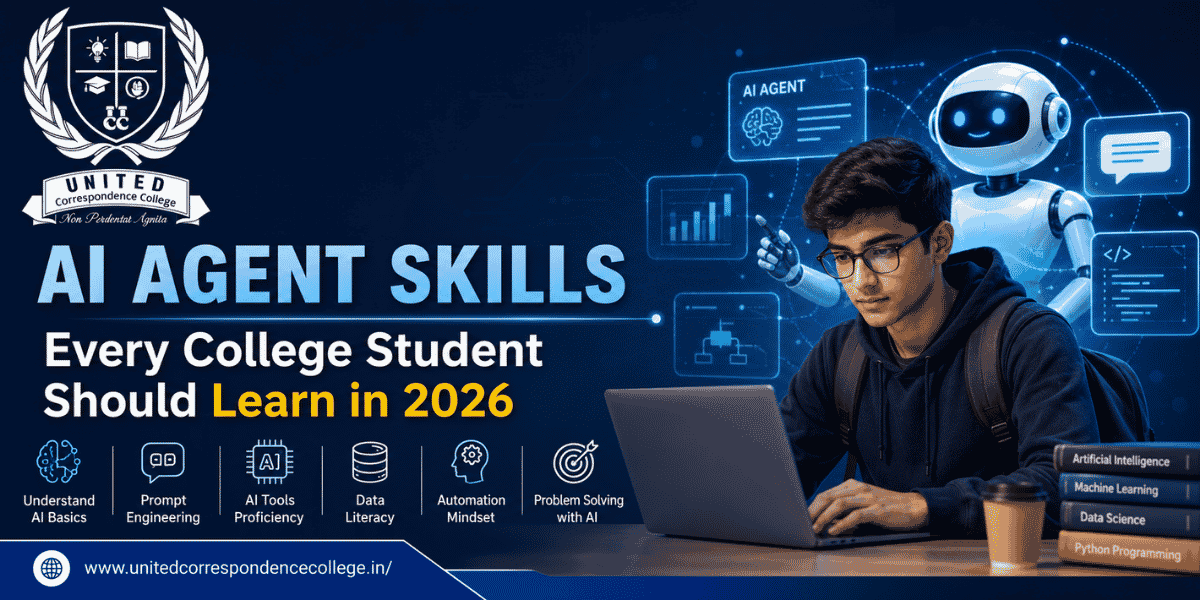
AI Agent Skills are quickly becoming one of the most valuable abilities every college student should develop in 2026. Unlike traditional AI tools that simply answer questions, AI agents can plan tasks, automate workflows, analyze information, and even make decisions based on user goals. As businesses increasingly adopt intelligent automation, employers are actively looking for graduates with strong AI Agent Skills who can work alongside modern AI technologies. Whether you want to build a career in software development, business, data science, or digital transformation, learning AI Agent Skills early can give you a competitive edge, improve your productivity, and prepare you for future-ready job opportunities in an AI-driven world.
What Are AI Agents?
AI agents are intelligent software systems that can perform tasks independently by understanding goals, analyzing information, making decisions, and taking appropriate actions. Unlike traditional chatbots that respond only to direct questions, AI agents can execute multiple tasks in sequence, remember context, interact with external applications, and automate complex workflows.
For example, an AI agent can:
- Schedule meetings
- Analyze spreadsheets
- Generate reports
- Write and debug code
- Manage emails
- Research information
- Create presentations
- Automate repetitive office tasks
This makes AI Agent Skills extremely valuable because organizations are rapidly integrating AI agents into daily business operations.
Popular examples include:
- ChatGPT Agent
- Claude AI
- Microsoft Copilot
- Google Gemini
- AutoGPT
- OpenAI Operator
- CrewAI
- LangChain Agents
Unlike earlier AI systems that simply generated content, modern AI agents function like digital assistants capable of completing real business workflows with minimal human intervention.
AI Chatbot vs AI Agent
| AI Chatbot | AI Agent |
| Answers user questions | Performs complete tasks independently |
| Requires constant prompts | Can plan multiple steps |
| Limited automation | End-to-end workflow automation |
| Mainly conversational | Goal-oriented execution |
| Minimal memory | Maintains context across tasks |
As AI technology advances, companies increasingly prefer professionals who possess practical AI Agent Skills because these skills directly improve productivity and operational efficiency.
Why AI Agent Skills Matter More Than Ever?
Artificial Intelligence is no longer limited to research labs or technology companies. Today, businesses across finance, healthcare, education, manufacturing, retail, and government are using AI agents to automate routine work and improve decision-making.
Here are the biggest reasons why AI Agent Skills are becoming essential.
AI is Transforming Every Industry
Organizations are using AI agents to automate customer support, generate business reports, manage software development, analyze financial data, and streamline operations.
As automation expands, employees who understand AI Agent Skills become valuable assets because they know how to work effectively alongside intelligent systems.
Employers Want AI-Ready Graduates
Companies no longer look only for academic qualifications. Recruiters increasingly value candidates who can:
- Use AI productively
- Automate repetitive work
- Improve business processes
- Analyze large datasets
- Build AI-assisted workflows
Students who learn AI Agent Skills before graduation often stand out during placements and technical interviews.
Higher Productivity
AI agents help professionals complete tasks significantly faster by reducing manual work.
For example, AI agents can:
- Draft emails
- Prepare reports
- Generate code
- Organize research
- Summarize meetings
- Create documentation
Learning AI Agent Skills allows students to become more productive both academically and professionally.
Strong Career Growth
AI-related careers continue expanding across multiple industries.
Professionals with AI Agent Skills can work in:
- Artificial Intelligence
- Software Development
- Data Analytics
- Business Intelligence
- Cloud Computing
- Product Management
- Digital Transformation
- Marketing Automation
Students pursuing BCA distance education can begin developing AI fundamentals alongside programming and database management, creating a strong foundation for future AI-driven careers.
Top AI Agent Skills Every College Student Should Learn
Developing AI Agent Skills requires a combination of technical knowledge, problem-solving ability, and practical experience. Rather than focusing only on theory, students should build hands-on expertise that employers value.
1. Prompt Engineering
Prompt engineering is one of the most fundamental AI Agent Skills because AI systems perform better when they receive clear and structured instructions.
Students should learn how to:
- Write effective prompts
- Improve response quality
- Break complex tasks into smaller steps
- Use role-based prompting
- Refine AI outputs
Strong prompt engineering dramatically improves the performance of AI agents.
2. AI Workflow Automation
Modern businesses increasingly automate repetitive work using AI.
Students should understand how AI agents can automate:
- Email management
- Customer support
- Content creation
- Data entry
- Task management
- Business reporting
Learning automation tools strengthens practical AI Agent Skills while improving workplace productivity.
3. Python Basics
Although many AI tools are no-code, Python remains one of the most useful programming languages for AI development.
Students should learn:
- Variables
- Functions
- Loops
- APIs
- Libraries
- Data processing
Python enables students to customize AI agents and build more advanced automation projects.
Students studying through an IT correspondence college in Bangalore can combine programming education with AI learning to prepare for emerging software development careers.
4. API Integration
AI agents often connect with external software using APIs.
Students should understand:
- REST APIs
- Authentication
- API requests
- JSON
- Webhooks
API knowledge allows AI agents to communicate with websites, databases, business applications, and cloud platforms.
Learning API integration significantly strengthens practical AI Agent Skills and prepares students for enterprise AI development.
5. Data Analysis with AI
Modern AI agents are capable of processing large volumes of information within seconds, making data analysis one of the most valuable AI Agent Skills in 2026. Organizations rely on AI to identify trends, generate reports, and support business decisions.
Students should learn how AI agents can:
- Analyze spreadsheets
- Generate visual reports
- Identify business trends
- Summarize datasets
- Predict outcomes
- Support decision-making
Learning data analysis helps students become more productive and prepares them for careers in analytics, finance, business intelligence, and Artificial Intelligence.
6. AI Research Skills
One of the biggest advantages of AI agents is their ability to collect, organize, and summarize information from multiple sources. Instead of spending hours searching online, students can use AI agents to conduct structured research.
Important research skills include:
- Finding reliable information
- Comparing multiple sources
- Creating structured summaries
- Fact verification
- Report generation
- Academic research assistance
Developing strong research abilities strengthens overall AI Agent Skills and improves both academic performance and workplace productivity.
Students pursuing MCA distance education in Bangalore can use AI-powered research tools to simplify technical subjects while working on programming assignments, software projects, and research documentation.
7. AI Content Evaluation
AI-generated content is becoming increasingly common, but professionals must know how to evaluate its quality before using it.
Students should learn to:
- Verify facts
- Improve clarity
- Remove AI hallucinations
- Check grammar
- Enhance readability
- Optimize business communication
Critical thinking remains one of the most important AI Agent Skills because human judgment is still essential for producing accurate and trustworthy work.
8. AI Ethics and Responsible AI
As AI adoption grows, ethical use becomes increasingly important.
Students should understand:
- Data privacy
- Responsible AI usage
- Bias in AI systems
- Transparency
- Intellectual property
- Academic integrity
Companies increasingly expect employees to use AI responsibly. Learning ethical practices ensures students develop trustworthy AI Agent Skills while avoiding misuse of AI technologies.
9. No-Code AI Automation
Not every student needs to become a software developer to build AI solutions. Today, many no-code platforms allow users to create AI workflows without extensive programming knowledge.
Popular platforms include:
- Zapier AI
- Make.com
- Microsoft Power Automate
- Notion AI
- Airtable AI
Students can automate tasks like:
- Email responses
- Social media scheduling
- File organization
- Lead management
- Task reminders
- Document generation
Learning no-code automation makes AI Agent Skills accessible to students from technical and non-technical backgrounds alike.
Students enrolled in IT distance education can practice building these automated workflows while balancing academic studies and personal commitments, gaining practical experience that employers value.
10. Problem Solving with AI Agents
Ultimately, AI is not about replacing human thinking—it is about enhancing it. One of the most important AI Agent Skills is knowing how to use AI to solve real-world problems efficiently.
Students should practice using AI agents to:
- Break down complex problems
- Generate multiple solutions
- Optimize workflows
- Improve productivity
- Support decision-making
- Automate repetitive tasks
Professionals who combine analytical thinking with AI tools will remain highly valuable even as automation continues expanding.
AI Agent Course
Learning AI Agent Skills becomes much easier when students follow a structured learning path. Today, many universities, online learning platforms, and technology companies offer specialized AI Agent courses designed for beginners.
A good AI Agent Course typically covers:
- AI fundamentals
- Prompt Engineering
- Large Language Models (LLMs)
- AI workflow automation
- Python for AI
- API integration
- AI ethics
- AI project development
Students should prioritize courses that include practical assignments and real-world projects rather than only theoretical lessons.
Some of the best learning platforms include:
- Coursera
- Google Cloud Skills Boost
- Microsoft Learn
- DeepLearning.AI
- Udemy
- LinkedIn Learning
- OpenAI Academy (when available)
Along with certifications, practical experience remains essential for developing strong AI Agent Skills.
AI Agent Skills & Best Learning Platforms
| AI Agent Skill | Best Learning Platform |
| Prompt Engineering | ChatGPT & Claude AI |
| Python Programming | Coursera / Codecademy |
| AI Automation | Zapier AI / Make.com |
| API Integration | Postman Learning Center |
| AI Research | Perplexity AI |
| Data Analysis | Google Colab |
| AI Projects | GitHub |
| AI Ethics | Microsoft Learn |
Best AI Agent Tools Every Student Should Learn
Practical experience is essential for mastering AI Agent Skills. Fortunately, many powerful AI tools are available for students to explore.
Some of the most popular AI agent tools include:
- ChatGPT – Writing, coding, brainstorming, and productivity.
- Claude AI – Long-form writing, document analysis, and structured reasoning.
- Google Gemini – Research, collaboration, and Google Workspace integration.
- Microsoft Copilot – AI assistance for Office applications and coding.
- Perplexity AI – AI-powered search with source-backed responses.
- Zapier AI – Workflow automation between apps.
- Make.com – Visual AI automation for businesses.
- CrewAI – Multi-agent collaboration for advanced AI workflows.
- LangChain – Framework for developing intelligent AI applications.
- OpenAI Operator – Emerging AI agent technology for autonomous task execution.
Students pursuing bca distance education in Bangalore can build hands-on experience with these tools while strengthening programming, automation, and problem-solving abilities. Developing practical expertise alongside academic studies helps learners stay ahead in the rapidly evolving AI landscape.
AI Agent Builder
As Artificial Intelligence continues to evolve, AI Agent Builders are becoming one of the most exciting technologies for students and professionals. An AI Agent Builder is a platform or framework that allows users to create intelligent AI agents capable of completing tasks, making decisions, interacting with software, and automating workflows. Instead of writing thousands of lines of code, many modern AI Agent Builders offer visual interfaces and pre-built templates that make development much easier.
Students who develop AI Agent Skills by learning AI Agent Builders gain practical experience that employers increasingly value. Building AI agents also helps improve logical thinking, workflow design, problem-solving, and software integration skills.
Popular AI Agent Builder platforms include:
- LangChain
- CrewAI
- Microsoft Copilot Studio
- OpenAI API
- Google Vertex AI
- Zapier AI
- Make.com
- AutoGen
- Flowise AI
These platforms allow students to create AI-powered assistants for customer support, task automation, report generation, coding assistance, research, and business productivity.
How College Students Can Learn AI Agent Skills?
Learning AI Agent Skills doesn’t require becoming an expert overnight. Students can gradually build their knowledge through structured learning, practical projects, and continuous experimentation with AI tools.
Step 1: Learn AI Fundamentals
Start by understanding:
- Artificial Intelligence
- Machine Learning
- Generative AI
- Large Language Models (LLMs)
- AI Agents
- Automation concepts
A strong conceptual foundation makes learning advanced AI technologies much easier.
Step 2: Practice Prompt Engineering
Prompt engineering is the foundation of every successful AI interaction.
Practice writing prompts that:
- Define clear objectives
- Specify output formats
- Provide context
- Break complex tasks into smaller steps
Improving prompt quality significantly enhances your AI Agent Skills.
Step 3: Learn Basic Programming
Although no-code platforms are becoming popular, learning Python provides much greater flexibility.
Students should understand:
- Variables
- Loops
- Functions
- APIs
- JSON
- File handling
Programming knowledge enables students to customize AI agents and build more sophisticated automation systems.
Step 4: Build Small AI Projects
Hands-on learning accelerates skill development.
Begin with projects like:
- AI Study Assistant
- Resume Review Agent
- Email Automation Agent
- Coding Assistant
- Meeting Summary Generator
- Research Assistant
- Personal Productivity Agent
Each completed project strengthens practical AI Agent Skills while building an impressive portfolio.
Step 5: Learn Automation Platforms
Modern businesses increasingly use no-code automation.
Practice using:
- Zapier
- Make.com
- Notion AI
- Microsoft Power Automate
Understanding workflow automation allows students to connect AI agents with business applications and improve productivity.
Step 6: Build an AI Portfolio
Employers value practical experience.
Include:
- GitHub repositories
- AI workflows
- Prompt libraries
- Automation projects
- API integrations
- Technical documentation
A strong portfolio demonstrates real-world AI Agent Skills beyond academic qualifications.
Students pursuing distance education in Bangalore can comfortably build these projects while balancing their studies, making them more competitive for internships and full-time technology roles.
Career Opportunities After Learning AI Agent Skills
The demand for AI professionals continues growing rapidly as organizations adopt intelligent automation across nearly every industry. Students with strong AI Agent Skills can explore exciting career opportunities beyond traditional software development.
Popular job roles include:
AI Engineer
Develops intelligent AI systems, automation solutions, and enterprise AI applications.
Prompt Engineer
Designs effective prompts that maximize AI performance across multiple business use cases.
AI Automation Specialist
Creates AI-powered workflows that improve organizational productivity and reduce manual work.
AI Product Manager
Works with development teams to design, launch, and improve AI-powered products.
Data Analyst
Uses AI tools to analyze business data, generate insights, and support strategic decisions.
Machine Learning Engineer
Develops predictive models and advanced AI systems for business applications.
Business Intelligence Analyst
Combines AI with analytics to improve organizational performance.
AI Consultant
Advises businesses on AI adoption, automation strategies, and digital transformation initiatives.
Professionals with practical AI Agent Skills are increasingly being hired across finance, healthcare, education, retail, software development, manufacturing, consulting, and government organizations.
Future Scope of AI Agent Skills in 2026
The future of AI Agent Skills is exceptionally promising because AI agents are rapidly evolving from simple assistants into autonomous digital coworkers capable of performing complex business tasks.
Key future trends include:
- Autonomous AI Agents
- Multi-Agent Collaboration
- AI in Software Development
- AI for Healthcare
- AI in Education
- AI Business Automation
- Smart Customer Support
- AI Research Assistants
- AI-Powered Decision Making
- Enterprise AI Workflows
Industry experts expect organizations to invest heavily in AI automation over the coming years, creating significant demand for professionals who understand both AI technologies and business processes. Students who begin developing AI Agent Skills today will be well-positioned for high-paying careers in Artificial Intelligence, software engineering, automation, cloud computing, data analytics, and digital transformation.
Why Choose UCC for Your Future AI Career?
Preparing for an AI-driven future requires both academic qualifications and practical technical skills. UCC (United Correspondence College) helps students achieve this balance through flexible learning programs designed for today’s evolving job market.
Whether you’re planning to pursue BCA distance education, continue with MCA distance education in Bangalore, or search for an IT correspondence college in Bangalore, UCC provides recognized programs that allow students to upgrade their qualifications while developing future-ready technology skills. Learners can also benefit from IT distance education, making it easier to balance higher education with professional and personal commitments.
Students enrolled through UCC can combine flexible academic learning with AI certifications, automation projects, programming practice, and real-world applications to strengthen their AI Agent Skills. By integrating modern AI knowledge with recognized degrees, UCC prepares learners for successful careers in Artificial Intelligence, software development, cloud computing, automation, and emerging digital technologies.
conclusion
The future belongs to professionals who can work effectively with intelligent automation, and developing AI Agent Skills is one of the smartest investments every college student can make in 2026. From automating workflows and analyzing data to building AI-powered applications, these skills are transforming the way businesses operate across every industry. By learning prompt engineering, Python, AI automation, API integration, and AI Agent Builders, students can prepare for exciting career opportunities in Artificial Intelligence, software development, cloud computing, and digital transformation. Start building your AI Agent Skills today, continue learning consistently, and stay ahead in the rapidly evolving AI-powered job market.
Build Your AI Career with UCC
Ready to prepare for the future of Artificial Intelligence? UCC (United Correspondence College) offers flexible programs such as BCA distance education, MCA distance education in Bangalore, IT correspondence college in Bangalore, and IT distance education to help students gain recognized qualifications while building industry-ready AI and technology skills. Learn at your own pace, earn a valuable degree, and develop practical expertise in AI, automation, programming, and digital technologies with UCC.
FAQs
1. What are AI Agent Skills?
AI Agent Skills refer to the abilities required to work with intelligent AI systems that can automate tasks, analyze data, make decisions, and improve productivity. These skills include prompt engineering, workflow automation, Python programming, API integration, AI ethics, and problem-solving. Unlike traditional AI usage, AI agents perform multi-step tasks with minimal human intervention, making them valuable across many industries. Students pursuing BCA distance education can begin learning these skills alongside their academic studies, helping them prepare for careers in Artificial Intelligence, software development, business automation, and cloud computing.
2. Why should college students learn AI Agent Skills?
Learning AI Agent Skills gives college students a competitive advantage because organizations increasingly rely on AI-powered automation to improve productivity and decision-making. These skills help students automate repetitive work, analyze information, generate content, and solve complex problems more efficiently. AI knowledge also enhances employability across software development, business, healthcare, finance, and education. Students studying through an IT correspondence college in Bangalore can strengthen both their academic foundation and practical AI expertise, making them better prepared for internships, campus placements, and future technology careers.
3. Do I need coding to learn AI Agent Skills?
No, coding is not mandatory to begin learning AI Agent Skills. Many modern AI platforms allow students to build intelligent workflows using no-code or low-code automation tools. However, learning basic Python programming significantly expands career opportunities by enabling customization, API integration, and advanced AI development. Students can first focus on prompt engineering and AI tools before gradually learning programming concepts. Those pursuing IT distance education can comfortably combine coding practice with AI learning, allowing them to build technical expertise while maintaining flexibility in their academic journey.
4. Which AI Agent tools should beginners learn?
Beginners should start with user-friendly AI platforms that provide practical learning opportunities. Popular tools include ChatGPT, Claude AI, Google Gemini, Microsoft Copilot, Perplexity AI, Zapier AI, Make.com, LangChain, CrewAI, and OpenAI APIs. These platforms help students understand automation, content generation, research, coding assistance, and workflow management. Practicing with multiple tools improves overall AI Agent Skills while exposing learners to different AI capabilities. Students enrolled in distance education in Bangalore can explore these tools alongside their studies and gradually build a strong portfolio of AI-powered projects.
5. How long does it take to learn AI Agent Skills?
The time required depends on consistency and learning goals. Students can understand the basics of AI Agent Skills within one to two months by practicing prompt engineering, AI tools, and workflow automation regularly. Building advanced expertise in Python, APIs, AI automation, and AI Agent Builders generally requires six to twelve months of continuous learning and project development. Completing practical assignments and creating AI-based solutions significantly improves skill development. Students pursuing bca distance education in Bangalore can steadily build AI knowledge while balancing academic responsibilities and professional commitments.
6. What careers are available after learning AI Agent Skills?
Professionals with strong AI Agent Skills can pursue careers as AI Engineers, Prompt Engineers, AI Automation Specialists, Machine Learning Engineers, Data Analysts, AI Consultants, AI Product Managers, Business Intelligence Analysts, and Software Developers. Demand for these roles continues to increase as organizations adopt Artificial Intelligence across industries. AI professionals enjoy competitive salaries, global career opportunities, and long-term growth. Students pursuing MCA distance education in Bangalore can enhance their career prospects by combining advanced education with AI certifications, automation projects, and practical experience.
7. Are AI Agent Skills useful for non-technical students?
Yes. AI Agent Skills are valuable for students from Commerce, Management, Arts, Science, and other non-technical backgrounds because many AI platforms require little or no programming knowledge. AI agents can improve productivity by assisting with research, writing, presentations, data organization, customer support, and workflow automation. Learning these skills helps students work more efficiently regardless of their academic discipline. Students pursuing BCA distance education or other flexible degree programs can use AI responsibly to improve learning while preparing for technology-driven workplaces.
8. What is the future scope of AI Agent Skills?
The future of AI Agent Skills is extremely promising as businesses increasingly adopt intelligent automation and autonomous AI systems. AI agents are expected to support software development, healthcare, finance, education, customer service, manufacturing, and business operations. Professionals who understand AI workflows, automation, and intelligent decision-making will remain in high demand across industries. Students studying through an IT correspondence college in Bangalore can prepare for future-ready careers by combining recognized academic qualifications with practical AI knowledge, certifications, and project-based learning.