
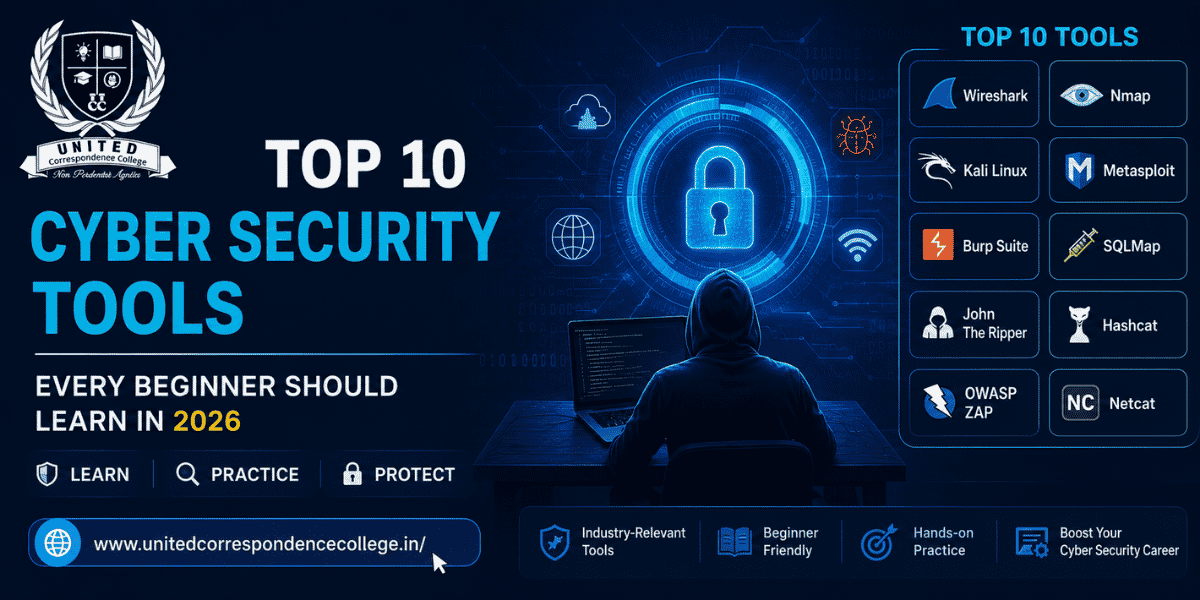
Cyber Security Tools are becoming one of the most valuable technical skills to learn in today’s digital world. From protecting personal information to defending organizations against cyber threats, Cyber Security Tools help security professionals identify vulnerabilities, monitor networks, detect attacks, and secure digital systems. As cybercrime continues to rise in 2026, learning Cyber Security Tools is no longer limited to ethical hackers or IT experts. Students, beginners, and aspiring cybersecurity professionals can all benefit from mastering Cyber Security Tools to improve their career prospects. This guide explores the Top 10 Cyber Security Tools every beginner should learn, their features, practical applications, and how they can help build a successful career in cybersecurity.
Why Every Beginner Should Learn Cyber Security Tools in 2026?
Cybersecurity has evolved into one of the fastest-growing industries globally. Governments, multinational companies, banks, healthcare organizations, and technology firms invest billions of dollars every year to strengthen their digital security. As a result, professionals with practical knowledge of Cyber Security Tools are in greater demand than ever before.
Unlike theoretical learning, cybersecurity tools provide hands-on experience. Beginners can understand how cyber attacks occur, how vulnerabilities are identified, and how organizations defend their systems against hackers. Learning these tools also develops analytical thinking, networking knowledge, Linux skills, and problem-solving abilities.
Another major advantage is career flexibility. Cybersecurity professionals can work in cloud security, penetration testing, digital forensics, security operations, threat intelligence, and compliance. Even software developers and network administrators benefit from understanding security concepts.
Students pursuing BCA distance education can strengthen their technical foundation by learning these tools alongside their academic curriculum. Practical cybersecurity skills not only improve employability but also prepare students for globally recognized certifications and industry roles.
Why Practical Experience Matters?
Reading cybersecurity books alone is not enough. The best way to become job-ready is by practicing with real tools in virtual labs, Capture The Flag (CTF) platforms, and simulated environments. Every hour spent using these tools builds confidence and prepares beginners for industry certifications and real-world security roles.
Cyber Security Tools List
Choosing the right cybersecurity tools can be overwhelming because hundreds of options are available. Beginners should start with tools that teach networking, system security, vulnerability assessment, penetration testing, and traffic analysis before moving toward advanced security platforms.
The following Cyber Security Tools List includes some of the most widely used tools by cybersecurity professionals across industries.
Beginner Cyber Security Tools Overview
| Tool | Primary Purpose | Difficulty | Free/Paid |
| Wireshark | Network Traffic Analysis | Easy | Free |
| Nmap | Network Scanning | Easy | Free |
| Kali Linux | Penetration Testing | Medium | Free |
| Burp Suite | Web Application Security | Medium | Free & Paid |
| Metasploit | Exploitation Framework | Medium | Free |
| Nessus | Vulnerability Assessment | Medium | Free Trial |
| OWASP ZAP | Web Security Testing | Easy | Free |
| Aircrack-ng | Wireless Security | Medium | Free |
| John the Ripper | Password Security Testing | Easy | Free |
| Splunk | Security Monitoring (SIEM) | Medium | Free & Paid |
1. Wireshark
Wireshark is one of the most popular Cyber Security Tools for beginners because it allows users to capture and analyze network traffic in real time. It helps students understand how devices communicate over a network and how malicious activities can be detected through packet analysis.
With Wireshark, beginners can inspect protocols, troubleshoot network issues, detect suspicious traffic, and analyze data packets. Since cybersecurity heavily depends on networking knowledge, mastering Wireshark builds a strong foundation for advanced security concepts.
Professionals across security operations centers (SOCs), network administration, and incident response teams regularly use Wireshark for diagnosing network problems and investigating cyber incidents.
2. Nmap (Network Mapper)
Nmap is another essential tool every cybersecurity beginner should learn. It is widely used for discovering devices connected to a network, identifying open ports, detecting operating systems, and assessing network vulnerabilities.
Security professionals rely on Nmap during penetration testing and security assessments because it quickly maps network infrastructure and highlights potential security risks.
Some important Nmap capabilities include:
- Port scanning
- Host discovery
- Service detection
- Operating system identification
- Vulnerability scanning
- Network inventory
Learning Nmap also helps beginners understand network architecture and strengthens their knowledge of TCP/IP protocols.
3. Kali Linux
Kali Linux is considered the industry’s most popular operating system for ethical hacking and penetration testing. Instead of installing multiple security applications separately, Kali Linux comes preloaded with hundreds of cybersecurity tools.
Some built-in tools include:
- Nmap
- Burp Suite
- Metasploit
- Aircrack-ng
- John the Ripper
- Hydra
- Wireshark
Kali Linux enables students to practice ethical hacking in controlled lab environments while learning vulnerability assessment, password auditing, web application testing, and wireless security.
Students studying through an IT correspondence college in Bangalore can significantly improve their practical cybersecurity skills by gaining hands-on experience with Kali Linux alongside their academic coursework.
4. Burp Suite
Burp Suite is one of the leading web application security testing tools used by ethical hackers, penetration testers, and bug bounty professionals.
It helps identify vulnerabilities such as:
- SQL Injection
- Cross-Site Scripting (XSS)
- Authentication flaws
- Session management issues
- Security misconfigurations
Burp Suite allows users to intercept web requests, modify HTTP traffic, and analyze web applications for potential weaknesses before attackers exploit them.
The Community Edition is free and provides enough functionality for beginners to understand web security fundamentals.
5. Metasploit Framework
Metasploit is one of the most powerful Cyber Security Tools used for penetration testing and security research. Instead of manually exploiting vulnerabilities, Metasploit provides an extensive framework containing thousands of exploit modules, payloads, and security testing utilities.
With Metasploit, beginners can:
- Test system vulnerabilities
- Validate security configurations
- Simulate cyber attacks
- Learn ethical hacking techniques
- Understand exploitation methods
Learning Metasploit also teaches responsible penetration testing practices while helping students understand how attackers exploit security weaknesses.
6. Nessus
Nessus is one of the most trusted Cyber Security Tools used by organizations to identify vulnerabilities before cybercriminals can exploit them. Developed by Tenable, Nessus performs comprehensive vulnerability assessments on servers, computers, cloud environments, and network devices. It scans systems for outdated software, missing security patches, weak passwords, and configuration issues that could lead to security breaches.
For beginners, Nessus provides an excellent introduction to vulnerability management and security auditing. Instead of manually checking every system, users can automate the process and generate detailed security reports with recommendations for fixing vulnerabilities.
Key features include:
- Vulnerability scanning
- Configuration assessment
- Patch management support
- Compliance auditing
- Risk prioritization
- Security reporting
Learning Nessus prepares students for careers in cybersecurity consulting, risk assessment, and enterprise security management.
7. OWASP ZAP (Zed Attack Proxy)
OWASP ZAP is a free, open-source web application security testing tool developed by the Open Worldwide Application Security Project (OWASP). It is widely recommended for beginners because of its simple interface and powerful vulnerability detection capabilities.
The tool helps identify common web application vulnerabilities such as:
- SQL Injection
- Cross-Site Scripting (XSS)
- Broken Authentication
- Security Misconfiguration
- Sensitive Data Exposure
OWASP ZAP automatically scans websites and generates reports highlighting potential security weaknesses. Beginners can safely practice web security testing using intentionally vulnerable applications like DVWA and Juice Shop.
Its active community and extensive documentation make it one of the best starting points for anyone interested in ethical hacking and application security.
8. Aircrack-ng
Wireless networks are common targets for cyber attacks, making Aircrack-ng one of the most valuable Cyber Security Tools for learning Wi-Fi security.
Aircrack-ng is a collection of tools used for:
- Wi-Fi security auditing
- Packet capture
- Network monitoring
- Password recovery
- Wireless vulnerability testing
Students can learn how wireless authentication works, identify weak network configurations, and understand modern Wi-Fi security standards. It is commonly used during ethical hacking courses to demonstrate the importance of strong wireless encryption.
By practicing in authorized lab environments, beginners gain valuable knowledge about wireless security without violating ethical or legal guidelines.
9. John the Ripper
John the Ripper is a password auditing and recovery tool used by cybersecurity professionals to test password strength. Organizations use it to identify weak passwords before attackers can exploit them.
This tool supports various password hash formats and helps security teams verify whether password policies are strong enough to protect sensitive systems.
Its major applications include:
- Password auditing
- Password recovery
- Security assessments
- Authentication testing
- Compliance verification
For beginners, John the Ripper introduces the concept of password security, hashing algorithms, and authentication mechanisms while emphasizing the importance of creating strong passwords.
10. Splunk
Splunk is one of the leading Security Information and Event Management (SIEM) platforms used by enterprises worldwide. Unlike penetration testing tools, Splunk focuses on monitoring, analyzing, and visualizing security logs generated by servers, applications, cloud services, and network devices.
Organizations use Splunk to:
- Monitor security events
- Detect suspicious activities
- Analyze logs
- Investigate cyber incidents
- Generate security dashboards
- Support threat intelligence
Learning Splunk helps beginners understand how modern Security Operations Centers (SOCs) detect attacks in real time. Since many large organizations rely on SIEM platforms, Splunk knowledge significantly improves career opportunities.
Students pursuing MCA distance education in Bangalore can strengthen their cybersecurity expertise by learning enterprise-level monitoring tools like Splunk alongside advanced software and networking concepts.
Cyber Security Tools And Techniques
Learning cybersecurity is not only about mastering software—it also requires understanding the techniques professionals use to secure systems and investigate attacks. Combining practical tools with proven techniques creates a strong foundation for beginners entering the cybersecurity field.
Some of the most important cybersecurity techniques include:
Network Scanning
Used to discover devices, open ports, and running services on a network.
Best Tool: Nmap
Packet Analysis
Monitoring network traffic to identify suspicious communications and troubleshoot connectivity issues.
Best Tool: Wireshark
Vulnerability Assessment
Scanning systems to identify security weaknesses before attackers exploit them.
Best Tool: Nessus
Penetration Testing
Simulating cyber attacks to evaluate an organization’s security posture.
Best Tools:
- Metasploit
- Kali Linux
- Burp Suite
Web Application Security Testing
Testing websites and web applications for common vulnerabilities.
Best Tools:
- Burp Suite
- OWASP ZAP
Wireless Security Testing
Evaluating Wi-Fi security and encryption strength.
Best Tool: Aircrack-ng
Password Auditing
Testing password strength and authentication mechanisms.
Best Tool: John the Ripper
Security Monitoring
Collecting and analyzing logs to detect threats and investigate incidents.
Best Tool: Splunk
Cyber Security Tools and Their Techniques
| Cyber Security Tool | Primary Technique | Common Use Case |
| Wireshark | Packet Analysis | Network Monitoring |
| Nmap | Network Scanning | Device Discovery |
| Kali Linux | Penetration Testing | Ethical Hacking Labs |
| Burp Suite | Web Security Testing | Application Security |
| Metasploit | Exploitation | Security Validation |
| Nessus | Vulnerability Assessment | Risk Identification |
| OWASP ZAP | Web Vulnerability Scanning | Secure Web Applications |
| Aircrack-ng | Wireless Security | Wi-Fi Auditing |
| John the Ripper | Password Auditing | Authentication Testing |
| Splunk | SIEM & Log Analysis | Threat Detection |
Beginner Cyber Security Learning Roadmap
Beginners often wonder where to start because cybersecurity covers multiple domains. A structured roadmap makes learning more manageable.
Step 1: Learn networking fundamentals (TCP/IP, DNS, HTTP, Firewalls)
Step 2: Understand Linux commands and operating systems.
Step 3: Practice using Wireshark and Nmap.
Step 4: Learn basic web security concepts.
Step 5: Explore Kali Linux and Burp Suite.
Step 6: Study vulnerability assessment using Nessus.
Step 7: Practice ethical hacking in virtual labs.
Step 8: Build projects and participate in Capture The Flag (CTF) competitions.
Students enrolled in IT distance education programs can follow this roadmap while balancing academic studies and practical training. Consistent hands-on practice combined with theoretical knowledge prepares learners for certifications and entry-level cybersecurity roles.
Cyber Security Tools For Beginners
Starting a career in cybersecurity may seem challenging at first, but choosing the right Cyber Security Tools makes the learning journey much easier. Beginners should focus on understanding networking, operating systems, web security, and ethical hacking while practicing with industry-standard tools. Rather than trying to learn every tool at once, it’s better to master one tool, understand its purpose, and then move to the next.
The following approach helps beginners develop practical cybersecurity skills effectively:
Learn Networking Fundamentals
Before using advanced security tools, understand how computer networks function. Concepts such as IP addressing, TCP/IP, DNS, HTTP, HTTPS, routers, switches, and firewalls form the backbone of cybersecurity. A strong networking foundation helps you understand how attacks occur and how security tools detect them.
Practice with Virtual Labs
Always practice cybersecurity in safe environments like:
- VirtualBox
- VMware Workstation
- TryHackMe
- Hack The Box
- OverTheWire
- DVWA
- OWASP Juice Shop
These platforms allow beginners to gain real-world experience without affecting live systems.
Learn Linux
Many Cyber Security Tools run on Linux-based operating systems, especially Kali Linux. Beginners should become comfortable with:
- Linux commands
- File permissions
- Package management
- Shell scripting
- Process management
Linux knowledge makes it easier to use penetration testing and security monitoring tools.
Develop Programming Skills
Although beginners can start without programming, learning basic coding significantly improves cybersecurity knowledge.
Useful programming languages include:
- Python
- Bash
- JavaScript
- SQL
Programming helps automate repetitive tasks, analyze logs, and develop custom security scripts.
Students pursuing bca distance education in Bangalore can combine their programming curriculum with cybersecurity practice, building both software development and security expertise for broader career opportunities.
Essential Skills Every Cyber Security Beginner Should Build
Learning Cyber Security Tools alone is not enough. Employers also look for professionals who possess practical technical skills and analytical thinking.
Some of the most valuable cybersecurity skills include:
Network Security
Understanding firewalls, VPNs, routers, intrusion detection systems, and network protocols.
Operating System Security
Working with:
- Windows Security
- Linux Security
- User management
- File permissions
- Security policies
Web Application Security
Learning about:
- SQL Injection
- Cross-Site Scripting (XSS)
- Authentication
- Cookies
- Sessions
- APIs
Cloud Security
As organizations migrate to cloud platforms, cloud security has become an essential skill.
Popular cloud platforms include:
- AWS
- Microsoft Azure
- Google Cloud Platform
Security Monitoring
Understanding SIEM tools, log analysis, and threat detection helps professionals monitor large enterprise environments effectively.
Incident Response
Knowing how to respond quickly after a cyber attack is an important responsibility for security professionals.
Incident response includes:
- Investigation
- Containment
- Recovery
- Reporting
Career Opportunities After Learning Cyber Security Tools
Cybersecurity professionals are among the highest-paid IT specialists today. Every industry now requires experts who can protect digital infrastructure against evolving cyber threats.
Popular job roles include:
- Cyber Security Analyst
- SOC Analyst
- Ethical Hacker
- Penetration Tester
- Network Security Engineer
- Information Security Analyst
- Cloud Security Engineer
- Incident Response Analyst
- Threat Intelligence Analyst
- Vulnerability Assessment Engineer
- Digital Forensics Specialist
- Security Consultant
Many organizations also hire cybersecurity professionals for compliance, governance, and risk management roles.
Best Cyber Security Certifications for Beginners
Professional certifications validate your knowledge and improve employability. Beginners should consider certifications that combine theoretical concepts with practical security skills.
Recommended certifications include:
CompTIA Security+
A globally recognized certification covering networking, risk management, cryptography, and security operations.
Certified Ethical Hacker (CEH)
Ideal for students interested in ethical hacking, penetration testing, and vulnerability assessment.
Google Cybersecurity Professional Certificate
A beginner-friendly certification focusing on security fundamentals and practical labs.
Cisco CyberOps Associate
Excellent for students who want to work in Security Operations Centers (SOC).
eJPT (Junior Penetration Tester)
A hands-on certification emphasizing practical penetration testing rather than theory.
OSCP (Future Goal)
Considered one of the world’s most respected penetration testing certifications for experienced professionals.
Future Scope of Cyber Security in 2026
The future of cybersecurity is exceptionally promising. Digital transformation, cloud computing, Artificial Intelligence, IoT devices, and remote work have significantly increased the need for skilled security professionals.
Major growth areas include:
- AI-powered Security
- Cloud Security
- Zero Trust Security
- IoT Security
- Digital Forensics
- Threat Intelligence
- Malware Analysis
- Ransomware Protection
- Security Automation
- Governance, Risk & Compliance
Industry reports continue to predict a shortage of qualified cybersecurity professionals worldwide, making it one of the most stable and rewarding technology careers.
Students pursuing distance education in Bangalore can combine flexible academic learning with cybersecurity certifications and practical experience to prepare for high-paying opportunities across government organizations, multinational corporations, financial institutions, healthcare companies, and technology firms.
Why Choose UCC for Your IT Career?
Building a successful cybersecurity career requires both academic knowledge and practical technical skills. UCC (United Correspondence College) helps students prepare for future technology careers through flexible learning programs that fit working professionals and aspiring IT students.
Whether you’re interested in BCA distance education, IT correspondence college in Bangalore, or IT distance education, UCC offers recognized programs that support career growth while allowing learners to continue developing practical skills in cybersecurity, networking, cloud computing, and software development.
By combining academic qualifications with hands-on experience in Cyber Security Tools, industry certifications, and real-world projects, students can confidently prepare for careers in ethical hacking, cyber defense, security analysis, and digital risk management. UCC empowers learners to build the technical expertise required to succeed in today’s rapidly evolving cybersecurity industry.
Conclusion
Learning the right Cyber Security Tools is one of the smartest investments beginners can make in 2026. From analyzing network traffic with Wireshark to performing penetration testing using Metasploit and securing web applications with Burp Suite, each tool builds practical skills that employers actively seek. However, tools alone are not enough—consistent practice, strong networking knowledge, Linux fundamentals, and industry certifications are equally important. By combining hands-on experience with continuous learning, beginners can confidently prepare for rewarding careers in cybersecurity, ethical hacking, cloud security, digital forensics, and security operations while staying ahead in an increasingly digital world.
Start Your Cyber Security Journey with UCC
Build a successful career in cybersecurity with UCC (United Correspondence College). Whether you’re pursuing BCA distance education, MCA distance education in Bangalore, IT correspondence college in Bangalore, or IT distance education, UCC offers flexible learning programs that help you gain academic qualifications while developing practical IT and cybersecurity skills. Start learning today and prepare for high-demand careers in ethical hacking, cyber defense, cloud security, and information security.
FAQs
1. Which Cyber Security Tools should beginners learn first?
Beginners should start with essential Cyber Security Tools that provide a strong foundation in networking, system security, and ethical hacking. Tools like Wireshark, Nmap, and Kali Linux help learners understand network traffic analysis, vulnerability scanning, and penetration testing. Once comfortable with these basics, students can move on to advanced tools such as Burp Suite, Metasploit, Nessus, and Splunk for web security, exploitation, and security monitoring. Practicing these tools in virtual labs builds hands-on experience and confidence. Students pursuing BCA distance education can combine practical cybersecurity learning with their academic studies, making them better prepared for certifications, internships, and entry-level cybersecurity careers.
2. Is Kali Linux necessary for learning Cyber Security?
Kali Linux is not compulsory, but it is one of the most valuable platforms for learning cybersecurity because it comes preloaded with hundreds of professional Cyber Security Tools. Instead of installing software individually, learners get access to penetration testing, vulnerability assessment, wireless security, digital forensics, and password auditing tools in one operating system. Kali Linux also helps students understand Linux commands and security workflows used by ethical hackers worldwide. Regular practice in safe lab environments builds practical confidence. Students studying through an IT correspondence college in Bangalore can strengthen their cybersecurity knowledge by using Kali Linux alongside networking, programming, and operating system concepts.
3. Are Cyber Security Tools free to use?
Yes, many industry-standard Cyber Security Tools are available free of cost, making cybersecurity accessible for beginners. Popular open-source tools such as Wireshark, Nmap, Kali Linux, OWASP ZAP, Aircrack-ng, Metasploit Community Edition, and John the Ripper provide powerful features without requiring expensive licenses. Some enterprise solutions like Nessus and Splunk also offer free editions or trial versions for learning purposes. Beginners can gain extensive hands-on experience before investing in premium software. Students pursuing IT distance education can use these free tools to practice vulnerability assessment, ethical hacking, and network analysis while developing practical cybersecurity skills from home.
4. Can I learn Cyber Security without coding?
Absolutely. Beginners can begin learning cybersecurity without programming by focusing on networking fundamentals, Linux, operating systems, and practical Cyber Security Tools. Many security roles, including SOC analysis and vulnerability management, rely more on understanding systems than writing code. However, learning programming languages such as Python, Bash, or JavaScript later can greatly improve automation, scripting, penetration testing, and malware analysis skills. Coding becomes increasingly useful as learners move into advanced cybersecurity positions. Students enrolled in distance education in Bangalore can gradually build programming knowledge alongside cybersecurity training, allowing them to develop well-rounded technical skills for future career growth.
5. Which Cyber Security certifications are best for beginners?
Several globally recognized certifications help beginners validate their knowledge of Cyber Security Tools and security fundamentals. Popular options include CompTIA Security+, Certified Ethical Hacker (CEH), Google Cybersecurity Professional Certificate, Cisco CyberOps Associate, and eJPT (Junior Penetration Tester). These certifications cover networking, risk management, ethical hacking, security operations, and practical cybersecurity techniques. Beginners should first build hands-on experience before attempting certification exams to maximize learning outcomes. Students pursuing bca distance education in Bangalore can enhance their resumes by combining academic qualifications with industry-recognized certifications, increasing their employability across IT, banking, healthcare, and government sectors.
6. What is the average salary of a Cyber Security Analyst in India?
Cyber Security Analysts are among the highest-paid IT professionals because organizations continue investing in digital protection. Fresh graduates typically earn between ₹4–8 LPA depending on their technical knowledge, certifications, and employer. Professionals with three to five years of experience can earn ₹10–18 LPA, while senior cybersecurity consultants, cloud security specialists, and ethical hackers often receive ₹20 LPA or more. Expertise in Cyber Security Tools, incident response, cloud security, and penetration testing significantly improves salary potential. Students pursuing MCA distance education in Bangalore can prepare for these rewarding opportunities by combining higher education with certifications and real-world cybersecurity projects.
7. How long does it take to learn Cyber Security Tools?
The time required to master Cyber Security Tools depends on your consistency, technical background, and career goals. Beginners can understand tools like Wireshark, Nmap, and Kali Linux within two to three months through regular hands-on practice. Developing advanced expertise in penetration testing, cloud security, malware analysis, and digital forensics generally takes six months to one year of continuous learning. Participating in virtual labs, Capture the Flag (CTF) competitions, and practical projects accelerates skill development. Students pursuing BCA distance education can comfortably balance academic coursework with cybersecurity practice, gradually building industry-ready knowledge and technical confidence.
8. Is Cyber Security a good career in 2026?
Yes, cybersecurity remains one of the fastest-growing and most stable technology careers in 2026. Increasing cyber threats, digital transformation, cloud adoption, and stricter data protection regulations continue driving demand for skilled professionals. Experts with knowledge of Cyber Security Tools, ethical hacking, cloud security, digital forensics, and security operations enjoy excellent salaries, international opportunities, and long-term career growth. Industries including banking, healthcare, government, e-commerce, manufacturing, and IT actively recruit cybersecurity professionals. Students studying through an IT correspondence college in Bangalore can prepare for these future-ready careers by combining flexible education with practical cybersecurity training and professional certifications.