
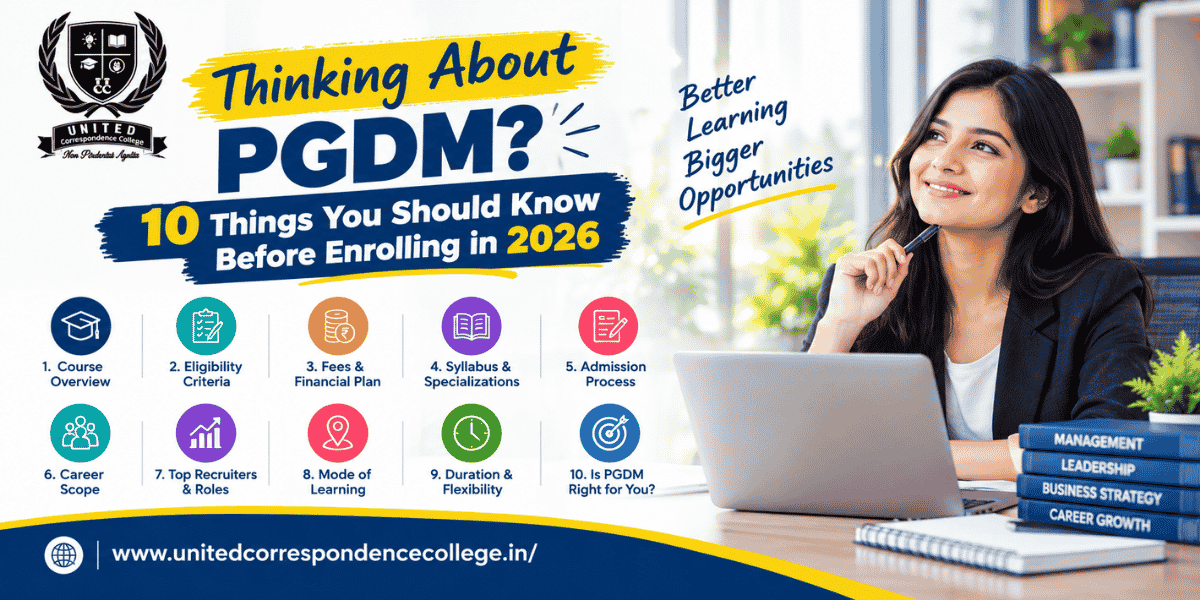
If you are Thinking About PGDM, you have probably already started comparing colleges, specializations, fees and career opportunities. But choosing a management program is not simply about finding a course with an attractive title. Thinking About PGDM should also mean thinking about your career direction, learning preferences, budget and the kind of skills you want to develop.
For students and working professionals, Thinking About PGDM in 2026 can open the door to several management-oriented career paths. At the same time, there are many details that deserve attention before you submit an application. From checking the institution and curriculum to understanding the difference between a diploma and a degree, every small decision can influence your overall learning experience.
So, if you are Thinking About PGDM, don’t make the decision only because someone recommended it or because a particular specialization is trending. Take a step back, understand what the program involves and then decide whether it matches your plans.
What Makes PGDM Worth Considering in 2026?
A PGDM, or Post Graduate Diploma in Management, is designed around management and business learning. Depending on the institute, students may study areas such as marketing, finance, human resources, operations, business analytics and other management functions.
The important point is that Thinking About PGDM should begin with a question: What do I want this qualification to help me achieve?
Current management education discussions increasingly focus on practical learning, industry relevance, analytics and changing business requirements. AICTE’s model curriculum for management programs also emphasizes learning outcomes, multidisciplinary management knowledge, electives and applied learning opportunities.
That makes it important to look beyond the course name and understand what a particular program actually teaches.
1. Start With Your Career Goal, Not the College Advertisement
The first thing to remember when Thinking About PGDM is that there is no single specialization that is perfect for everyone.
If you enjoy communication, customer behaviour and branding, marketing may feel more natural. If numbers, investments and financial planning interest you, finance may be a better direction. Students who enjoy working with people may consider human resources, while those who like processes and efficiency may prefer operations.
Business analytics is another option for learners who enjoy data, technology and decision-making.
Instead of asking, “Which specialization is most popular?” ask:
- What subjects do I actually enjoy?
- What type of work would I like to do?
- Which skills do I already have?
- Which skills do I need to develop?
- Where do I see myself after completing the program?
This simple exercise can make Thinking About PGDM much more purposeful.
2. Understand What You Are Actually Signing Up For
Before Thinking About PGDM, understand the learning experience rather than focusing only on the certificate.
A good PGDM course can involve more than reading textbooks and appearing for examinations. Depending on the institution and format, students may encounter case studies, presentations, assignments, projects, business discussions, practical exercises and industry-oriented learning.
This matters because management is not only about remembering definitions. A future manager may need to analyse a situation, communicate an idea, work with a team and make decisions with limited information.
When Thinking About PGDM, look at the curriculum and ask whether it gives you opportunities to build these abilities.
What should you look for in a curriculum?
| Area | What to Check |
| Core management | Business fundamentals |
| Specialization | Subjects related to your career goal |
| Practical learning | Projects, cases and assignments |
| Technology | Relevant digital and analytical skills |
| Industry exposure | Practical business understanding |
A curriculum that connects theory with application can make your learning journey more meaningful.
3. Don’t Skip the Recognition and Institution Check
One of the most important parts of Thinking About PGDM is verifying the institution and program before paying fees.
Students sometimes concentrate heavily on advertisements, placement promises or attractive brochures while overlooking the basic question: Who is offering this program and under what framework?
PGDM and MBA are not simply two names for exactly the same qualification. A PGDM is generally a postgraduate diploma offered by an autonomous management institute, while an MBA is a university-awarded degree. The exact recognition and equivalence position can depend on the institution and program, so students should verify the relevant details before admission.
If you are Thinking About PGDM, check the official information relating to:
- Institution status
- Program approval or recognition
- Course duration
- Admission requirements
- Examination process
- Learning mode
- Certification details
- Any applicable equivalence information
Don’t depend on a third-party claim when official information is available.
4. Choose a Specialization That You Can See Yourself Studying
The next stage of Thinking About PGDM is deciding what area of management interests you.
Some commonly explored PGDM specializations include:
- Marketing Management
- Financial Management
- Human Resource Management
- Operations Management
- Business Analytics
- International Business
- Digital Marketing
- Information Technology Management
The right choice depends on your interests and career plans.
For example, someone who enjoys creating campaigns and understanding customers may find marketing engaging. A learner interested in financial analysis may naturally move toward finance. Someone who enjoys solving operational problems may prefer operations.
The goal is not to select a specialization simply because it appears frequently in advertisements. Your PGDM specializations should make sense for the type of professional you want to become.
This is one reason Thinking About PGDM should involve career planning before admission rather than after the first semester.
5. Compare the Learning Mode With Your Lifestyle
Another important part of Thinking About PGDM is deciding whether the learning format fits your everyday responsibilities.
Students may explore regular, online or other flexible management-learning options depending on the institution and program.
A working professional, for example, may need greater flexibility around work commitments. A recent graduate may prefer a learning environment with more direct interaction and campus exposure.
Before choosing, consider:
- Live or recorded classes
- Faculty interaction
- Assignment schedules
- Examination pattern
- Study materials
- Student support
- Project requirements
- Time commitment
Searching for Management distance education in Bangalore or distance education colleges in Bangalore can help you discover flexible study options, but don’t select a program simply because it is convenient.
Convenience is useful only when the program also matches your academic and career expectations.
6. Understand PGDM Eligibility Before Starting the Application
A common mistake during Thinking About PGDM is assuming that every institute follows exactly the same admission criteria.
PGDM eligibility can vary between institutions and programs. Many management programs require a bachelor’s degree, while some may also consider entrance examination scores as part of their admission process.
For example, the admission requirements of a specific PGDM program can include graduation qualifications and an entrance score. MANAGE’s 2026–28 PGDM prospectus, for instance, specifies eligibility requirements and uses CAT scores as part of its selection process.
Therefore, when Thinking About PGDM, always check the eligibility information of the particular institution you want to join.
Don’t assume that the eligibility criteria of one college automatically apply to another.
7. Look at the Complete Cost, Not Just the Headline Fee
When Thinking About PGDM, money naturally becomes an important part of the decision.
Instead of looking only at the number displayed on an advertisement, understand the complete financial commitment.
Ask whether the quoted amount includes:
- Tuition fees
- Registration charges
- Examination charges
- Study materials
- Project-related expenses
- Additional certifications
- Other institutional charges
Also check the payment schedule and refund terms before making a commitment.
A Simple Fee-Checking Guide
| What to Check | Why It Matters |
| Total course fee | Helps you plan your budget |
| Payment schedule | Shows when payments are due |
| Examination fee | Avoids unexpected expenses |
| Study materials | Shows what is included |
| Additional charges | Helps calculate the real cost |
When Thinking About PGDM, comparing the total value of the program with the overall cost is much more useful than comparing one advertised fee with another.
8. Don’t Choose a Program Only Because of Placement Claims
Placement is naturally important when Thinking About PGDM, but it should not be the only deciding factor.
A statement such as “excellent placements” doesn’t tell you enough. Try to understand what career support actually looks like.
Look for information about:
- Recruiter participation
- Internship opportunities
- Career counselling
- Interview preparation
- Resume support
- Industry interaction
- Alumni network
- Types of roles available
Also remember that placement assistance and guaranteed employment are not necessarily the same thing.
When thinking about PGDM, your own skills, communication ability, academic performance, practical exposure and career preparation can also influence outcomes.
A better question is not simply, “Does the college provide placement?”
Ask:
“How does the institution help students become employable?”
That question can reveal much more.
9. Don’t Ignore the PGDM vs MBA Question
Almost every serious student thinking about PGDM eventually asks whether an MBA would be a better option.
The two qualifications overlap in management education, but they have differences in how they are awarded and structured. An MBA is generally a university degree, while a PGDM is generally a postgraduate diploma offered by an autonomous institute. The specific recognition and equivalence situation should always be checked for the program you are considering.
PGDM vs MBA: Quick View
| Factor | PGDM | MBA |
| Qualification | Postgraduate diploma | Postgraduate degree |
| Typical provider | Autonomous institute | University/affiliated institution |
| Curriculum | Can be institute-designed | Generally university structured |
| Industry orientation | Depends on institute | Depends on institution |
| Best choice | Depends on your goal | Depends on your goal |
So, thinking about PGDM does not mean you have to assume that PGDM is automatically better than MBA.
Instead, compare the specific institution, curriculum, recognition, learning format, cost and career support.
10. Check Whether the Program Fits Your Future, Not Just Your Present
The final point to remember when thinking about PGDM is surprisingly simple: think beyond admission day.
Ask yourself where the qualification could fit into your longer-term plans.
Maybe you want to move into marketing. Perhaps you want to transition from a technical role into management. You may want to develop leadership skills or prepare for a business-focused career.
A useful way to evaluate the program is:
Career goal → Specialization → Curriculum → Skills → Experience → Career opportunity
When these six pieces connect, your decision becomes much clearer.
This is also where PGDM career scope becomes more meaningful. Instead of asking whether PGDM has “scope,” think about which roles your chosen specialization can prepare you for and what additional skills you will need.
Where Can You Explore Management Learning Options?
Students researching Management distance education in Bangalore may come across different institutions and learning formats. Searches such as Management correspondence college near me, correspondence degree colleges in Bangalore, correspondence college in India, and distance education colleges in Bangalore can produce many options.
However, search results alone should not determine your admission decision.
Use them as a starting point. Then compare each institution based on its official program information, learning structure, curriculum, eligibility, fees, support services and other factors that matter to you.
If you are exploring flexible management education, UCC can be one institution to research alongside other available options. Take time to understand the program details rather than making a decision from a short advertisement.
Who Should Consider PGDM in 2026?
Thinking about PGDM can make sense for different types of learners.
Fresh Graduates
A management qualification may help graduates develop business knowledge and explore management-oriented career paths.
Working Professionals
Professionals who want to strengthen their management knowledge may consider a flexible learning format that fits around their existing responsibilities.
Career Switchers
If you are planning to move from one field into marketing, HR, finance, operations or another management area, a relevant specialization may help you build foundational knowledge.
Aspiring Entrepreneurs
Management education can introduce learners to areas such as finance, marketing, operations, strategy and business planning.
However, thinking about PGDM should always be connected to a clear reason for studying.
When Should You Think Twice Before Enrolling?
Not everyone needs a PGDM immediately.
You may want to pause if:
- You are choosing it only because your friends are doing it.
- You haven’t decided what you want from the qualification.
- You haven’t checked the institution’s credentials.
- You are expecting the qualification alone to guarantee a high-paying job.
- You haven’t considered the total cost.
- You don’t currently have enough time for consistent study.
A short pause before admission can prevent a much bigger problem later.
Your 2026 PGDM Decision Checklist
Before submitting your application, ask yourself:
- Do I know why I want to study management?
- Have I compared relevant PGDM specializations?
- Have I checked PGDM eligibility?
- Have I reviewed the complete curriculum?
- Do I understand the learning mode?
- Have I checked the institution and program details?
- Do I know the complete cost?
- Have I researched career and placement support?
- Have I considered PGDM vs MBA for my specific goal?
- Can I realistically manage the program with my existing responsibilities?
If most of your answers are “yes,” you are approaching the decision with much more clarity.
Why UCC Can Be Part of Your Research?
For learners exploring management-focused flexible education options, UCC can be included in your comparison list.
Rather than choosing an institution only because of its name, compare the factors that matter to you—course structure, learning support, admission requirements, curriculum and overall suitability.
The smartest approach to Thinking About PGDM is to research first and enrol second.
Conclusion
Thinking about PGDM in 2026 can be exciting, especially when you are looking for a new academic or professional direction. But the best decision is rarely the one made fastest.
Take time to understand what you want from the program. Check the institution. Review the curriculum. Compare specializations. Understand the complete cost. Look carefully at the learning format and career support. Most importantly, make sure the program fits the professional direction you want to build.
The real value of Thinking About PGDM comes from approaching the choice with realistic expectations.
A management qualification can give you knowledge, but your long-term results will also depend on how actively you develop communication, analytical thinking, leadership, digital skills, problem-solving ability and practical business understanding.
If you are still thinking about PGDM, don’t ask only, “Is this course good?”
Ask a better question:
“Is this particular program good for the career I want to build?”
That shift in thinking can make your 2026 admission decision much stronger.
Ready to Take the Next Step?
If you are thinking about PGDM and want to explore your options, start by comparing the program structure, eligibility, specialization, learning format and overall cost.
Research your choices carefully, understand the admission requirements and select an option that fits your career goals and learning needs.
Explore your PGDM options with United Correspondence College and take the next step toward building your management career with a clearer plan.
FAQs
1. What is PGDM?
PGDM stands for Post Graduate Diploma in Management. It is a postgraduate management qualification designed to develop knowledge and skills in areas such as business, leadership, strategy and management.
2. Is PGDM a good option in 2026?
PGDM can be a useful option for students and professionals interested in management careers, provided they choose a credible program that matches their career goals, learning preferences and budget.
3. What is the eligibility for PGDM?
PGDM eligibility varies by institution. Many programs require candidates to have a bachelor’s degree, while some may also consider management entrance examination scores. Always check the requirements of the specific program before applying.
4. What are the popular PGDM specializations?
Common PGDM specializations include Marketing, Finance, Human Resources, Operations, Business Analytics, International Business and Digital Marketing. Availability varies by institution.
5. What is the career scope after PGDM?
PGDM career scope depends on the specialization, institution, skills and experience of the learner. Graduates may explore roles in areas such as marketing, finance, HR, operations, sales, business development and analytics.