
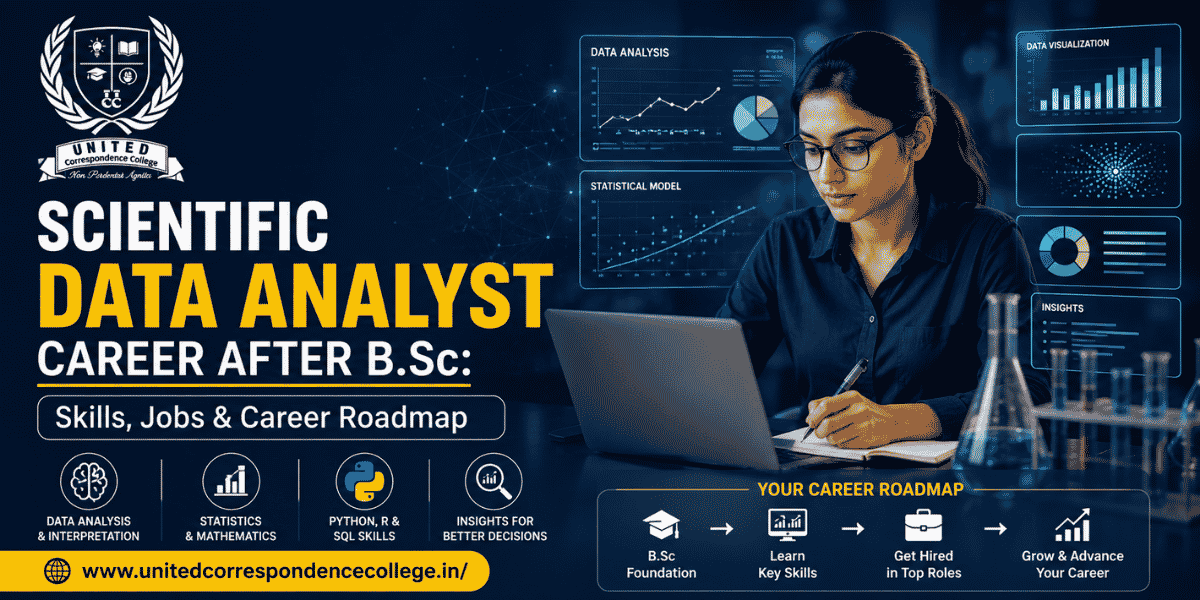
A Scientific Data Analyst Career can be an exciting option for B.Sc graduates who enjoy science but also want to work with data, technology, and problem-solving. Modern research, healthcare, biotechnology, pharmaceuticals, laboratories, and environmental studies increasingly depend on reliable data analysis. This creates opportunities for graduates who can understand scientific information and turn complex datasets into useful insights.
If you are wondering whether a Scientific Data Analyst Career is possible after B.Sc, the answer is yes. Your science background can give you a valuable understanding of the subject matter, while skills such as Excel, SQL, statistics, Python, data visualization, and scientific reporting can help you become job-ready. Current data-analytics career guidance also emphasizes learning skills in a practical sequence rather than trying to master every tool at once.
This guide explains how to build a Scientific Data Analyst Career, which skills matter, what jobs you can explore, how to create a portfolio, and how to move from a B.Sc graduate to a confident data professional.
Why Choose a Scientific Data Analyst Career After B.Sc?
A B.Sc degree does more than provide subject knowledge. It develops observation, logical thinking, experimentation, interpretation, and problem-solving abilities. These qualities are useful when working with scientific datasets.
A Scientific Data Analyst Career combines those existing strengths with modern analytical skills.
For example, a biology graduate may understand biological experiments better than someone who only knows data tools. A chemistry graduate may already understand laboratory measurements. A physics graduate may be comfortable with quantitative relationships, while a mathematics graduate may have a stronger statistical foundation.
That combination creates a useful career profile:
Scientific knowledge + Data skills + Analytical thinking + Communication = Stronger career profile
The wider data-analytics market also continues to provide entry routes for graduates from non-computer-science backgrounds, provided they develop practical skills and demonstrate them through projects.
What Does a Scientific Data Analyst Actually Do?
Before planning a Scientific Data Analyst Career, it is important to understand what the work looks like.
A scientific data analyst may work with experimental results, laboratory records, research datasets, clinical information, environmental measurements, biological observations, or other structured scientific information.
The typical workflow looks like this:
Scientific Question → Data Collection → Data Cleaning → Analysis → Visualization → Interpretation → Reporting
A professional may be responsible for:
- Collecting and organizing datasets
- Checking data quality and consistency
- Removing duplicates and errors
- Performing statistical analysis
- Identifying trends and patterns
- Creating charts and dashboards
- Preparing analytical reports
- Supporting research teams
- Explaining findings to scientific and non-technical stakeholders
- Maintaining accurate documentation
This makes a Scientific Data Analyst Career different from simply working with spreadsheets. The analyst must understand what the data represents and why the result matters.
Can Every B.Sc Graduate Build a Scientific Data Analyst Career?
Yes, but the starting point can differ according to your specialization.
Your degree does not have to be perfectly aligned with computer science. What matters is how you connect your scientific background with analytical skills.
| B.Sc Background | Useful Scientific Data Area | Possible Direction |
| Biology | Biological and research data | Research Data Analyst |
| Biotechnology | Experimental and biotech datasets | Biotech Data Analyst |
| Chemistry | Laboratory and pharmaceutical data | Scientific Data Analyst |
| Physics | Experimental and quantitative data | Research Data Analyst |
| Mathematics | Statistical datasets | Statistical/Data Analyst |
| Computer Science | Databases and analytical systems | Data Analyst |
This is one of the biggest advantages of building a Scientific Data Analyst Career after B.Sc: you can use your existing subject knowledge instead of starting completely from zero.
For students considering further education, a relevant postgraduate qualification can also strengthen subject expertise. Options such as an M.Sc correspondence college in Bangalore may be worth exploring depending on your academic background, career goals, eligibility, and the recognition of the programme.
Scientific Data Analyst Career Skills You Should Learn
The most important part of a Scientific Data Analyst Career is the skill stack. You do not need to learn everything in one month. A better approach is to build skills progressively.
1. Excel and Spreadsheet Analysis
Excel remains a practical starting point for data work.
Learn:
- Formulas and functions
- Sorting and filtering
- Pivot tables
- Lookup functions
- Conditional formatting
- Data cleaning
- Basic charts
- Simple dashboards
Excel helps you understand how raw information becomes structured and usable.
2. Statistics
Statistics is particularly important in a Scientific Data Analyst Career because scientific work depends heavily on interpreting measurements and relationships.
Focus on:
- Mean, median, and mode
- Standard deviation
- Variance
- Probability basics
- Correlation
- Distributions
- Sampling
- Hypothesis testing
- Basic regression
- Interpreting statistical results
You do not necessarily need advanced mathematics at the beginning. You need to understand what a statistical result means and when a particular method should be used.
3. SQL
SQL becomes useful when datasets are stored in databases.
Learn:
- SELECT
- WHERE
- GROUP BY
- ORDER BY
- JOIN
- CASE statements
- Aggregations
- Subqueries
- Common table expressions
- Basic window functions
Modern analyst roadmaps consistently place SQL among the core employability skills, alongside spreadsheets and visualization.
4. Python or R
For a more advanced Scientific Data Analyst Career, learning Python or R can make a major difference.
Python can help with:
- Data cleaning
- Data manipulation
- Exploratory analysis
- Automation
- Statistical analysis
- Visualization
Useful Python libraries include Pandas, NumPy, Matplotlib, and Seaborn.
R is also valuable for statistical analysis and research-oriented work.
You do not need to become a software developer. The goal is to use programming as an analytical tool.
5. Data Visualization
Scientific findings become more useful when people can understand them quickly.
Learn tools such as:
- Power BI
- Tableau
- Python visualization libraries
- Excel charts
A good visualization should answer a question rather than simply decorate a report.
6. Scientific Communication
This skill is often overlooked.
A successful analyst should be able to explain:
What happened? Why did it happen? What does the data suggest? What should happen next?
That ability can become an important advantage in a Scientific Data Analyst Career because scientific teams may need analysts who can communicate findings clearly.
Do You Need Coding for a Scientific Data Analyst Career?
Not necessarily at the beginning.
You can start your Scientific Data Analyst Career journey with Excel, statistics, data cleaning, and visualization. However, SQL should become an important part of your learning path, while Python or R can expand the types of analysis you can perform.
A practical progression is:
Excel → Statistics → SQL → Power BI/Tableau → Python or R → Scientific Projects
This approach prevents beginners from jumping directly into advanced programming without understanding the fundamentals.
Current 2026 analyst roadmaps similarly recommend learning core spreadsheet, SQL, visualization, statistics, and Python skills in a logical order.
Scientific Data Analyst Career Roadmap: A Practical Path
A clear roadmap makes a Scientific Data Analyst Career much easier to approach.
Step 1: Strengthen Your Scientific Foundation
Start with the knowledge you already gained through your B.Sc.
Understand:
- Research methods
- Experimental concepts
- Scientific measurements
- Data interpretation
- Basic statistics
Step 2: Learn Excel
Use real datasets rather than only watching tutorials.
Try creating:
- Summary reports
- Trend charts
- Pivot-table analysis
- Basic dashboards
Step 3: Learn SQL
Move from spreadsheet-based data to database-based analysis.
Practise writing queries and answering analytical questions.
Step 4: Learn Python or R
Once your analytical thinking is stronger, start automating repetitive tasks and analysing larger datasets.
Step 5: Build Visualization Skills
Learn how to turn findings into dashboards and understandable scientific charts.
Step 6: Work on Scientific Projects
This is where your Scientific Data Analyst Career becomes more practical.
Instead of building only generic sales dashboards, work with datasets related to your science background.
Step 7: Create a Portfolio
Upload projects with:
- Problem statement
- Dataset
- Cleaning process
- Analysis
- Visualizations
- Findings
- Conclusion
Step 8: Prepare for Applications
Update your resume, LinkedIn profile, project portfolio, and interview preparation.
A Simple 6–12 Month Roadmap
| Time | Learning Focus | Goal |
| Months 1–2 | Excel + Statistics | Build fundamentals |
| Months 3–4 | SQL + Data Cleaning | Work with structured data |
| Months 5–6 | Python/R + Visualization | Perform deeper analysis |
| Months 7–8 | Scientific Projects | Build portfolio |
| Months 9–10 | Advanced Analysis | Improve practical skills |
| Months 11–12 | Resume + Interviews | Become job-ready |
The exact timeline will vary based on your starting level, study hours, and consistency. Some current Indian data-analyst roadmaps estimate roughly four to nine months for focused beginners to become job-ready, but this should be treated as a broad guide rather than a guarantee.
Projects That Can Strengthen Your Scientific Data Analyst Career
Certificates can show that you studied a subject, but projects show that you can actually use it.
Consider creating projects such as:
Project 1: Environmental Data Analysis
Analyse air-quality, rainfall, temperature, or pollution data.
Demonstrate:
- Data cleaning
- Trend analysis
- Visualization
- Statistical interpretation
Project 2: Laboratory Dataset Analysis
Work with a sample laboratory dataset and identify unusual values, trends, and relationships.
Project 3: Biological Data Dashboard
Create an interactive dashboard showing biological or health-related measurements.
Project 4: Pharmaceutical Dataset
Analyse a public dataset related to medicine, drug sales, clinical information, or pharmaceutical operations where appropriate.
Project 5: Research Survey Analysis
Take a structured research survey and analyse responses using statistics and visualization.
These projects can give your Scientific Data Analyst Career a stronger direction because they demonstrate both scientific understanding and analytical ability.
What Jobs Can You Explore After Building These Skills?
A Scientific Data Analyst Career does not always begin with a job title containing the exact words “Scientific Data Analyst.”
Search for related roles such as:
- Scientific Data Analyst
- Research Data Analyst
- Data Analyst
- Laboratory Data Analyst
- Clinical Data Analyst
- Biotech Data Analyst
- Healthcare Data Analyst
- Statistical Analyst
- Research Assistant
- Data Quality Analyst
- Junior Data Analyst
The broader data-analytics field is also considered an accessible entry point for graduates from science and other non-CS backgrounds when they can demonstrate the required skills.
Where Can a Scientific Data Analyst Work?
A Scientific Data Analyst Career can connect with several industries.
| Industry | Typical Data Work |
| Pharmaceuticals | Clinical, research, and operational data |
| Biotechnology | Experimental and biological data |
| Healthcare | Patient and healthcare datasets |
| Research | Experimental and observational data |
| Environmental Science | Climate and pollution data |
| Laboratories | Testing and measurement data |
| Education & Research | Surveys and academic datasets |
This flexibility allows graduates to explore industries based on both their academic background and personal interests.
How Further Education Can Support Your Career?
Not every student wants to enter employment immediately after B.Sc.
Some may choose postgraduate study to deepen their subject knowledge before moving into analytics.
If you are comparing a B.Sc correspondence college in Karnataka, check the programme structure, university recognition, curriculum, practical exposure, and how well the qualification fits your long-term career plans.
Similarly, students who want advanced subject knowledge may research an M.Sc correspondence college in Bangalore and compare specializations before making a decision.
For learners specifically interested in flexible study options, Science distance education in Bangalore can also be considered where the programme is appropriate and properly recognized.
The important point is that further education and analytics skills do not have to be treated as completely separate paths. A student can build deeper scientific knowledge while developing practical data skills alongside it.
How UCC Can Support Your Learning Journey?
If your goal is to continue your education while developing skills for a Scientific Data Analyst Career, flexible learning can be useful for managing academic study alongside skill development.
UCC can be considered by learners looking for flexible higher-education pathways while they work on practical areas such as analytics, statistics, data tools, and professional development.
Before selecting any programme, always check the current programme details, eligibility, recognition, curriculum, and suitability for your intended career path.
Mistakes That Can Slow Down Your Scientific Data Analyst Career
A Scientific Data Analyst Career requires more than collecting certificates.
Avoid these common mistakes:
Learning Too Many Tools
Do not try to learn Python, R, SQL, Tableau, Power BI, machine learning, cloud computing, and every other technology simultaneously.
Build depth in the core skills first.
Ignoring Statistics
Scientific analysis depends on sound interpretation. Tool knowledge without statistical understanding can lead to misleading conclusions.
Creating Only Generic Projects
A B.Sc graduate has an opportunity to create science-focused projects. Use it.
Focusing Only on Certificates
A certificate is useful, but a portfolio demonstrates what you can actually do.
Applying Only to One Job Title
Search for related analytical, research, laboratory, healthcare, biotech, and data roles.
Not Learning Communication
A technically correct analysis is not useful if you cannot explain the result.
How to Prepare for Your First Interview?
Interview preparation is an important part of your Scientific Data Analyst Career.
Expect questions around:
- Excel
- SQL
- Statistics
- Data cleaning
- Visualization
- Python/R basics
- Your academic background
- Your projects
- Problem-solving
- Scientific interpretation
You may be asked:
“Tell us about a dataset you analysed.”
A strong answer can follow this structure:
Problem → Dataset → Method → Analysis → Finding → Impact
For example, explain what problem you wanted to investigate, what data you used, how you cleaned it, what analysis you performed, what you discovered, and why the finding mattered.
What Makes a B.Sc Graduate Valuable in Data Analytics?
The strongest Scientific Data Analyst Career profile is not simply someone who knows software.
It is someone who understands both the data and the domain behind the data.
That is where a B.Sc background can become valuable.
A science graduate may already understand:
- Scientific terminology
- Experimental processes
- Measurement concepts
- Research methodology
- Evidence-based thinking
- Logical reasoning
Adding analytics skills creates a broader professional profile.
Is a Scientific Data Analyst Career a Good Choice After B.Sc?
For students who enjoy both science and working with information, a Scientific Data Analyst Career can be a promising direction.
It can be especially suitable if you:
- Enjoy working with numbers and datasets
- Like finding patterns
- Have an interest in research
- Want to use technology without becoming a full-time software developer
- Enjoy solving problems
- Can communicate findings clearly
- Are willing to continuously learn
It may not be the right fit for someone who strongly prefers laboratory work with minimal computer-based analysis or someone who dislikes statistics and structured problem-solving.
The key is to choose the career because the work interests you—not simply because analytics is popular.
Your Next Move After B.Sc
Building a Scientific Data Analyst Career does not require you to transform your career overnight.
Start with the knowledge you already have.
Then add:
Science → Statistics → Excel → SQL → Visualization → Python/R → Projects → Portfolio → Applications
So that your first step does not aim to make you a senior data scientist, but rather to train you to be able to analyze data, interpret it, and demonstrate your skills to potential employers through practical applications. From there, your Scientific Data Analyst Career can advance towards research analytics, healthcare analytics, biotech analytics, data science, statistical analysis, or other fields.
For students who are considering more flexible options, researching correspondence colleges in Bangalore and distance education in Bangalore can be an important part of building a scientific career path, while training in practical analytics can give you the skills you need to gain employment alongside your degree.
Why Choose UCC for Your Education Journey?
UCC can be a good choice for those who want to pursue higher education in a convenient way and develop their careers.
A competent Scientific Data Analyst Career usually implies a thorough education, multiple practical skills, project experience, and continuous enhancement of one’s knowledge. The right course might offer fundamental theoretical knowledge, while practical analytics experience will allow one to become job-ready.
Therefore, before enrolling, it is essential to evaluate the programme’s benefits, entry requirements, accreditation, syllabus, mode of study, and career prospects.
Conclusion
Your B.Sc degree is not a dead end for your career.
A Scientific Data Analyst Career can help you satisfy your desire to contribute both to science and to modern data analysis. You can combine science with such exciting fields as data analysis, healthcare, biotechnology, pharmaceuticals, laboratories, and many other industries.
If you want to start a Scientific Data Analyst career, you should first improve your understanding of statistics. Then, learn Excel, SQL languages, and data visualization. After that, you can start learning Python or R and do some projects about scientific data sets.
Are you about to embark on a new stage of your academic and professional journey? United Correspondence College offers a wide variety of flexible study choices and specializations that can help you achieve your career ambitions. Come on over to UCC and let’s make your dreams come true.
FAQs
1. Can I become a Scientific Data Analyst after B.Sc?
Graduates with B.Sc have various options to make a career in Scientific Data Analysis by combining their science specialisation with analytical skills. Candidates must gain knowledge of statistics, excel, and SQL and develop skills in data visualisation to become a Scientific Data Analyst. Students can also utilise their B.Sc specialisation to understand scientific data, research, experiments or laboratory information better. Additionally, developing a strong portfolio can benefit students when landing a Science Data Analyst job as they will have practical exposure and experience working on the relevant projects. Individuals can start their careers in various entry-level data, research, laboratory, healthcare or scientific analyst positions and progress towards more specialisation-specific jobs with experience and technical expertise.
2. Which B.Sc specialization is suitable for scientific data analysis?
B.Sc specialisations such as biology, biotechnology, chemistry, physics, and maths have a decent scope in scientific data analysis. Biology and biotechnology students can work in healthcare, laboratory data, and research fields, whereas students with specialisation in chemistry can find jobs in pharmaceuticals and experimental sciences areas. Physics and maths offer a strong foundation in quantitative analysis, and computer science specialisation supports database management and programming skills. Students interested in B.Sc data analytics must develop additional statistical, excel, data visualisation, and programming language skills (Python or R). However, an individual’s career in scientific data analysis is not restricted to their specialisation. Students aiming to make a career in scientific data analysis must identify their intended industry, strengthen relevant analytical skills, and develop a portfolio that demonstrates their practical experience with analysing data sets.
3. What skills are required for a Scientific Data Analyst Career?
Scientific data analysts require a blend of scientific, analytical, and technical skills for their jobs. Most scientific data analyst jobs require statistical concepts, excel, and SQL skills. Candidates for a Scientific Data Analyst Career should be able to clean and visualise data using appropriate tools and have fundamental programming language expertise (Python or R). Individuals must understand how to extract insights from scientific data sets, identify patterns, evaluate quality, and present their conclusions effectively. Experience working with the relevant datasets may be more important than theoretical knowledge, so students must develop practical experience. Those new to this field may benefit from first gaining basic statistical and excel skills before learning to use more complex languages like Python or R. Data analysts in scientific fields usually work alongside scientists, researchers, managers, and executives, so analytical skills and effective communication of results are essential.
4. Can a B.Sc Biology graduate become a data analyst?
B.Sc biology graduates can become data analysts by supplementing their scientific expertise with analytical skills and technical know-how of appropriate tools. Biological science students already have an edge when it comes to understanding experiments, observations, and scientific facts. Gaining additional excel, statistical, SQL, and data visualisation skills can facilitate exploring various job opportunities in research, healthcare, biotechnology, laboratory data, and clinical science. Students considering a data analyst career after B.Sc biology must invest time in gaining practical skills and completing relevant projects on healthcare and biological science data and build a strong portfolio. This helps in demonstrating their analytical skills and practical knowledge of working on scientific data sets when applying for entry-level data analyst jobs.
5. Do I need an M.Sc to become a Scientific Data Analyst?
Individuals do not require an M.Sc degree to become a scientific data analyst as most entry-level positions require more technical and practical skills. Moreover, an M.Sc degree can provide additional scientific knowledge that may be necessary for more research-oriented scientific data analyst jobs. However, people considering postgraduate studies in scientific data analysis must research and identify the most relevant M.Sc programmes (correspondence college in Bangalore). Students should evaluate the eligibility, specialisation, and recognition of the chosen programme and its relevance for their desired career before making any decisions. Additionally, students must continue honing their analytical, technical, and practical skills even after completing an M.Sc to ensure they have the expertise to succeed in scientific data analyst jobs.