
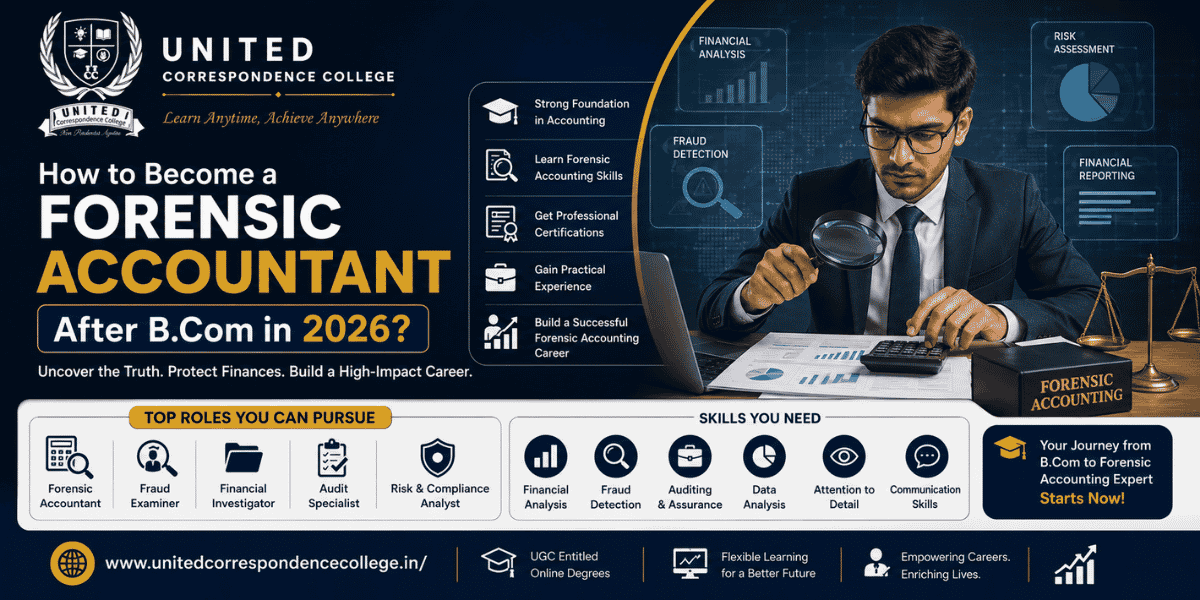
Imagine discovering that a company’s financial statements look perfectly normal, but a closer look at the transactions reveals something unusual. A few payments do not match the records, certain expenses seem inflated, or money has moved through accounts in a suspicious pattern. This is where a Forensic Accountant After B.Com can turn accounting knowledge into investigative work.
For B.Com graduates who enjoy numbers but also like solving problems, Forensic Accountant After B.Com can be an interesting career direction in 2026. Unlike traditional accounting, this field combines accounting, auditing, financial analysis, investigation, documentation and, in some cases, legal proceedings. The Institute of Chartered Accountants of India also describes forensic accounting and fraud detection as a specialised area involving accounting, auditing, data-mining tools and investigative skills.
So, how do you actually build a career as a Forensic Accountant After B.Com? Let’s break the journey down in a simple and practical way.
What Does a Forensic Accountant Actually Do?
Before thinking about becoming a Forensic Accountant After B.Com, it is important to understand what the job involves.
A forensic accountant examines financial information to identify irregularities, trace transactions and support investigations. The work may involve corporate fraud, financial disputes, insurance claims, regulatory matters or litigation.
A typical investigation may involve:
- Examining financial statements
- Checking unusual transactions
- Tracing money movements
- Reviewing invoices and supporting documents
- Identifying accounting inconsistencies
- Analysing financial data
- Preparing investigation reports
- Supporting legal or regulatory proceedings
According to the Association of Certified Fraud Examiners, forensic accountants may conduct forensic research, trace funds and assets, analyse financial data and prepare reports for litigation.
That makes Forensic Accountant After B.Com a career path that goes beyond simply preparing accounts.
Why Is Forensic Accounting Becoming an Interesting Career Choice in 2026?
Businesses today handle enormous amounts of financial data. As transactions become increasingly digital, organisations also need stronger systems for identifying fraud, financial manipulation and suspicious activity.
This creates opportunities for professionals who can understand both numbers and the story behind those numbers.
A Forensic Accountant After B.Com can potentially work across banking, consulting, insurance, corporate finance, audit and investigation-related environments.
The field is also becoming more technology-driven. Modern forensic accounting can involve data analytics, computer-assisted audit techniques and data-mining tools rather than relying entirely on manual examination.
For someone considering a Forensic Accountant After B.Com career, this means that accounting knowledge should be combined with analytical and digital skills.
Can You Become a Forensic Accountant After B.Com?
Yes, a B.Com can provide a strong academic foundation for this career.
Your undergraduate studies usually expose you to subjects such as:
- Financial accounting
- Auditing
- Taxation
- Business law
- Cost accounting
- Financial management
- Business economics
These subjects are directly or indirectly useful when investigating financial records.
However, simply completing B.Com does not automatically make someone a forensic accounting specialist. The next step is to build specialised knowledge and practical skills.
That is why the journey to becoming a Forensic Accountant After B.Com should be viewed as a combination of education, technical skills, practical exposure and professional development.
Your B.Com Knowledge Can Become Your Investigation Toolkit
One of the biggest advantages of a B.Com graduate entering this field is that many fundamentals are already familiar.
| B.Com Subject | Use in Forensic Accounting |
| Financial Accounting | Understanding financial statements |
| Auditing | Identifying inconsistencies and control issues |
| Taxation | Examining questionable tax transactions |
| Business Law | Understanding legal implications |
| Cost Accounting | Analysing unusual costs |
| Financial Management | Understanding financial decisions |
This foundation gives a Forensic Accountant After B.Com a starting point for developing more advanced investigative capabilities.
For example, an accounting graduate may already know how a balance sheet should look. Forensic training helps them ask the next question: “Why does this number look different from what the underlying transactions suggest?”
That change in thinking is important.
How to Become a Forensic Accountant After B.Com: The Practical Roadmap?
There is no single route that every graduate must follow. Your path can depend on your interests, qualifications, experience and the type of organisation you want to join.
Step 1: Strengthen Your Accounting Fundamentals
Start by becoming comfortable with financial statements, accounting standards, auditing concepts and taxation.
Do not rush through these subjects just because you studied them during B.Com. They form the foundation of forensic investigation.
A good Forensic Accountant After B.Com should be able to understand financial information before attempting to investigate it.
Step 2: Learn the Fundamentals of Fraud Investigation
Next, understand how financial fraud can occur.
Study areas such as:
- Fraud schemes
- Financial statement manipulation
- Asset misappropriation
- Expense fraud
- Revenue manipulation
- Suspicious transactions
- Internal control weaknesses
The goal is not simply to memorise different types of fraud. You should learn how investigators identify patterns that may indicate financial misconduct.
Step 3: Develop Data Analysis Skills
This is where a modern Forensic Accountant After B.Com can gain an advantage.
Start with advanced Excel and gradually explore data analytics and database concepts.
Useful skills include:
- Advanced Excel
- Pivot tables
- Data cleaning
- Financial data analysis
- Basic SQL
- Data visualisation
- Spreadsheet-based investigation
You do not need to become a software developer. However, being comfortable working with large datasets can make your profile more useful.
Step 4: Explore Professional Certifications
Specialised certifications can strengthen your knowledge and professional profile.
For example, ICAI currently offers a Forensic Accounting & Fraud Detection course covering areas such as forensic accounting, fraud detection and prevention, CAATs, data-mining tools and investigative skills.
Other specialised programmes are also available for graduates. For example, IGMPI’s 2026-27 prospectus states that graduates from any discipline are eligible for its postgraduate and executive programmes in forensic accounting and fraud investigation.
The right qualification for a Forensic Accountant After B.Com should be selected based on your intended role, credibility of the institution, curriculum and career objectives.
Step 5: Get Practical Experience
Do not wait until you have the perfect qualification before gaining experience.
You can explore:
- Accounting internships
- Audit internships
- Internal audit roles
- Financial analysis positions
- Risk and compliance roles
- Fraud-related projects
Many forensic accountants first gain general accounting experience before moving into specialised forensic work.
Step 6: Build Investigation-Based Projects
A fresher can create practical projects even without working on an actual fraud case.
For example, create a fictional company and analyse:
- Unusual expenses
- Duplicate invoices
- Irregular payments
- Revenue fluctuations
- Suspicious vendor transactions
Then prepare a short investigation report explaining what you found and how you reached your conclusion.
This gives your Forensic Accountant After B.Com profile something more meaningful than a list of certificates.
Skills You Need to Become a Strong Forensic Accountant
Being good at accounting is helpful, but forensic accounting requires a broader skill set.
Analytical Thinking
You need to notice patterns that others may overlook.
Attention to Detail
Small differences can sometimes lead to important discoveries.
Auditing Knowledge
Understanding controls and verification procedures is highly useful.
Data Analysis
Financial investigations can involve thousands of transactions.
Communication
A forensic accountant must explain complicated financial findings clearly.
Report Writing
Investigation findings need to be documented logically and accurately.
Business Law Awareness
Some assignments may involve disputes, investigations or legal proceedings.
Professional Ethics
Confidential financial information must be handled responsibly.
For a Forensic Accountant After B.Com, these skills work together. Finding an unusual transaction is only the first step; understanding it and explaining its significance is equally important.
Where Can a Forensic Accountant Work?
One reason to consider a Forensic Accountant After B.Com career is the variety of industries where these skills can be useful.
| Industry | Possible Area of Work |
| Banking | Fraud and transaction investigations |
| Insurance | Claims and financial fraud |
| Consulting | Forensic and investigation services |
| Corporates | Internal fraud and risk |
| Audit Firms | Forensic audit and investigation |
| Financial Services | Compliance and financial crime |
| Legal Support | Financial analysis for disputes |
Forensic accounting is also relevant to government bodies, banks, insurance companies and specialist firms, according to ICAI’s course information.
This makes Forensic Accountant After B.Com a potentially flexible career direction rather than a qualification tied to one industry.
What Job Roles Can You Target?
Your first job may not literally have the title “Forensic Accountant.”
That is completely normal.
You could explore positions such as:
- Audit Associate
- Financial Analyst
- Fraud Analyst
- Risk Analyst
- Internal Audit Associate
- Forensic Accounting Analyst
- Financial Crime Analyst
- Forensic Accounting Consultant
With experience, you can move towards specialised positions involving investigations, fraud risk, litigation support and financial analysis.
The important thing for a Forensic Accountant After B.Com is to focus on the skills and responsibilities of a role rather than only its job title.
Forensic Accountant vs Accountant vs Auditor
These careers overlap, but their main objectives are different.
| Career | Main Focus |
| Accountant | Recording and reporting financial transactions |
| Auditor | Checking financial information and controls |
| Forensic Accountant | Investigating financial irregularities and supporting investigations |
An accountant may prepare the financial records.
An auditor may examine whether those records are reliable.
A forensic accountant may be asked to investigate why something appears suspicious and what the financial evidence reveals.
That distinction helps explain why Forensic Accountant After B.Com is becoming an attractive specialised option for commerce graduates who enjoy investigation.
What Tools Should a Forensic Accountant Learn in 2026?
Technology is becoming an important part of financial investigations.
Start with:
Excel → Advanced Excel → Data Analysis → SQL Basics → Data Visualisation → Forensic/Data Investigation Tools
You can also learn how to work with large datasets, identify duplicate transactions and detect unusual patterns.
The objective isn’t to collect as many software certificates as possible. Instead, focus on learning tools that help you answer practical questions.
For example:
Which transactions are unusual?
Which vendors receive repeated payments?
Are there duplicate invoices?
Does a particular expense category suddenly increase?
That practical mindset can make a Forensic Accountant After B.Com more effective.
Can a Fresher Become a Forensic Accountant?
Yes, but expectations should be realistic.
A fresher may need to start with an accounting, audit, finance, risk or analyst position before moving into a highly specialised forensic role.
A sensible path could look like:
B.Com → Accounting/Audit Foundation → Forensic Training → Data Skills → Internship/Entry-Level Experience → Specialised Forensic Role
This route can make the transition more manageable.
A Forensic Accountant After B.Com does not necessarily need to jump directly into a senior investigation position. Career progression usually comes through developing relevant experience over time.
Forensic Accountant Salary in India in 2026
Salary can vary significantly depending on experience, employer, location, qualifications and specialisation.
Current online salary sources show wide variation. One 2026 career dataset places entry-level forensic accounting compensation around ₹4–10 lakh annually, while experienced professionals can move substantially higher. Another source estimates entry-level Indian salaries around ₹4–8 lakh and senior professionals around ₹15–25 lakh or more.
For Bangalore specifically, Glassdoor’s current listing shows a median total pay figure around ₹9.94 lakh per year, although the available sample is limited and individual salaries can differ considerably.
So, instead of choosing a course only because of a salary figure, a Forensic Accountant After B.Com should focus on building skills that improve long-term employability.
Is M.Com Useful for a Forensic Accounting Career?
An M.Com can be useful if you want deeper academic knowledge in accounting, finance or related areas.
For students comparing options such as M.Com correspondence colleges in Bangalore, it is worth considering how the postgraduate programme fits with your actual career goal.
An M.Com can strengthen your academic background, while specialised forensic accounting training can help you develop investigation-focused knowledge.
The two can complement each other, depending on your career plan.
Students exploring B.Com distance education in Bangalore may also consider whether their programme gives them enough flexibility to simultaneously develop practical skills, internships and specialised certifications.
Can You Study While Working?
Yes, depending on the programme format and your schedule.
Flexible education options can be useful for students and working professionals who want to continue gaining experience while studying.
When researching correspondence colleges in Bangalore, don’t look only at fees. Compare:
- Course curriculum
- Recognition and credibility
- Learning support
- Assessment pattern
- Flexibility
- Career guidance
- Practical exposure
Similarly, people searching for an Online Traditional Course Correspondence College Near Me should first identify whether they want a degree programme, professional certification or specialised career course.
The right choice depends on the qualification you need and where you want that qualification to take your career.
What About M.Com After B.Com?
For graduates who want to continue their academic journey, M.Com can be another route.
Those researching correspondence degree colleges in Bangalore may consider postgraduate study alongside specialised accounting and analytical skills.
If you are comparing distance education colleges in Bangalore, look beyond the convenience factor and check whether the programme aligns with your long-term career objective.
For example, someone targeting forensic accounting may benefit from combining postgraduate accounting knowledge with auditing, fraud investigation and data-analysis skills.
How UCC Can Support Your Next Academic Step?
If you are a B.Com graduate looking for flexible ways to continue your education, UCC can be considered as part of your research into suitable higher-education options.
The important point is to choose an academic route that fits your current schedule and future career direction. For a Forensic Accountant After B.Com, education should ideally be combined with practical learning, analytical skills and industry exposure.
Before enrolling, always review the current programme details, eligibility, recognition and applicable institutional information.
A Simple 12-Month Plan for Aspiring Forensic Accountants
If you are starting from zero, don’t try to learn everything at once.
Months 1–3
Focus on:
- Accounting fundamentals
- Auditing
- Advanced Excel
- Financial statement analysis
Months 4–6
Move into:
- Fraud concepts
- Forensic accounting basics
- Investigation techniques
- Financial data analysis
Months 7–9
Build:
- Practical projects
- Investigation reports
- Data-analysis exercises
- Internship experience
Months 10–12
Work on:
- Professional certification
- Resume
- LinkedIn profile
- Interview preparation
- Entry-level applications
This gradual approach makes becoming a Forensic Accountant After B.Com feel much more achievable.
Common Mistakes B.Com Graduates Should Avoid
A few mistakes can slow down your progress.
Only Collecting Certificates
A certificate is useful, but employers also want evidence that you can apply what you learned.
Ignoring Technology
Financial investigations increasingly involve data, so Excel and analytics should not be ignored.
Applying Only for “Forensic Accountant” Jobs
Look at audit, risk, fraud, compliance and financial analyst roles too.
Forgetting Communication
Finding a problem is one thing. Explaining the evidence clearly is another.
Expecting Immediate Senior-Level Work
Specialised careers usually develop progressively.
Choosing a Course Without Checking Its Curriculum
Always examine what the programme actually teaches before enrolling.
For a Forensic Accountant After B.Com, practical capability should remain the priority.
Is Forensic Accounting a Good Career After B.Com in 2026?
If you enjoy accounting but don’t want your career to revolve only around routine bookkeeping or reporting, forensic accounting can be worth exploring.
It combines:
Accounting + Auditing + Investigation + Data + Business + Law
That combination is what makes Forensic Accountant After B.Com an interesting career option.
It can also provide opportunities across different industries, allowing professionals to gradually specialise in areas such as fraud investigation, financial crime, litigation support, internal investigations or risk.
However, it is important to enter the field with realistic expectations. Strong accounting fundamentals, continuous learning, practical experience and analytical thinking matter more than simply having a job title.
Conclusion
Your B.Com does not have to be the end of your accounting journey. It can be the foundation for a more specialised career where your ability to understand numbers becomes an investigative advantage.
If Forensic AccountantAfter B.Com interests you, start with the basics: strengthen accounting and auditing knowledge, learn data analysis, explore specialised forensic education, build practical projects and gain relevant experience.
For students looking for flexible higher-education pathways, United Correspondence College can be explored alongside other suitable options based on your academic and career goals.
Ready to move beyond traditional accounting? Start researching the right programme, build your forensic accounting skill set and take your first step toward an investigation-focused finance career.
FAQs
1. Can I become a forensic accountant after B.Com?
Yes. B.Com provides a useful foundation in accounting, auditing, taxation and finance. You can then develop specialised forensic accounting and fraud-investigation skills.
2. Is B.Com enough to become a forensic accountant?
B.Com can provide the foundation, but specialised training, relevant experience and professional credentials can strengthen your profile.
3. What skills are required for a forensic accountant?
Important skills include accounting, auditing, financial analysis, data analysis, critical thinking, attention to detail, report writing and communication.
4. Is forensic accounting a good career after B.Com?
It can be a good option for graduates interested in financial investigation, fraud detection and analytical work.
5. Can a fresher work in forensic accounting?
Freshers may begin with accounting, audit, risk, compliance or analyst roles and then transition into specialised forensic accounting positions.
6. What tools should I learn for forensic accounting in 2026?
Start with Excel and financial analysis, then consider SQL, data visualisation and other relevant data-analysis or forensic tools.
7. Is M.Com useful for forensic accounting?
M.Com can strengthen your academic background in commerce and accounting. Combining it with specialised forensic accounting knowledge can create a broader profile.
8. What is the difference between auditing and forensic accounting?
Auditing generally focuses on examining financial information and controls, while forensic accounting focuses more specifically on investigating financial irregularities and supporting investigations.