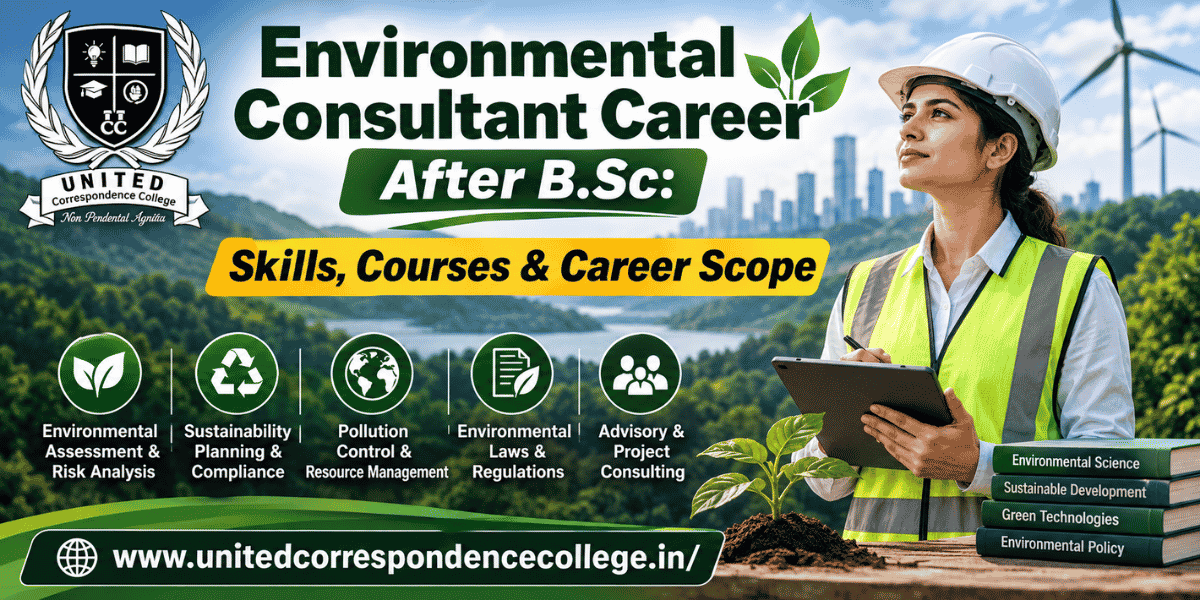
If you have a B.Sc. and are considering a career that bridges a scientific qualification with real-world issues affecting the environment, becoming an Environmental Consultant could be a worthy pursuit in 2026. An Environmental Consultant advises companies and government agencies on environmental concerns while aiding them in complying with environmental regulations and assessing the impact of proposed projects on the environment. The occupation provides an excellent career option for B.Sc. holders, particularly those with a strong background in environmental sciences, since the job requires more than just descriptive scientific knowledge – it demands technical, analytical and communicative skills.
However, with the appropriate combination of environmental science courses and experience, a B.Sc. can prepare you for a stimulating career as an Environmental Consultant and other consultancy occupations in the environmental management field.
Why Environmental Consulting Is Worth Exploring in 2026?
Environmental concerns are more and more associated with business. Infrastructural, manufacturing, energy, construction, waste management and other industries require experts that understand ecological necessities and can interpret technical information into recommendable practices.
Hence, an Environmental Consultant is a professional that operates on various kinds of objects of work instead of specializing in a specific business sphere. Contemporary career sources point out the main areas of activity, which include environmental assessment, pollution abatement, compliance, sustainability and consultative services. Notably, employers emphasize the ability to prepare reports, deliver presentations, analyze data, conduct GIS studies and have regulatory expertise.
For a B.Sc. graduate, this is a fascinating opportunity to combine theoretical knowledge and gain experience in the field to become an expert that resolves ecological issues of organizations and various projects.
What Does an Environmental Consultant Actually Do?
Think of an Environmental Consultant as a job that combines the environmental sciences, regulations, and management together.
A typical project can often follow a simple cycle of:
Client Requirement → Environmental Information Gathering→ Assessment → Compliance Review and Recommendations → Technical Report Writing→ Implementation Support
Depending on the employer, an Environmental Consultant can perform duties such as:
- Environmental assessments,
- Conducting or assisting in Environmental Impact Assessments,
- Conducting reviews in relation to environmental risk management and compliance,
- Gathering or analysing data (air, water, soil/waste, or other),
- Preparing technical reports,
- Conducting environmental audits,
- Assisting with waste management plans,
- Working with geographical information systems (GIS),
- Presenting information to clients and project managers,
- And making recommendations on managing environmental risks.
In short, the work of an Environmental Consultant combines both scientific, technical, managerial, and regulatory areas, and is not as simple as just theory-based environmental science.
Can You Become an Environmental Consultant After B.Sc.?
Yes, for your B.Sc. background, employer requirements and the role you target. Environmental science is the most direct route although related science degrees can also provide a useful foundation.
Graduates of a B.Sc. can build a pathway from subjects such as environmental science, biology, chemistry, geology, geography, life sciences or related disciplines. The resources of career show that environmental consulting is among the possible career options for a B.Sc. Environmental Science graduate although current role profiles also demonstrate that related environmental or science qualifications can be of relevance.
The important point is that your degree gives you the foundation, but your employability will increasingly be based on the application of that knowledge.
B.Sc. Backgrounds That Can Support the Journey
| B.Sc. Background | Useful Direction |
| Environmental Science | Consulting, compliance, EIA, sustainability |
| Biology / Life Sciences | Ecology, biodiversity, environmental monitoring |
| Chemistry | Pollution, laboratory and water-quality work |
| Geology | Groundwater, land and environmental assessment |
| Geography | GIS, mapping and spatial analysis |
| Physics | Environmental monitoring and technical analysis |
If your degree is not specifically in environmental science, don’t assume the door is closed. Instead, identify the environmental area where your existing subject knowledge can give you an advantage.
The Skill Set That Can Move You From Graduate to Consultant
One of the most significant differences between a graduate profile and a consulting-ready profile is an ability to combine several skills.
1. Environmental Science Knowledge
It implies having a good command of ecosystems, pollution, natural resources, climate problems and environmental management.
2. Environmental Impact Assessment Knowledge
Environmental Impact Assessment is a valuable tool for assessing likely impacts of proposed developments on the environment and the ways in which these impacts might be managed.
3. Regulatory Awareness
An Environmental Consultant frequently works with environmental regulations, permits, standards, requirements and documentation. It is not expected that you will memorise all of the regulations but you should be able to research and implement the relevant aspects.
4. GIS and Spatial Skills
GIS can be employed for mapping, land-use, environmental assessment and spatial interpretation. Many Environmental career resources will mention GIS skills as a useful skill-set.
5. Data Analysis
Acquire skills to work with tables and perform various calculations to study and present the data and make conclusions based on the calculated statistics.
6. Report Writing
A correct observation of results without the ability to describe and explain them appropriately is not enough. Reports on the environmental issues require special attention since they should contain all the necessary findings and recommendations to solve existing problems.
7. Communication
You may be required to communicate with clients, field teams, regulators, engineers, scientists or other local stakeholders. Effective communication is therefore a critical professional skill.
8. Problem-Solving
Projects in consulting can be triggered by a question, or a potential risk. It is your responsibility to investigate further and find an effective answer.
Which Courses Should You Consider After B.Sc.?
There is no single course that automatically makes someone an Environmental Consultant. A better approach is to select learning based on the career direction you want.
| Course Area | What It Can Add |
| Environmental Management | Understanding of environmental systems and management practices |
| Environmental Impact Assessment | Project assessment and mitigation knowledge |
| GIS & Remote Sensing | Mapping and spatial analysis |
| Environmental Auditing | Compliance and audit-oriented skills |
| Sustainability | Corporate environmental and resource-management perspective |
| ESG | Understanding of environmental issues in business and reporting |
| Waste Management | Practical knowledge of waste systems and compliance |
| Environmental Data Analysis | Stronger analytical decision-making |
These can complement a B.Sc. and help you build a more targeted profile. If you are comparing environmental science courses, look beyond the certificate name. Check the syllabus, practical work, project component, tools taught and whether the course matches the role you want.
Environmental Consultant Career Pathways You Can Choose
Environmental Consultant designates a number of possible specializations. You have the option to pursue several, and you aren’t expected to become an expert in all of them.
Environmental Impact Assessment
If you have a project-oriented mindset, this is the branch for you. You’ll analyze the potential environmental consequences of infrastructure, industrial or business projects and prepare the necessary reports.
Environmental Compliance
This direction is perfect for those who love regulations, papers and strict standards. You can try your hand at checking whether a particular organization or project is up to all environmental requirements.
Sustainability Consulting
This option is more about combining environmental expertise and organizational values. One can work on resource efficiency, sustainability strategy, and environmental performance, along with related reporting and analysis.
ESG and Corporate Sustainability
One thing to note is that ESG can be an excellent choice if you want to expand your opportunities on the business side of things. It is a way to link environmental expertise and information with financial, strategic, and operational aspects of operations.
GIS and Environmental Data
If you like technology and analysis, GIS can become your specialist strength which can be used for mapping and spatial data which can help environmental assessments, land analysis and project planning.
Waste and Pollution Management
This is a more operational route involving waste systems, pollution control, monitoring and compliance.
How to Build Experience When You Are a Fresher?
Many graduates get stuck here. They look for Environmental Consultant jobs, see experience requirements and think they cannot get into the field.
Instead build proof of your skills before you apply.
Start with a portfolio.
Project Idea 1: Environmental Impact Assessment Case Study
Pick a made‑up infrastructure project. Look at the environmental impacts. Explain how to examine those impacts. Offer ideas for reducing or stopping them.
Project Idea 2: Water-Quality Data Analysis
Take a dataset that anyone can download. Run an analysis that shows trends. Point out observations. Give recommendations based on the data.
Project Idea 3: GIS Environmental Map
Build a map that shows land use, water bodies, vegetation or another environmental feature. Keep the map easy to read and useful.
Project Idea 4: Waste Management Plan
Develop a realistic waste-management plan for a college, office, apartment complex or small business.
Project Idea 5: Sustainability Assessment
Choose a company or imagine a business and define areas where it could potentially save resources, reduce waste or improve its environmental performance.
For each project, you can follow the structure below:
- Problem
- Data
- Method
- Findings
- Recommendation
This will make your portfolio more compelling than a simple collection of certificates.
Where Can an Environmental Consultant Work?
The career can move across multiple sectors because environmental requirements appear in many types of projects.
| Sector | Possible Work |
| Manufacturing | Compliance, pollution and environmental management |
| Construction | Environmental assessment and project support |
| Infrastructure | EIA, planning and environmental risk |
| Energy | Environmental monitoring and sustainability |
| Mining | Land, water and ecological assessment |
| Waste Management | Waste planning and compliance |
| Consulting Firms | Advisory, assessment and technical reports |
| Corporate Sector | Sustainability and ESG |
| Research & NGOs | Environmental studies and conservation |
This variety is one reason environmental consulting can be attractive to science graduates who do not want to stay in a single laboratory-based career.
Job Titles to Search Instead of Only “Environmental Consultant”
Your first job may not bear the title of Environmental Consultant. When using a job portal, try expanding your search terms. Think of keywords and related terms such as:
- Environmental Analyst
- Environmental Associate
- Environmental Officer
- Environmental Specialist
- Environmental Compliance Analyst
- EIA Associate
- Environmental Monitoring Executive
- Sustainability Analyst
- Sustainability Associate
- ESG Analyst
- Waste Management Executive
- GIS/Environmental Analyst And Many More
By doing this, you are making your search process much broader .
What Does Career Growth Look Like?
An Environmental Consultant career typically progresses with experience and depth of expertise.
A possible career parth is as follows:
B.Sc. Graduate → Environmental Trainee / Associate → Environmental Analyst → Environmental Consultant → Senior Consultant → Project Manager / Specialist → Sustainability or Environmental Lead
Your career trajectory will be influenced by the industry you join, the technical specialism you develop, the range of projects you work on, your communication skills and additional certifications.
Some career paths progress into management positions, whilst others focus on becoming experts in EIA, GIS, sustainability, environmental compliance, climate or a certain industry.
What About Higher Studies?
A B.Sc. is a fundamental base upon which you can continue to build your academic foundation.
If you are interested in furthering your studies and gaining in-depth knowledge of a particular subject, an M.Sc. in Environmental Science or related fields would be an ideal option to strengthen your academic credentials. Completing a masters course can also be beneficial if you are looking to make a shift into a more specialized, research-intensive or higher-level field.
Students looking to pursue a distance Msc degree college in Bangalore or an M.Sc. Correspondence colleges in Bangalore must compare and contrast the curriculum and accreditation of the program, learning methodology and level of practical application as well as determining its relevance to their desired career specialty.
In the same way, students considering enrolling at distance education colleges in Bangalore must understand that while convenient, they should evaluate their course of study critically in order to ensure that it will help them gain the required environmental knowledge.
Why Practical Skills Matter More Than a Long Certificate List?
Imagine two graduates.
Graduate A has completed several short certificates but cannot explain an environmental assessment or interpret a basic dataset.
Graduate B has completed fewer courses but has built an EIA case study, a GIS project, a sustainability assessment and a clear technical report.
For many entry-level opportunities, Graduate B has stronger evidence of practical ability.
That is why your goal should not be “collect as many certificates as possible.”
Your goal should be:
Learn → Practise → Build → Document → Demonstrate
This is especially important when applying for Environmental Consultant jobs as a fresher.
Can Distance Education Support This Career?
Yes, distance learning can be useful when it allows you to continue your education while building practical skills alongside it.
For example, someone exploring Science distance education in Bangalore may use flexible learning to strengthen academic qualifications while simultaneously working on GIS, environmental data, report writing or sustainability projects.
Likewise, a B.Sc. graduate researching a B.Sc. correspondence college in Karnataka should think beyond the degree title and evaluate whether the programme provides a foundation that supports the next stage of their career.
If your goal is to move toward an Environmental Consultant role, education should ideally be combined with practical exposure rather than treated as a standalone solution.
For learners comparing distance education colleges in Bangalore, the same principle applies: choose a programme that fits your long-term career plan and gives you enough flexibility to develop job-ready skills.
How UCC Can Fit Into Your Learning Journey?
For students looking for flexible higher-education options, UCC can be considered as part of a broader learning plan. The important step is to identify the qualification you need, compare the course structure and then add practical environmental skills that support your target role.
UCC can be part of that journey, but your career preparation should go beyond classroom learning. Build projects, learn relevant tools, improve your communication and understand how environmental work is performed in real organisations.
What Should You Learn First in 2026?
If you are starting from zero, don’t try to master everything together.
Follow this order:
Step 1: Strengthen environmental science fundamentals.
Step 2: Learn basic environmental regulations and compliance concepts.
Step 3: Pick one technical skill such as GIS or environmental data analysis.
Step 4: Study Environmental Impact Assessment or environmental management.
Step 5: Build two or three portfolio projects.
Step 6: Apply for internships and entry-level environmental roles.
Step 7: Decide whether you need an M.Sc. or another specialized qualification.
This sequence keeps the journey manageable.
A 6-Month Roadmap for Aspiring Environmental Consultants
| Timeline | Focus | Outcome |
| Month 1 | Environmental fundamentals | Stronger subject base |
| Month 2 | Regulations + compliance | Better industry understanding |
| Month 3 | GIS / data analysis | One technical skill |
| Month 4 | EIA / sustainability | Career specialization |
| Month 5 | Portfolio projects | 2–3 proof-of-skill projects |
| Month 6 | Resume + applications | Start targeted job search |
What Skills Will Matter Even More in the Future?
Environmental careers are becoming more data-driven and connected with business decisions. This means the strongest profiles may combine environmental knowledge with technology and communication.
Useful future-facing areas include:
- GIS and spatial analytics
- Environmental data analysis
- Sustainability reporting
- ESG
- Climate-risk understanding
- Digital environmental monitoring
- Environmental compliance
- Technical communication
- Research and evidence-based decision-making
The goal is not to become an expert in every emerging technology. Instead, become someone who understands environmental problems and knows how to use modern tools to analyse and communicate them.
Common Mistakes B.Sc. Graduates Should Avoid
1. Applying only for jobs titled Environmental Consultant
Look for analyst, associate, compliance, EIA, sustainability and environmental officer positions too.
2. Ignoring GIS and data skills
Technical tools can help you demonstrate that you can work with real environmental information.
3. Treating regulations as purely theoretical
Consulting work often requires practical understanding of compliance.
4. Collecting certificates without creating projects
A portfolio can show what you can actually do.
5. Having no technical writing samples
Reports are an important part of many environmental roles.
6. Waiting for the “perfect” job before gaining experience
Internships, project-based work and entry-level roles can provide valuable exposure.
7. Assuming an M.Sc. alone guarantees a consulting position
Higher education can strengthen your profile, but practical skills and experience still matter.
8. Forgetting that communication is part of consulting
Technical knowledge becomes more valuable when you can explain it clearly.
Environmental Consultant Career: Is It Right for You?
Before choosing this path, ask yourself a few simple questions.
Do you enjoy science but also want to solve practical problems?
Are you comfortable reading reports, analysing information and following regulations?
Would you enjoy a career that can include both desk work and field exposure?
Are you willing to learn tools such as GIS and data analysis?
Can you explain technical information in a simple way?
If most answers are yes, an Environmental Consultant pathway may be worth exploring.
Salary Expectations and Career Scope
Salary should be viewed as a range rather than a fixed promise. Current Indian career sources show widely varying indicative figures depending on city, employer, experience and specialization. Some sources place entry-level environmental roles in relatively modest bands, while experienced consultants and specialists can move considerably higher.
Rather than choosing this career only for an expected salary, look at the long-term combination of specialization, experience and industry exposure.
The career scope can expand toward environmental consulting, sustainability, ESG, compliance, EIA, GIS, waste management, environmental monitoring, research and related fields. Recent career resources also highlight environmental consulting across private companies, government-linked organisations, NGOs and research settings.
How to Start Your Environmental Consultant Journey?
You do not need to have everything figured out on day one.
Start with your B.Sc. foundation. Identify the environmental area that interests you. Add one practical technical skill. Learn the basics of regulations. Build a small portfolio. Then start looking at internships and entry-level environmental roles.
If higher education makes sense for your goal, compare suitable programmes carefully. Students looking at a distance Msc degree college in Bangalore or an M.Sc. correspondence college in Bangalore can use flexible study as one part of a broader career strategy.
For those considering a B.Sc. correspondence college in Karnataka or other distance-learning routes, the same rule applies: choose learning that supports your next career step, not simply another qualification to add to your resume.
Conclusion
A B.Sc. gives you a scientific starting point. It does not have to define where your career ends.
In 2026, an Environmental Consultant can work at the intersection of science, regulation, data, sustainability and business. That makes the field broader than many students initially realise.
The strongest path is not simply:
Degree → Job
It is:
Degree → Skills → Practical Projects → Specialization → Industry Exposure → Career Growth
Build that combination patiently, and you can position yourself for Environmental Consultant jobs as well as related opportunities in sustainability, environmental management, EIA, ESG and environmental data.
If you are serious about building a career in this field, start with one skill, one project and one clear career direction. Small, consistent steps can turn your B.Sc. background into a much stronger professional profile.
Ready to Build Your Environmental Career?
Your B.Sc. can be the beginning of a career that combines science with sustainability, technology and real-world problem-solving. Explore the right learning pathway, strengthen your practical skills and start building projects that demonstrate what you can actually do.
Take the next step toward becoming an industry-ready Environmental Consultant in 2026. United Correspondence College can be part of your broader learning journey as you work toward the qualifications and skills needed for your career goals.
Frequently Asked Questions
1. Can I become an Environmental Consultant after B.Sc.?
Yes. Graduates from environmental science and related science disciplines can explore this career, although specific employer requirements vary. Adding practical skills such as EIA, GIS, data analysis and environmental compliance can strengthen your profile.
2. Which B.Sc. degree is best for Environmental Consultant jobs?
B.Sc. Environmental Science is one of the most direct backgrounds, while biology, chemistry, geology, geography and related life-science disciplines can also support environmental career pathways.
3. Which skills are important for an Environmental Consultant?
Environmental knowledge, regulatory awareness, EIA, GIS, data analysis, report writing, communication and problem-solving are useful skills.
4. Is GIS important for Environmental Consultant roles?
GIS can be highly useful for mapping, spatial analysis, environmental assessment and interpreting location-based environmental information.
5. Do I need an M.Sc. to become an Environmental Consultant?
Not necessarily for every entry-level role. Some employers accept relevant bachelor’s-level backgrounds, while a master’s can strengthen specialization and may be preferred for certain positions. Current listings also show that requirements vary by seniority and employer.
6. What courses should I take after B.Sc. for environmental careers?
You can consider courses in environmental management, EIA, GIS, remote sensing, sustainability, ESG, environmental auditing, waste management and environmental data analysis depending on your target role.
7. What are the career options related to Environmental Consultant?
Related options include Environmental Analyst, Environmental Officer, EIA Associate, Sustainability Analyst, ESG Analyst, Environmental Compliance Analyst, GIS/Environmental Analyst and Waste Management Executive.
8. Can distance education help me build an environmental career?
Distance education can offer flexibility for academic progression, but it should ideally be combined with practical projects, technical skills, internships and industry exposure.