
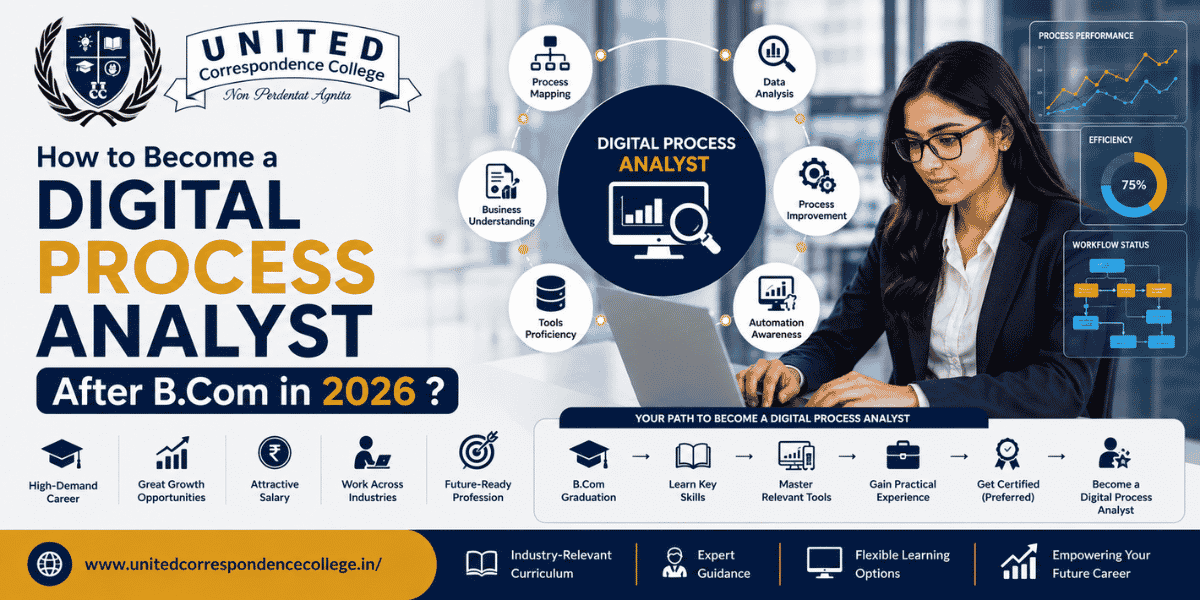
A B.Com degree opens the door to a career in accounting, finance, banking, operations, and management. However, it does not necessarily chain you to a specific profession for the rest of your life. In 2026, the business world requires more versatile experts who understand not only business processes but also digital tools and methods. This is why a career as a Digital Process Analyst is a great choice for anyone with a B.Com degree.
A Digital Process Analyst’s job is to optimize business processes and make them more effective by studying information flows, teamwork mechanisms, and day-to-day operations rules, analyzing this data, and proposing improvements. If you have a passion for detective work and identifying inefficiencies in established practices, you might find this career appealing. You will not need to know how to code or have profound IT expertise to succeed in this line of work. However, you will need to be able to communicate effectively with different team members and have a good understanding of how business processes work.
What Does a Digital Process Analyst Do?
Imagine working in a company where a simple employee onboarding procedure takes ten days to complete due to the information having to go through multiple departments by email and Excel. A Digital Process Analyst would look at this procedure, define what steps are required, analyse and design the most suitable digital process to manage this task and help the company improve it.
A Digital Process Analyst’s main objective is to understand the business needs and contribute to the improvement of processes through digital technology. Their duties may include documenting, controlling, analysing, and proposing process improvements, capturing requirements, supporting digital transformation projects, and advising on digital tools and their application to improve processes.
This profession is relevant across industries, as process improvement is necessary wherever there are operations to be optimised. A Digital Process Analyst can work in finance, customer service, procurement, human resources, and technology-enabled shared services. They can operate in various industries such as banking, financial services, healthcare, retail, information technology, manufacturing, logistics, and shared-service organisations.
Why Is This Career Suitable for B.Com Graduates?
Your B.Com knowledge is a great platform to base a career on. You have a decent understanding of accounting, business management, economics, statistics, taxation, or computer systems. All of these fields provide a comprehensive understanding of business processes, the flow of money and information in organizations, and how to remain accurate in calculations.
The knowledge of a Digital Process Analyst is crucial in bringing business processes to a new level of performance. After learning the fundamentals, the skills in process analysis, mapping, data analytics, and robotics and their impact on business processes, and the knowledge of business process management, will complement your B.Com degree skills nicely.
| B.Com Knowledge | How It Helps in Process Analysis |
| Accounting | Helps understand finance-related workflows, controls and approvals |
| Business Management | Helps understand departments, responsibilities and operations |
| Statistics | Helps interpret performance data and trends |
| Economics | Builds an efficiency and resource-allocation mindset |
| Business Communication | Helps with requirements, documentation and stakeholder discussions |
| Computer Applications | Makes it easier to learn modern business and analytics tools |
This combination is one reason a Digital Process Analyst path can be attractive, especially when a graduate wants to work between business teams and technology teams.
Skills You Should Build in 2026
The most promising way to prepare is to study the most relevant technologies and build a focused stack of skills.
1. Business Process Knowledge
To be able to recommend a digital solution, a Digital Process Analyst must first understand how a process works. Knowing what steps are required, who is responsible for what, what approvals are needed, and what deliverables are produced helps in discovering what can be optimized. It is essential to have a clear vision of how a process flows to spot redundancies, unnecessary steps, and delays. The more details are known about a process, the easier it is to propose a solution that would help streamline operations.
2. Process Mapping
For a Digital Process Analyst, process mapping is a tool to identify possible bottlenecks.
You should be able to document a convoluted business process in the form of a simple visual schematic. It is critical to learn the basics of BPMN notation and practice drawing process diagrams with various notations in Visio, Lucidchart, or other applications.
You should be able to capture on a diagram:
- Who is responsible for what
- What happens first
- Where approvals are needed
- Where information is shared
- Where delays can occur
- Where the process ends
3. Excel and Data Analysis
A Digital Process Analyst uses data to drive observations instead of relying purely on intuition.
Advanced excel skills are essential to an analyst; formulas, Pivottables, lookups, data cleansing, conditional logic and dashboards are all part of the toolset needed to transform data into information that can drive business observations.
As an example, being able to say “The invoice process is slow” is one thing, but a Digital Process Analyst would rather quantify how slow, identify what stage contributes the most to the overall turnaround time or even which step is the main contributor to the overall process duration.
4. Power BI
For a digital process analyst, dashboards can help to visualize the cycle time, volume, and service-level trends more effectively.
Using the Power BI tool, I can create dashboards that will demonstrate the process performance. It is also essential to know how to configure data, clean it, calculate some metrics, and display information. Let me suggest your dashboard that will display the following data:
- The Number of incoming requests
- Average processing time
- Number of pending and completed requests
- Performance by departments
- Trends for each month
5. SQL Basics
Basic SQL allows an aspiring Digital Process Analyst to develop a good understanding of sources of data about the business operations.
It is not necessary to become an expert database engineer, but knowledge of basic SQL concepts such as SELECT, WHERE, GROUP BY, JOINs, and aggregate functions enables one to formulate better questions about the data. This in turn, facilitates better discussion with technical partners.
6. Automation Awareness
The digital process analyst must be able to identify processes that can be automated in order to make them more efficient.
Analyze the capabilities of workflow automation, RPA, API, and AI-based tools, and have a good grasp of when to apply which. The candidate should be able to identify simple processes that can be automated and explain what value automation brings to the process.
The automation of a process is not always relevant, and a good analyst must first understand the process and assess the benefits of automation before implementing it.
7. Communication and Documentation
A Digital Process Analyst professional has to communicate the details they learn from the business process to business users in a comprehensible way.
Learn requirements documentation, SOP writing, meeting support, process documentation, and presentation skills to acquire a strong background in communication. It becomes even more critical when stakeholders are from different areas and may have diverse priorities, such as finance, operations, and management. Additionally, your communication skills need to be strong enough to deal with conversations with IT professionals.
Which Tools Should You Learn?
Do not chase ten certificates or twenty software platforms. Learn a practical set of tools and understand what problem each one solves.
| Tool/Area | What to Learn |
| Excel | Data cleaning, formulas, PivotTables and dashboards |
| Power BI | Data visualization and reporting |
| SQL | Basic querying and data extraction |
| Visio/Lucidchart | Process mapping and workflow visualization |
| BPMN | Standard process modelling concepts |
| Power Automate | Workflow automation basics |
| RPA concepts | Understanding repetitive task automation |
| CRM/ERP basics | Understanding how business systems support processes |
For students exploring correspondence college in India options, including degree correspondence colleges in Bangalore, the key point is to look beyond the degree title. A flexible B.Com route can be useful when it gives you enough time to develop practical digital skills alongside your academic work.
How to Build Experience Without Having a Job?
One of the most common issues among fresh graduates is that they cannot find a job because of the lack of experience. However, it is possible to mitigate this problem before graduation by creating several portfolio projects. Below are three possible options.
Project 1: Employee Onboarding
This project is a great idea for someone who wants to become a Digital Process Analyst because it involves approval, handover, and delays. The main objective of the project is to design a process for new employees’ onboarding, starting from their acceptance of the job offer. It is necessary to outline the sequence of emails, approvals, paperwork, and access to systems. It is also essential to suggest a digital solution to manage the new employee’s onboarding process.
Project 2: Invoice Approval
Another excellent project for an aspiring Digital Process Analyst is to design a process for invoice approval. It will allow demonstrating skills in designing and automating processes. First, it is needed to study an example of the invoice approval process and identify the necessary approvals, documents, and checks. Second, it is essential to visualize the current process and suggest areas for improvement and opportunities for automation.
Project 3: Customer Complaint Management
The third project that would demonstrate the candidate’s value to an employer is to design a process for customer complaints. This project will allow showing the ability to create a workflow and outline key performance indicators. It is necessary to design a customer complaint management process and determine the KPIs, such as response time and resolution time. The process must also include actions taken to resolve the complaints and close them. Following that, it will be possible to determine the benefits of the suggested process for the organization.
While working on the projects, it is essential to outline the current process, identify improvement opportunities, suggest a future process, and determine benefits. After that, the candidate will be able to demonstrate their analytical skills and years of experience in one document instead of a certificate.
A Simple Career Roadmap After B.Com
| Stage | Your Focus | Outcome |
| Stage 1 | Learn Excel, process mapping and business analysis basics | Understand the foundation |
| Stage 2 | Add Power BI, SQL and BPMN | Build analytical capability |
| Stage 3 | Learn automation concepts | Understand digital improvement |
| Stage 4 | Complete two or three portfolio projects | Show practical ability |
| Stage 5 | Improve resume and LinkedIn profile | Present your skills clearly |
| Stage 6 | Apply for analyst and operations roles | Start gaining professional experience |
This roadmap also works well for students comparing correspondence degree colleges in Bangalore, because the learning journey does not have to stop at the classroom. You can use your study time to build a practical portfolio.
Which Jobs Can You Target?
Do not look only for Digital Process Analyst jobs. There are different types of positions, so try searching for any related roles as well. A Digital Process Analyst candidate may consider looking for jobs such as:
- Junior Business Analyst
- Process Analyst
- Business Process Associate
- Operations Analyst
- Process Improvement Associate
- Digital Operations Analyst
- Business Operations Analyst
- Automation Analyst
- Junior Process Consultant
A candidate’s first search may produce better results if they look for different types of positions.
What Does a Digital Process Analyst Need to Know About Business Requirements?
A process improvement project typically begins with a business problem. A Digital Process Analyst must fully understand the users’ needs before rushing to a technological solution.
For instance, if the finance department spends countless hours checking invoice data manually, it may be tempting to jump to automation right away. However, a responsible Digital Process Analyst would ask:
- Why is this process manual?
- Which information needs verified?
- Where does the data come from?
- What are the most frequent errors?
- Who approves the invoice?
- How long does this process take?
- What can be changed?
These questions enable the Digital Process Analyst to comprehend the problem rather than fix the technology.
What Is the Role of Certifications?
Although certifications may give your credentials a nice boost, they should compliment your skills, not substitute for them. Think about learning complementary fields, like business analysis, BPM, Lean Six Sigma, Power BI, SQL, RPA or process automation,
For example
For those short-listing executive distance management education in Bangalore, you may want to invest your time and money into a program that will teach you practical business expertise while simultaneously building on your digital competencies. Likewise, if you are a student trying to understand B.Com distance education in Bangalore, you can make the most of the extra time by working on analytics or process improvement projects.
The most powerful skill set is always a mix of
degree plus digital skills, enriched with projects, communication skills and practical experience.
Can M.Com Help You Grow Further?
Yes, an M.Com can help you gain the knowledge to understand commerce processes, finances and management better, especially with regards to financial processes, shared services and business operations.
Students exploring M.Com Correspondence Colleges in Bangalore must understand how the qualification fits into their professional goals.
However, a degree cannot make one job-ready in a domain like process analyst which requires a lot of on the job skills, tools and processes.
How UCC Can Fit Into Your Career Plan?
If you are considering an alternative academic route, UCC can be your destination so as to pursue an engineering-based business career. However, it is important that you look at qualifications as a means and your time as a resource to gain digital proficiency.
UCC can also turn out to be a valuable option for students who are looking to widen their horizon beyond a purely commerce career and compare best correspondence colleges in Bangalore. Before you take up any of the aforesaid courses, it is advisable to get the latest course details, eligibility criteria, accreditation and admissions information directly from the concerned institutes.
Those who are considering joining B.com Correspondence Colleges in Karnataka, B.Com Correspondence Colleges in Bangalore or MBA Distance Education in Bangalore must also bear in mind the possible career options available to them post-qualification.
How Much Can You Earn?
Salary should not be fixed as a specific figure. For someone who is just starting their career, the worth of a Digital Process Analyst profession is also determined by the number of transferrable skills, such as analytics, and opportunities for improvement and automation.
Depending on the factors such as:
- Location
- Company
- Industry
- Experience
- Technical skills
- Business knowledge
- Automation expertise
- Analytics capability
one may expect different compensation. For someone who is just entering the profession, the most realistic expectation is to secure the entry-level position and to gain experience. Once one gains experience and develops skills, such as process improvement, analytics, and automation, there is an opportunity to move on to more advanced analyst positions and roles in transformation and change management.
What Does Career Growth Look Like?
A typical career progression would look like:
B.Com Graduate → Junior/Operations Role → Process Analyst → Digital Process Analyst → Senior Process Analyst/Business Analyst → Process Excellence/Digital Transformation Role
Depending on your interests, as a Digital Process Analyst you could branch out into business analysis, automation, data analytics, process excellence, product operations or digital transformation
For fresh graduates exploring distance education in Bangalore, a career as Digital Process Analyst could be an exciting avenue to explore, with business education complemented by digital skills.
For working professionals, you could start off as a Digital Process Analyst by working on projects, certifications and building an end to end body of work to showcase how your education, tools and project experience come together as a compelling career narrative.
Common Mistakes B.Com Graduates Should Avoid
First of all, avoid learning any tools without knowing their relevance to a certain business process.
Second, while collecting certifications, do not forget about portfolio projects.
Third, apply to more than one job position.
Fourth, do not limit yourself to a B.Com degree. Your knowledge in commerce can benefit you in almost every sphere if you add to it the skills of a processes-oriented thinker and digital savant. Last but not least, you should never wait for graduation to begin contributing to the development of your own practical experience. Even something as simple as a project completed right now can be expanded upon in a future interview.
Is Digital Process Analysis a Good Career After B.Com in 2026?
For students who are interested in business processes, problem-solving, and technology but do not want to pursue a career in coding, a Digital Process Analyst can be a great choice. This profession combines business processes and data analytics.
The job of a Digital Process Analyst is exciting because it focuses not only on cost reduction through optimization but also on shortening the time of processes, improving customer relations, control, and removing repetitive and error-prone elements. In other words, a Digital Process Analyst can help in making a business more efficient by relying on technology.
Therefore, this profession is interesting because it requires both technical and interpersonal skills. A Digital Process Analyst needs to have curiosity and critical thinking to ask the right questions to resolve business processes issues. Some examples of questions that a Digital Process Analyst can ask include:
- Why is this step needed?
- Can this step be removed?
- Where is the process delayed?
- What data can show this issue?
- Can technology help to eliminate this step?
- What will be better if we change this process?
By asking these questions, a student with a B.Com degree can become a successful Digital Process Analyst.
Why Bangalore Can Be a Useful Career Market?
Bangalore is home to many technology companies, global capability centers, financial services, consulting, and shared service operations. Therefore, this place offers a great opportunity for students who are looking to develop skills in business processes, analytics, and digital transformation.
Those who are searching for correspondence colleges in Bangalore or management distance education in Bangalore will benefit by investing in knowledge areas aligned with dominant businesses. In addition, if one is already employed, it is possible to gain experience and study at the same time. The most important thing is to build a career narrative that will help you get a better job.
I would suggest that you design a story that connects your professional experience, acquired skills, and educational qualifications into a single narrative.
Conclusion
If you want to become a Digital Process Analyst, you should not try to learn everything at once.
First, you need to get to know Excel and process mapping, then learn Power BI and SQL, and then study BPMN, workflow automation, and digital transformation. After that, you need to do two or three end-to-end projects and document what changes you have made.
Once you have done all of the above, you can start looking for entry-level analyst or operational jobs.
A career as a Digital Process Analyst is a progressive one. Your B.Com degree will give you knowledge of the business world, and you will be able to combine it with digital expertise.
Ready to Build Your Digital Career After B.Com?
Are you looking to advance your career options beyond ordinary business? You need to acquire the right academic background and skills to remain competitive in the ever-progressing market. These skills include analytics, process improvement, automation, and digital business operations among others. You can consider enrolling at United Correspondence College to gain a B.com and emerge as a digital process analyst in 2026.
Get to learn more about your possible courses at UCC and start preparing to become a digital business analyst in the near future.
FAQs
1. Does the candidate need to become a Digital Process Analyst after B. Com?
Yes, the candidate can become a Digital Process Analyst after B. Com as the basic knowledge of business, finance, accounts, management, and organization that is gained through B. Com can be combined along with learning the skills of process mapping, analytics, automating processes, and effective communication to become an analyst.
2. Does the candidate need coding skills to become a Digital Process Analyst?
The candidate does not need advanced skills in coding but needs basic knowledge of coding languages like Structured Query Language (SQL) and an understanding of automation, application programming interfaces (API), and digital systems to gain an edge over others in this field.
3. What skills should the candidate learn to become a Digital Process Analyst?
The candidate should first gain expertise in excel, business process mapping, and analytics before moving on to Power BI, Structured Query Language (SQL), Business Process Model and Notation (BPMN), and automation.
4. Are there job opportunities for a fresher in the field of process analyst?
Yes, there are job opportunities for fresher’s in the field of a process analyst, but there are a few positions that require experience, so the candidate can explore entry-level, junior analyst, operations analyst, business analyst, and associate roles in the domain.
5. Which tools are required?
Excel, Power BI, SQL, process-mapping tools, BPMN and workflow automation platforms are good places to start.
6. Is M.Com necessary after B.Com for this career?
It would help to build proficiency in commerce and management, but digital skills are more pertinent to the work of a digital process analyst.
7. Are there any project recommendations?
You could design projects around employee onboarding, invoice approvals, customer complaint resolution, procurement or order processing. Demonstrate the existing process, inefficiencies, proposed changes and benefits to be accrued.
8. How is a business analyst different from a digital process analyst?
There is some overlap, but the focus is slightly different. A business analyst could be more solution-focused, while a digital process analyst has a stronger focus on analysing, modelling and improving end-to-end processes, as well as their digitisation. It can vary from organisation to organisation.