
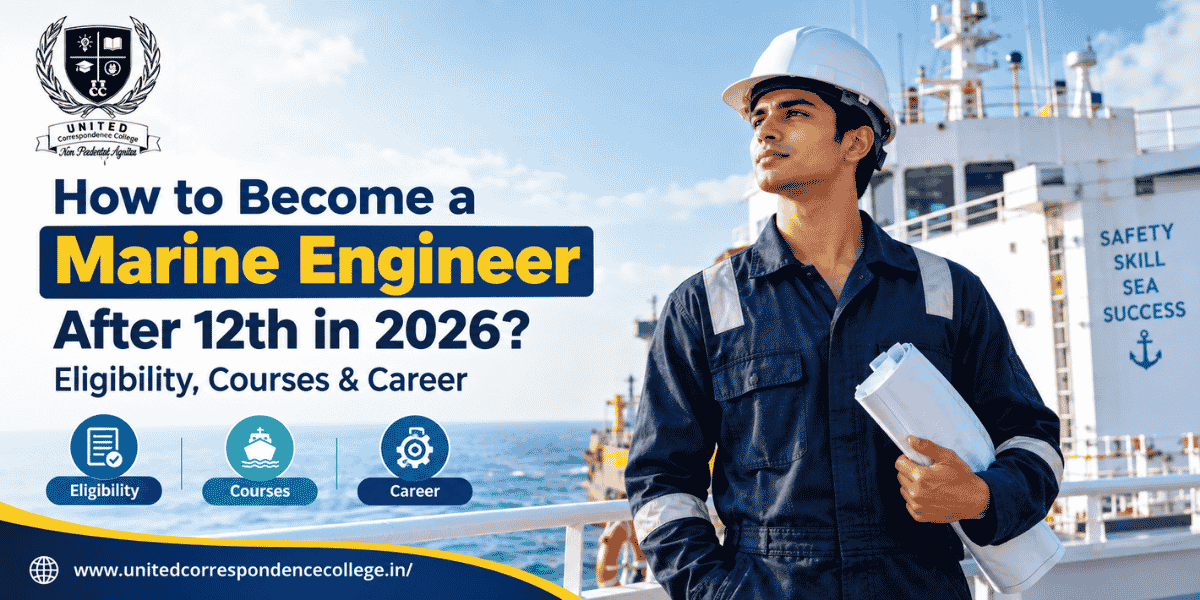
Have you ever wondered what happens inside the engine room of a massive ship travelling across the sea? If you enjoy machines, engineering, technology and the idea of working in the maritime industry, learning how to Become a Marine Engineer could be an exciting career direction after Class 12. However, this profession requires more than simply choosing an engineering course. Students need the right academic background, medical fitness, maritime training and practical exposure to move from the classroom to a working ship.
For students planning their careers in 2026, understanding the complete pathway before applying is especially important. From choosing the right programme to meeting eligibility conditions and gaining practical experience, every stage matters. This guide explains how students can Become a Marine Engineer after 12th, what they can study, what the career involves and what to consider before selecting an institute.
Why Are Students Choosing Marine Engineering After 12th?
Marine engineering combines traditional engineering knowledge with the specialised technology used on ships and other marine vessels. Instead of working only in a conventional workshop or office, marine engineers can be responsible for machinery that keeps a vessel operating safely.
A student who wants to Become a Marine Engineer should first understand that the career is highly practical. Marine engineers may work with engines, pumps, generators, fuel systems, refrigeration equipment, electrical systems and automated machinery.
The profession can also offer exposure to international shipping and different types of vessels. At the same time, it involves discipline, safety procedures, technical responsibility and periods away from home. Therefore, students should look at the lifestyle as carefully as they look at the salary or job title.
What Does a Marine Engineer Actually Do?
Before deciding to Become a Marine Engineer, it helps to understand the work behind the designation.
A marine engineer is involved in operating, maintaining and troubleshooting the machinery and engineering systems of a ship. Depending on their rank and responsibilities, their work can include:
- Monitoring main and auxiliary engines
- Maintaining pumps, compressors and generators
- Checking fuel and cooling systems
- Supporting electrical and automation systems
- Identifying mechanical problems
- Carrying out preventive maintenance
- Following onboard safety procedures
- Maintaining engineering records
- Responding to machinery-related emergencies
In simple terms, the deck team focuses heavily on navigation and cargo operations, while the engineering team is responsible for the machinery and technical systems that keep the vessel running.
This distinction is important because students sometimes confuse marine engineering with nautical or deck careers.
Can You Become a Marine Engineer After 12th?
Yes, students can pursue a marine engineering pathway after 12th if they meet the required academic and other conditions for the programme they choose.
For a direct undergraduate marine engineering route, Physics, Chemistry and Mathematics are important subjects. IMU’s current Marine Engineering information specifies 10+2 with PCM, a minimum 60% PCM aggregate and at least 50% in English for its listed programme. Medical fitness certification from a Directorate General of Shipping-approved medical practitioner is also part of the stated requirements.
So, if your goal is to Become a Marine Engineer, your preparation should begin while you are still in school.
Subjects That Matter After 12th
The main subjects to pay attention to are:
- Physics
- Chemistry
- Mathematics
- English
Physics helps students understand mechanics, energy and thermodynamics. Mathematics develops analytical and calculation skills, while Chemistry becomes useful for understanding fuels, materials and various engineering processes.
English also matters because communication, documentation, instructions and professional maritime communication are important in the industry.
The Roadmap to Become a Marine Engineer After 12th
Instead of thinking about marine engineering as one single course, think of it as a journey.
12th with PCM → Entrance/Admission → Marine Engineering Programme → Maritime/Pre-Sea Training → Medical Fitness → Practical/Sea Training → Required Certification → Marine Engineering Career
Each step prepares you for the next.
Step 1: Complete 12th With the Required Subjects
The first step to Become a Marine Engineer is completing your 10+2 education with the subjects required by your chosen programme.
Students should not wait until admission season to check their marks. Review the eligibility criteria of the programme early and identify whether your PCM and English scores meet the requirements.
Step 2: Select the Right Marine Engineering Programme
The next decision is choosing a recognised and appropriate marine engineering programme.
A four-year B.Tech Marine Engineering programme is one direct undergraduate route. IMU currently lists B.Tech Marine Engineering as a four-year undergraduate programme, with its 2026 prospectus specifying PCM and English requirements and a valid IMU-CET rank for the programme described there.
When comparing institutes, don’t look only at advertisements. Check the programme’s recognition, training facilities, practical exposure and current maritime requirements.
Step 3: Complete Maritime Training
Engineering knowledge is only one part of becoming a seagoing professional. Maritime training helps students understand shipboard safety, emergency procedures and the practical environment in which they may work.
DG Shipping guidance identifies approved marine engineering degree routes and other approved training pathways for engine officers.
Step 4: Clear the Medical Requirements
Medical fitness is an important part of the pathway.
Students should check eyesight, colour vision, hearing and other medical standards before committing to the profession. IMU’s marine engineering eligibility information specifically includes medical fitness certification from a doctor approved by the Directorate General of Shipping.
This is why a student planning to Become a Marine Engineer should not treat medical fitness as a last-minute formality.
Step 5: Gain Practical and Sea Experience
Marine engineering becomes much more meaningful when classroom concepts are connected with actual machinery.
Practical training and sea-going experience help students understand how engines, generators, pumps and other systems operate under real working conditions.
This stage also develops discipline, teamwork and problem-solving skills that cannot be learned entirely from textbooks.
Step 6: Progress Through the Maritime Career Path
After completing the relevant education, training and required certification, a marine engineer can gradually move through different ranks.
A simplified career progression may look like:
Trainee/Cadet → Junior/Watchkeeping Engineer → Second Engineer → Chief Engineer
The exact progression depends on applicable certification requirements, sea service, examinations, performance and other professional conditions.
Which Courses Can Help You Become a Marine Engineer?
The most direct option after 12th is a marine engineering degree programme. However, students may also encounter related engineering and lateral-entry routes.
Some students search for Engineering distance education because they are looking for flexible engineering study options. However, students should not assume that a general distance-learning engineering programme automatically qualifies them for a seagoing marine engineering career. Maritime careers have specialised training and regulatory requirements.
Similarly, searches such as Engineering correspondence college in Bangalore may show many flexible-learning options, but students should distinguish between general engineering education and programmes specifically designed for maritime careers.
Students may also come across the phrase B.Tech correspondence college in India while researching flexible education. Again, the mode of study should be evaluated carefully because a seagoing engineering pathway involves practical and maritime training that cannot simply be replaced by general correspondence study.
Simple Course Comparison
| Course/Route | Main Purpose | Best For |
| B.Tech Marine Engineering | Direct marine engineering education | Students targeting a seagoing engineering career |
| Relevant Engineering Route | Builds broader engineering knowledge | Students considering alternative technical pathways |
| Diploma Route | Provides technical foundation | Students exploring diploma/lateral-entry possibilities |
| Maritime Training | Develops shipboard skills and safety knowledge | Students entering the maritime profession |
IMU and DG Shipping information also show that certain lateral-entry pathways can exist for candidates with relevant engineering or diploma qualifications, subject to the applicable conditions.
What If You Have a Diploma in Engineering?
Students searching for Diploma in Engr correspondence college in India should be particularly careful about the difference between a general diploma and a recognised technical qualification eligible for a specific marine engineering route.
For example, IMU’s listed lateral-entry information includes certain three-year engineering diplomas in Marine, Mechanical, Electrical or Electrical & Electronics, subject to the specified marks and institutional approval requirements.
Therefore, don’t choose a diploma simply because it contains the word “engineering.” First check whether the qualification is accepted for the marine engineering pathway you intend to follow.
What Will You Study in Marine Engineering?
Once you Become a Marine Engineer, the concepts you learned in Physics and Mathematics become much more practical.
Typical areas of study can include:
- Marine engines
- Thermodynamics
- Fluid mechanics
- Engineering mechanics
- Marine electrical systems
- Ship machinery
- Heat transfer
- Engineering drawing
- Automation and control
- Marine safety
- Maintenance technology
- Workshop practice
Imagine learning about thermodynamics in class and later seeing how energy conversion works inside an actual marine engine. That connection between theory and machinery is one of the most interesting aspects of the profession.
What Skills Do You Need to Become a Marine Engineer?
Academic marks can help you enter the programme, but professional success requires much more.
To Become a Marine Engineer and build a sustainable career, students should develop:
Technical Thinking
Ships contain complex machinery. Engineers need to understand how different systems interact and identify the cause of a problem.
Problem-Solving
A machinery issue at sea cannot always be handled by simply calling an outside technician. Engineers need to analyse situations and respond systematically.
Discipline
Maritime operations follow strict procedures. Safety checks, maintenance schedules and documentation must be taken seriously.
Teamwork
Marine engineers work as part of an onboard team. Clear communication is essential, particularly during maintenance and emergencies.
Adaptability
Life at sea can be very different from a regular office job. Students need to be comfortable adapting to a structured environment and changing operational conditions.
What Is Life Like for a Marine Engineer?
Many students decide to Become a Marine Engineer because they like the idea of ships and international travel. But the profession also has a demanding side.
A marine engineer may spend extended periods onboard a vessel. Working hours can be structured around watchkeeping and operational requirements. Engineers may also need to work in challenging conditions while following strict safety standards.
The positive side is that the job can provide strong technical exposure, international experience and opportunities to progress within the maritime industry.
The important question is not simply, “How much can I earn?” A better question is, “Am I comfortable with the lifestyle and responsibilities that come with this career?”
Marine Engineering Career Opportunities After Graduation
After you become a Marine Engineer, your career does not necessarily end with working onboard a ship.
Depending on qualifications and experience, professionals may explore opportunities in:
- Merchant shipping
- Ship management companies
- Shipyards
- Marine equipment companies
- Offshore industries
- Port and maritime services
- Marine technical support
- Marine surveying
- Consultancy
- Shore-based engineering roles
IMU’s 2026 prospectus also highlights career opportunities including Marine Engineer, Project Manager, Operations Manager, Marine Surveyor, Consultant and Researcher.
This means marine engineering can develop into both sea-going and shore-based career options over time.
What About Distance Education in Bangalore?
The phrase distance education in Bangalore is commonly searched by students who want flexible education options. Bangalore also has a large education ecosystem, which makes it easy to find programmes across many fields.
However, a student planning to Become a Marine Engineer should not select a course solely because it is flexible or available online.
Marine engineering is a practical and regulated career area. Students need to check whether the programme they are considering actually meets the academic, practical and maritime requirements associated with their intended career.
Likewise, people searching for a correspondence college in India should compare the learning mode with the actual requirements of the profession. A correspondence qualification may be suitable for some academic or career goals, but that does not automatically make it suitable for a seagoing marine engineering pathway.
How to Choose the Right Marine Engineering Institute
Before you Become a Marine Engineer, spend time researching the institute rather than making a decision based only on admission advertisements.
Check:
- Programme recognition and approval
- Current eligibility requirements
- Practical training facilities
- Workshop and laboratory infrastructure
- Maritime training arrangements
- Placement or industry connections
- Faculty experience
- Accommodation and campus facilities
- Total fees and additional expenses
- Career and training support
Most importantly, verify the current approval status and eligibility directly from the relevant official authority or institute before paying admission fees.
Common Mistakes Students Should Avoid
Students who want to Become a Marine Engineer sometimes focus heavily on the course title and overlook the practical requirements.
Choosing Only on the Basis of Salary
Salary is important, but it should not be the only deciding factor. Lifestyle, working conditions and career progression matter too.
Ignoring Medical Fitness
Don’t wait until after admission to discover a medical issue that may affect your eligibility.
Selecting a Course Without Checking Approval
Always verify whether the course and institute meet the requirements applicable to your intended maritime career.
Confusing General Engineering With Marine Engineering
Mechanical or other engineering qualifications can have different pathways into maritime careers. They should not automatically be treated as equivalent to a direct marine engineering programme.
Assuming Distance or Correspondence Study Is Enough
A student may find an Engineering correspondence college in Bangalore or a correspondence college in India that looks attractive online, but the real question is whether the qualification fits the professional pathway being targeted.
Is Marine Engineering a Good Career in 2026?
For students interested in engineering, ships, machinery and technical problem-solving, choosing to Become a Marine Engineer can offer a distinctive career path.
The maritime sector continues to depend on technically trained professionals who can operate and maintain increasingly sophisticated machinery. At the same time, automation and modern ship technology mean that engineers need to keep learning throughout their careers.
The best candidates are not simply those who want to travel or earn well. They are students who genuinely enjoy engineering, can handle responsibility and are prepared for the realities of working at sea.
A Simple Checklist Before You Apply
If you are serious about deciding to Become a Marine Engineer, use this checklist:
- Completed 12th with the required subjects
- Checked PCM eligibility
- Checked English requirements
- Reviewed age criteria
- Understood medical standards
- Researched approved programmes
- Compared practical training facilities
- Understood maritime training requirements
- Checked admission/entrance requirements
- Considered sea-life and working conditions
- Compared career opportunities
- Verified the latest rules before admission
Conclusion
The decision to Become a Marine Engineer should begin with understanding the profession, not simply searching for a course.
For a student after 12th, the journey can involve the right academic subjects, a suitable marine engineering programme, medical fitness, maritime training, practical exposure and professional certification. Each stage has a purpose.
If you enjoy engineering and are genuinely interested in ships, machinery and a technical career that can take you beyond a conventional workplace, marine engineering may be worth exploring.
The smartest approach is to compare programmes carefully, verify current eligibility and choose an educational pathway that supports your long-term career goals.
CTA
Planning your career after 12th? Explore the right engineering and career-focused study options with United Correspondence College (UCC). Understand your course choices, eligibility and future opportunities before taking your next academic step. Connect with UCC to learn more about suitable programmes and make a confident decision about your career.
FAQs
1. Can I become a marine engineer after 12th?
Yes. Students with the required 10+2 subjects and marks can apply for eligible marine engineering programmes. For example, IMU’s listed B.Tech Marine Engineering route requires Physics, Chemistry and Mathematics, along with the specified English requirement and medical fitness conditions.
2. Which subjects are required to become a marine engineer after 12th?
Physics, Chemistry and Mathematics are the key subjects for the direct undergraduate marine engineering route. English requirements also apply to relevant programmes.
3. Is marine engineering a four-year course?
A B.Tech Marine Engineering programme is commonly structured as a four-year undergraduate programme. IMU’s current programme information lists B.Tech Marine Engineering with a four-year duration.
4. Is medical fitness compulsory for marine engineering?
Medical fitness is an important requirement for seagoing marine engineering pathways. IMU specifies a medical fitness certificate issued by a medical practitioner approved by the Directorate General of Shipping for its marine engineering programme.
5. Can a diploma holder enter marine engineering?
Certain relevant diploma holders may have lateral-entry opportunities, depending on the programme and current eligibility rules. IMU’s listed pathway includes specified engineering diplomas with required marks.
6. Can girls become marine engineers?
Yes. Women can pursue marine engineering and maritime careers subject to the applicable academic, medical, training and regulatory requirements.