
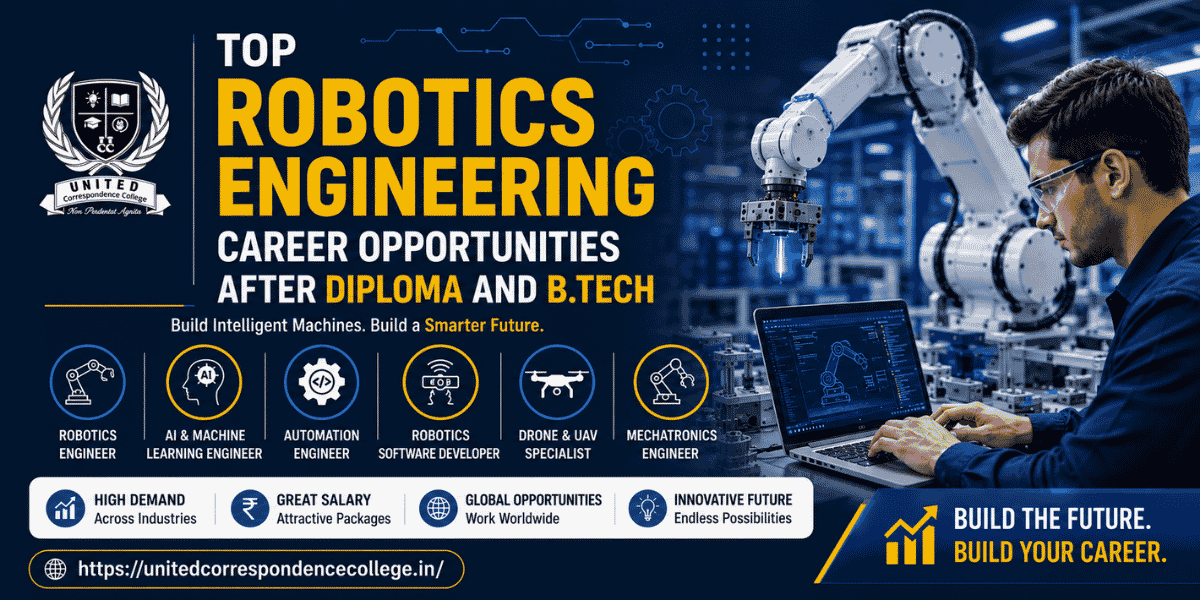
The world is rapidly moving toward automation, Artificial Intelligence (AI), and smart technologies, making Robotics Engineering Career Opportunities one of the most promising career paths in 2026. From self-driving vehicles and industrial robots to healthcare automation and smart manufacturing, robotics is transforming how industries operate. As organizations invest heavily in automation solutions, the demand for skilled robotics professionals continues to rise across India and globally.
For students who have completed a diploma or engineering degree, the future looks incredibly bright. Today, Robotics Engineering Career Opportunities offer not only excellent salary packages but also long-term career growth, innovation-driven roles, and opportunities to work on cutting-edge technologies. Whether you are studying through regular programs, Engineering distance education, or exploring flexible learning options through distance education in bangalore, robotics can help you build a rewarding and future-ready career.
At UCC, students and working professionals can explore flexible educational pathways designed to support emerging engineering careers and help them stay competitive in today’s technology-driven world.
Why Robotics Engineering Is Growing Faster Than Ever?
The adoption of robotics is no longer limited to large factories. Businesses across sectors are implementing robotics to improve productivity, reduce costs, increase precision, and enhance workplace safety.
Several factors are driving the growth of Robotics Engineering Career Opportunities:
- Artificial Intelligence integration
- Industry 4.0 adoption
- Smart manufacturing systems
- Autonomous vehicles
- Healthcare automation
- Drone technology
- Warehouse robotics
- Agricultural automation
As industries continue investing in digital transformation, Robotics Engineering Career Opportunities are expected to remain among the most in-demand engineering careers throughout the decade.
Industries Driving Robotics Demand in 2026
Robotics is creating opportunities across multiple sectors.
| Industry | Robotics Applications |
| Manufacturing | Automated production lines |
| Healthcare | Surgical and diagnostic robots |
| Logistics | Warehouse automation |
| Agriculture | Smart farming equipment |
| Aerospace | Autonomous systems |
| Defense | Surveillance and security robots |
The widespread adoption of robotics ensures a steady increase in Robotics Engineering Career Opportunities for diploma and engineering graduates.
What Does a Robotics Engineer Do?
A robotics engineer designs, develops, programs, tests, and maintains robotic systems used in various industries. Their work combines mechanical engineering, electronics, software development, and AI technologies.
Common Responsibilities
- Designing robotic systems
- Programming robots
- Testing and troubleshooting
- Integrating AI solutions
- Developing automation processes
- Maintaining robotic equipment
- Improving operational efficiency
Professionals with expertise in these areas often find more advanced Robotics Engineering Career Opportunities and faster career progression.
Educational Pathways to Enter Robotics Engineering
There are multiple routes to enter the robotics industry depending on your educational background.
After Diploma Engineering
Students completing a Diploma in Engr correspondence college in India can begin their careers in technical and support roles related to robotics and automation.
Potential entry-level positions include:
- Robotics Technician
- Automation Support Engineer
- Maintenance Technician
- Production Automation Assistant
A diploma provides practical knowledge and serves as a strong foundation for future Robotics Engineering Career Opportunities.
After B.Tech Engineering
Students graduating from a B.Tech correspondence college in India or traditional engineering institutions often qualify for advanced robotics positions.
Relevant specializations include:
- Mechanical Engineering
- Electronics Engineering
- Computer Science
- Robotics Engineering
- Mechatronics Engineering
These graduates can access higher-level Robotics Engineering Career Opportunities involving design, development, research, and AI integration.
Essential Skills Required for Robotics Engineering Careers
To succeed in robotics, students must develop both technical and soft skills.
Technical Skills
- Python Programming
- C++
- Artificial Intelligence
- Machine Learning
- Computer Vision
- PLC Programming
- Embedded Systems
- IoT Technologies
Soft Skills
- Critical Thinking
- Problem Solving
- Creativity
- Communication
- Team Collaboration
Students pursuing Engineering distance education programs often strengthen these competencies through certifications and practical projects.
Top Robotics Engineering Career Opportunities After Diploma and B.Tech
1. Robotics Design Engineer
One of the most exciting Robotics Engineering Career Opportunities is becoming a Robotics Design Engineer.
Responsibilities
- Designing robotic systems
- Creating prototypes
- Improving robot performance
- Conducting product testing
Ideal For
- Mechanical Engineers
- Robotics Engineers
- Mechatronics Graduates
2. Automation Engineer
Automation Engineers develop systems that improve efficiency and reduce manual intervention.
Responsibilities
- Designing automation solutions
- Managing industrial robots
- Optimizing production systems
Automation remains one of the fastest-growing Robotics Engineering Career Opportunities worldwide.
3. AI Robotics Engineer
AI Robotics Engineers build intelligent systems capable of learning and adapting.
Responsibilities
- Integrating AI algorithms
- Developing autonomous robots
- Implementing machine learning models
This role represents one of the most advanced Robotics Engineering Career Opportunities in 2026.
4. Robotics Software Developer
Software developers create the programs that control robotic systems.
Responsibilities
- Coding robotic applications
- Developing control software
- Testing robotic behavior
Professionals with strong programming skills enjoy excellent Robotics Engineering Career Opportunities.
5. Industrial Robotics Engineer
Industrial Robotics Engineers focus on manufacturing automation.
Industries Hiring
- Automotive
- Electronics
- Heavy Machinery
- Consumer Goods
Demand for this role continues to grow due to increasing factory automation.
6. Autonomous Vehicle Engineer
Autonomous vehicles rely heavily on robotics and AI technologies.
Responsibilities
- Developing navigation systems
- Integrating sensors
- Testing autonomous functionality
This is among the most innovative Robotics Engineering Career Opportunities available today.
7. Healthcare Robotics Specialist
Healthcare is increasingly adopting robotics for surgical and patient-care applications.
Responsibilities
- Managing surgical robots
- Developing medical automation systems
- Supporting rehabilitation robotics
Healthcare robotics offers highly specialized Robotics Engineering Career Opportunities.
8. Robotics Research Scientist
Research scientists focus on developing next-generation robotics technologies.
Responsibilities
- Conducting robotics research
- Developing new automation concepts
- Publishing technical findings
Students pursuing higher education through a M.Tech correspondence college in Karnataka often enter research-oriented roles.
Salary Potential in Robotics Engineering
One of the reasons students pursue Robotics Engineering Career Opportunities is the attractive salary potential.
| Job Role | Average Salary Range |
| Robotics Engineer | ₹5–10 LPA |
| Automation Engineer | ₹4–9 LPA |
| AI Robotics Engineer | ₹8–18 LPA |
| Robotics Software Developer | ₹6–15 LPA |
| Research Scientist | ₹8–20 LPA |
| Autonomous Systems Engineer | ₹7–18 LPA |
Salaries vary depending on skills, certifications, experience, and industry.
Certifications That Improve Robotics Careers
Apart from academic qualifications, certifications significantly improve employability.
Popular Certifications
- Robot Operating System (ROS)
- Machine Learning Certifications
- Artificial Intelligence Programs
- PLC Programming
- Industrial Automation
- Embedded Systems
- Computer Vision
These certifications help students access better Robotics Engineering Career Opportunities and higher salary packages.
Future Scope of Robotics Engineering in India
India is rapidly becoming a hub for automation and advanced manufacturing. Government initiatives, smart factory adoption, and AI-driven innovation are creating strong demand for robotics professionals.
Emerging Areas
- AI Robotics
- Smart Manufacturing
- Drone Technology
- Agricultural Robotics
- Healthcare Automation
- Autonomous Transportation
Experts predict that Robotics Engineering Career Opportunities will continue expanding as businesses invest in next-generation technologies.
How Distance Learning Supports Engineering Careers?
Modern students and working professionals often prefer flexible education options.
Programs offered through:
- Engineering correspondence college in Bangalore
- Engineering distance education
- distance education in bangalore
- M.Tech correspondence college in Karnataka
allow learners to continue upgrading their qualifications while maintaining professional commitments.
Flexible learning pathways help students remain competitive and access emerging Robotics Engineering Career Opportunities without interrupting their careers.
Common Mistakes Students Should Avoid
Ignoring Programming Skills
Robotics heavily relies on software development.
Avoiding Certifications
Certifications improve practical knowledge and employability.
Focusing Only on Salary
Choose a specialization based on long-term interest and growth.
Not Building Projects
Practical experience is essential for securing quality jobs.
Ignoring Industry Trends
Stay updated with advancements in AI, automation, and robotics.
Why Choose UCC for Future-Ready Engineering Education?
As technology evolves, students need educational support that aligns with industry demands.
Benefits of UCC
- Flexible learning opportunities
- Career-focused guidance
- Support for working professionals
- Industry-relevant programs
- Student-centered academic assistance
Whether you’re exploring engineering qualifications or advanced specializations, UCC helps learners prepare for emerging technology careers and long-term professional success.
Conclusion
The future of robotics has never looked brighter. With automation, Artificial Intelligence, and smart technologies becoming central to modern industries, Robotics Engineering Career Opportunities offer exceptional growth potential for diploma and B.Tech graduates. From Robotics Design Engineers and Automation Engineers to AI Specialists and Autonomous Vehicle Developers, the field provides diverse career paths with excellent salaries and global demand.
Students pursuing qualifications through traditional programs, Engineering distance education, or institutions such as an Engineering correspondence college in Bangalore can build the skills required to thrive in this exciting industry. With the right education, certifications, and practical experience, the opportunities in robotics are virtually limitless.
At United Correspondence College, students can explore flexible educational pathways that support future-focused careers and help them achieve their professional goals.
Ready to build a future in Robotics, Automation, and Artificial Intelligence?
Connect with UCC today and discover flexible educational opportunities designed to help you succeed in one of the fastest-growing engineering fields in 2026 and beyond.
FAQs
1. Is Robotics Engineering a good career after Diploma?
Yes, Robotics Engineering is an excellent career choice for diploma graduates, especially as industries continue adopting automation and smart technologies. Students who complete a Diploma in Engr correspondence college in India can begin their careers in roles such as Robotics Technician, Automation Support Engineer, and Maintenance Engineer. These positions provide valuable hands-on experience with robotic systems and industrial automation equipment. As professionals gain experience and additional certifications, they can advance into higher-paying engineering and management roles. With increasing demand across manufacturing, healthcare, logistics, and automotive sectors, Robotics Engineering offers strong job security, career growth, and future-ready opportunities for diploma holders.
2. Can B.Tech graduates become Robotics Engineers?
Absolutely. Graduates from a B.Tech correspondence college in India or traditional engineering institutions can build successful careers in Robotics Engineering. A B.Tech degree provides strong knowledge in programming, electronics, mechanical systems, automation, and Artificial Intelligence, which are essential for robotics roles. Students can specialize in areas such as robot design, automation systems, machine learning, and autonomous technologies. Many companies actively recruit engineering graduates for positions like Robotics Engineer, AI Engineer, Automation Engineer, and Research Associate. With the growing adoption of robotics across industries, B.Tech graduates have access to excellent career opportunities and long-term professional growth.
3. What skills are required for Robotics Engineering?
Success in Robotics Engineering requires a combination of technical expertise and soft skills. Students pursuing Engineering distance education programs should focus on developing programming knowledge, machine learning skills, electronics fundamentals, embedded systems expertise, and automation concepts. Popular programming languages include Python and C++. Additionally, engineers must understand sensors, control systems, and robotics software platforms. Soft skills such as critical thinking, communication, teamwork, and problem-solving are equally important because robotics projects often involve collaboration across multiple departments. Developing these skills helps students remain competitive and increases their chances of securing high-quality robotics positions in leading organizations.
4. Which programming language is best for robotics?
Python is widely considered the best programming language for robotics because it is easy to learn, versatile, and supported by numerous AI and robotics frameworks. Students studying through an Engineering correspondence college in Bangalore often begin learning Python due to its extensive use in automation, machine learning, computer vision, and robotics applications. C++ is another important language because it offers high performance and is commonly used in real-time robotic systems. Learning both Python and C++ can significantly improve a student’s ability to develop, test, and deploy robotic solutions, making them more attractive to employers in the robotics industry.
5. What is the average salary of a Robotics Engineer in India?
The salary of a Robotics Engineer in India varies based on qualifications, technical skills, certifications, and work experience. Entry-level professionals generally earn between ₹5 lakh and ₹10 lakh per annum, while experienced engineers can earn significantly higher salaries. Graduates who pursue advanced qualifications through an M.Tech correspondence college in Karnataka often qualify for specialized research, AI, and robotics development roles that offer better compensation. Salaries are typically higher in industries such as automotive manufacturing, Artificial Intelligence, aerospace, and industrial automation. Continuous skill development and certifications can further increase earning potential and career advancement opportunities.
6. Which industries hire Robotics Engineers?
Robotics Engineers are in demand across a wide range of industries due to the growing use of automation technologies. Students pursuing distance education in bangalore can explore opportunities in manufacturing, healthcare, logistics, agriculture, aerospace, defense, and automotive sectors. Manufacturing companies use robots to improve production efficiency, while healthcare organizations use robotic systems for surgeries and rehabilitation. Logistics firms rely on warehouse automation, and agricultural businesses utilize robotics for precision farming. The increasing need for smart technologies ensures strong employment opportunities for Robotics Engineers across multiple sectors, making it one of the most versatile engineering career paths available today.
7. Is Artificial Intelligence important for robotics careers?
Yes, Artificial Intelligence plays a critical role in modern robotics because it enables machines to learn, adapt, and make decisions independently. Students enrolled in Engineering distance education programs often study AI concepts alongside robotics to prepare for future industry demands. AI helps robots perform complex tasks such as object recognition, navigation, predictive maintenance, and autonomous decision-making. As industries increasingly adopt intelligent automation systems, employers prefer professionals who understand both robotics and AI technologies. Combining expertise in these fields significantly improves career prospects and allows engineers to work on cutting-edge innovations shaping the future of automation.
8. Can distance education students pursue robotics careers?
Yes, students studying through recognized distance learning programs can successfully build careers in robotics. Institutions offering distance education in bangalore provide flexible opportunities for learners to acquire engineering knowledge while balancing work and personal commitments. However, students should also focus on gaining practical experience through projects, internships, workshops, and certifications. Robotics employers value hands-on skills and technical competence alongside academic qualifications. By combining theoretical knowledge with real-world application, distance education students can qualify for robotics, automation, AI, and industrial engineering roles. Continuous learning and upskilling are key to succeeding in this rapidly evolving field.